February 27, 2026
Short-Term vs Long-Term Rentals in Mauritius
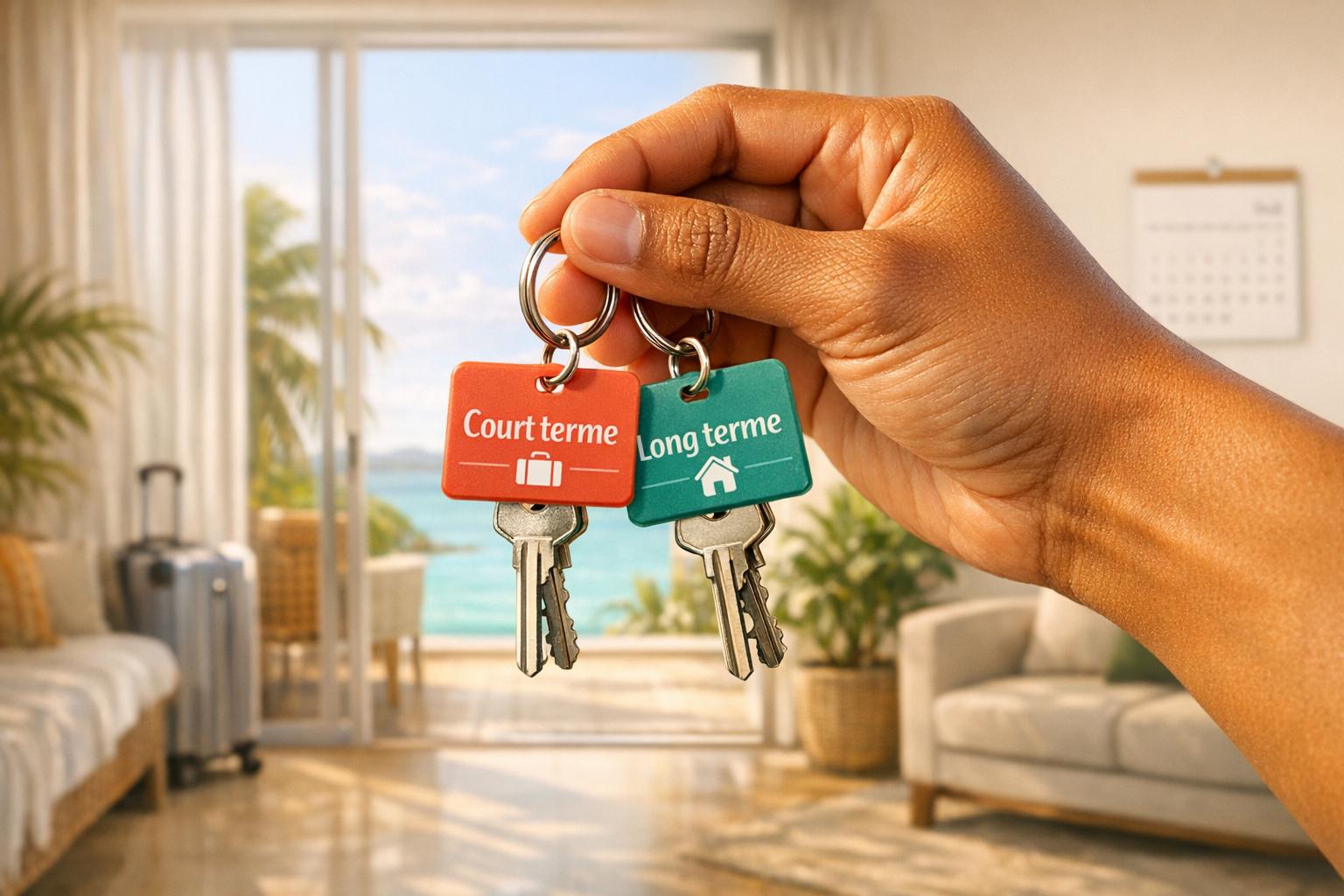
Mauritius offers two main options for property rentals: short-term and long-term. Each model presents advantages and constraints depending on your financial objectives, availability for management, and personal preferences.
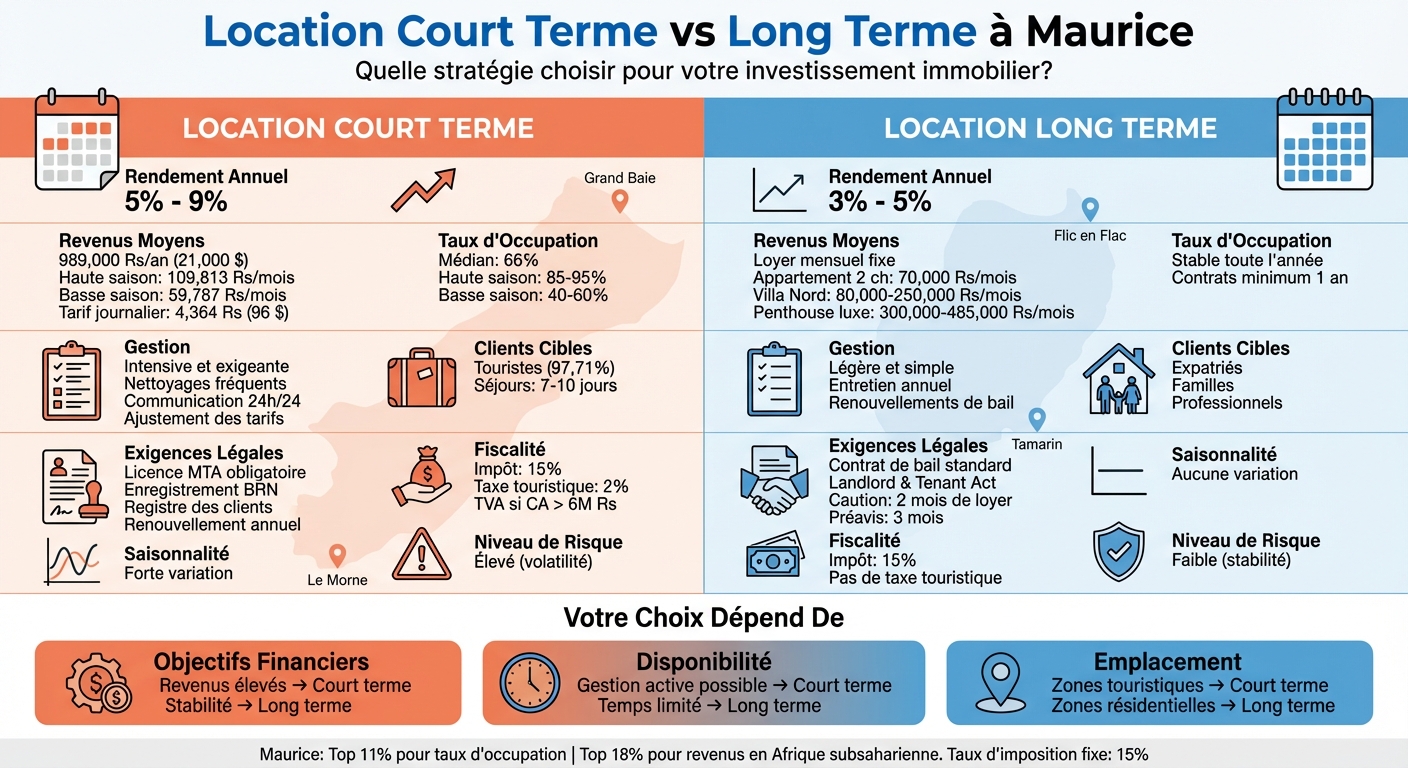
- Short-term rental: Ideal for maximising income (returns of 5% to 9%), particularly in tourist areas like Grand Baie or Le Morne. This model requires active management (frequent bookings, cleaning, price adjustments) and legal procedures, notably a licence from the Mauritius Tourism Authority. Income varies by season, with peaks during high season (December-January).
- Long-term rental: Stable and less demanding, this option guarantees a constant monthly income (returns of 3% to 5%). It primarily attracts expatriates and families, with contracts of a minimum of one year. Administrative procedures are simpler, but it is crucial to ensure good property maintenance and clear relationships with tenants.
Quick Summary:
| Criterion | Short Term | Long Term |
|---|---|---|
| Yield | 5 % - 9 % | 3 % - 5 % |
| Management | Demanding (cleaning, etc.) | Less constraining |
| Seasonality | Significant | None |
| Target Clients | Tourists | Expatriates, families |
| Legal Requirements | MTA licence mandatory | Standard lease agreement |
Your choice will depend on your priorities: high income and flexibility with short-term rental, or stability and simplicity with long-term rental.
Short-Term vs Long-Term Rentals in Mauritius: Complete Comparison
Short-Term Rentals in Mauritius
Characteristics of Short-Term Rentals
In Mauritius, short-term rentals primarily cater to foreign visitors, who represent approximately 97.71% of tenants on platforms like Airbnb. These fully furnished properties generate an average annual income of Rs 989,000 (around $21,000), with a median occupancy rate of 66%. This places Mauritius in the top 11% for occupancy rates and the top 18% for income among sub-Saharan African markets.
However, income varies by season. During the high season (October-November), owners can expect monthly incomes reaching Rs 109,813, while during the low season, these incomes drop to around Rs 59,787. The median daily rate is Rs 4,364 ($96). Location also plays a crucial role: in Le Morne, the average rate climbs to $200.53 with an occupancy rate of 54.31%, while in Flic en Flac, the average rate is $112.82, but with a lower occupancy rate of 40.62%.
These attractive figures are, however, accompanied by strict regulations, aiming to guarantee the quality and safety of the accommodations offered.
Regulatory Requirements and Licences
To rent a property for a period of less than 12 months, it is essential to obtain a Tourism Enterprise Licence from the Mauritius Tourism Authority (MTA). Owners must also register with the Registrar of Businesses to obtain a Business Registration Number (BRN).
Obtaining the licence requires several steps:
- Provide documents such as proof of ownership, detailed plans, fire safety compliance certificates, and public liability insurance.
- Undergo a physical inspection by the MTA to verify that the accommodation complies with current standards.
- Keep a register of guests (names, contact details, and dates of stay).
The licence is valid for a period of 12 months and must be renewed at least 3 months before its expiration to avoid a 50% penalty. In case of non-renewal, fines can reach up to 100% of the taxes due. Regular inspections, conducted by the MTA in collaboration with the police, help detect non-compliant operators.
Management and Operations
Complying with legal obligations is not enough: effective management is essential to ensure customer satisfaction and maximise the performance of short-term rentals. This involves:
- Quick and clear communication with tenants.
- Rigorous organisation of cleaning between each stay.
- Provision of useful information on local attractions.
Fiscally, rental income is subject to a 15% tax, after deduction of expenses such as management, maintenance, cleaning, insurance, and repairs. In addition, a 2% tourist tax must be collected on the total amount of accommodation. Finally, VAT registration becomes mandatory if the annual turnover exceeds Rs 6 million.
Owners can choose to manage their properties themselves or entrust this task to a professional agency. Although this incurs additional costs (tax-deductible), an agency can help optimise performance by offering quality services. Amenities such as private swimming pools or proximity to beaches remain major assets for attracting an international clientele.
sbb-itb-3115173
Long-Term Rentals in Mauritius
Characteristics of Long-Term Rentals
Long-term rentals in Mauritius are distinguished by their financial stability. Unlike seasonal rentals, they guarantee a constant monthly income, unaffected by high or low season variations. This model primarily attracts expatriates, families, and professionals on relocation, with contracts usually lasting at least one year, renewable as needed.
The amount of rent depends on the location and type of property. For example:
- A 2-bedroom apartment in Flic en Flac costs approximately Rs 70,000 per month.
- A beachfront penthouse in Cap Malheureux can reach Rs 300,000 monthly.
- Family villas in the North (Grand Baie, Pereybere) rent for between Rs 80,000 and Rs 250,000 per month.
- In the West, in Tamarin or Black River, rents range between Rs 80,000 and Rs 150,000.
- High-end properties, such as those in Belle Vue Harel, can go up to Rs 485,000 per month.
This type of rental particularly attracts families, thanks to the proximity of international schools, as well as entrepreneurs and digital nomads attracted by the pleasant living environment and modern infrastructure. It is common for long-term tenants to eventually purchase a property after several years spent on the island.
Lease Agreements and Legal Requirements
Long-term rentals are governed by the Landlord and Tenant Act 1999 and the Mauritian Civil Code (articles 1721 to 1762). Although a verbal agreement is legally recognised, a written contract remains essential to avoid any misunderstanding. This document must include key information such as the lease duration, rent amount, security deposit, rent review conditions, and termination procedures.
Here are the main legal requirements:
- A security deposit equivalent to two months' rent is required.
- Three months' notice is required for contracts longer than three years (one month for those under three years).
- Rent is payable in advance, often before the 3rd day of the month, and can be settled by bank transfer.
- The rent amount fixed in the contract is considered "fair rent" and cannot be increased without legal justification.
Owners must also ensure that foreign tenants have a valid residence or work permit before signing the contract. These rules ensure clear and secure transactions.
Property Maintenance and Tenant Relations
Managing long-term rentals is generally simpler than managing short-term rentals. Tenants handle daily cleaning and minor repairs, while the owner remains responsible for structural work. These obligations must be clearly defined in the contract.
Some important points:
- The owner is subject to a fixed tax rate of 15% on rental income.
- A copy of the current property tax notice must be provided to tenants.
- The property and its contents must be insured.
Subletting is prohibited without the written consent of the owner. To maintain a good relationship with tenants, it is crucial to ensure regular maintenance of facilities (plumbing, electricity) and to respond quickly to their needs. In case of a dispute, the Residential Tenancy Board can intervene for mediation.
This rental model, with its stability and precise requirements, contrasts sharply with seasonal rentals, which are often more unpredictable and management-intensive.
Short-Term vs Long-Term Rentals: Direct Comparison
The choice between short-term and long-term rentals in Mauritius primarily depends on your financial objectives and the time you are willing to dedicate to management. Short-term rentals offer higher gross returns, ranging between 5% and 9%, compared to 3% to 5% for long-term rentals. This difference stems from the unique operation of each model: seasonal rentals allow for price adjustments based on demand, with nightly rates ranging from $300 to $600 for a 3-bedroom beachfront villa. In contrast, long-term rentals offer stability through a fixed monthly income. These financial disparities also come with differences in daily management.
Management: Short-Term vs Long-Term
Managing short-term rentals is more demanding. This includes quick responses to messages, late arrivals, cleaning after each stay, and constant price adjustments according to seasons. In comparison, long-term rentals require fewer interventions, often limited to annual maintenance and contract renewals. First Grand Property Management summarises this trend well:
A well-managed short-term strategy often represents the most judicious choice for prestige properties in Mauritius.
Impact of Seasons
Short-term rentals are heavily influenced by seasonal variations. During the high season (December-January), the occupancy rate can reach 85–95%, while it drops to 40–60% in the low season (June-August). Conversely, long-term rentals do not experience these fluctuations, offering financial stability throughout the year.
Regulatory Framework
Both models are subject to distinct regulations. Short-term rentals require a permit from the Tourism Authority, a guest register, and specific insurance. Long-term rentals, on the other hand, are governed by the Landlord and Tenant Act and require a standard lease agreement.
Comparative Table: Key Factors
| Criterion | Short-Term Rental | Long-Term Rental |
|---|---|---|
| Income Potential | High (ROI 5–9 %) | Moderate (ROI 3–5 %) |
| Management Load | Intensive (frequent cleaning, 24/7 communication) | Light (annual maintenance, renewals) |
| Legal Requirements | Tourism Authority permit mandatory | Standard lease agreement (Landlord & Tenant Act) |
| Occupant Turnover | High (7–10 day stays) | Low (minimum one-year contracts) |
| Seasonal Variations | Significant (40–95 % occupancy) | Non-existent (fixed monthly rent) |
| Risk Level | High (volatility, off-peak periods) | Low (financial stability) |
| Security Deposit | Variable depending on platform | Equivalent to 2 months' rent |
These criteria must be evaluated based on your investment priorities and your availability to manage the property.
Factors to Consider When Choosing a Rental Strategy
Beyond the figures, qualitative elements play a crucial role in choosing your rental strategy. Opting for a short-term or long-term rental primarily depends on three key aspects: potential return, flexibility of use, and the management effort required. It is important to evaluate these criteria based on your financial objectives and personal situation before making a decision.
Location and Market Demand
The location of a property directly influences the most suitable rental strategy. Coastal areas such as Grand Baie, Péreybère, Tamarin, and Black River attract a significant tourist clientele, thus favouring short-term rentals. Conversely, properties located inland primarily cater to local residents and expatriates, making them ideal candidates for long-term rentals with often more accessible rents.
In regions like Tamarin and Black River, demand is particularly strong among expatriate families. This makes furnished villas and houses very attractive for long-term leases, especially if they are near international schools, medical centres, and shops.
Julien, a real estate agent, explains: “Expatriates often opt for furnished rentals as it saves them from buying furniture for a period that is sometimes not very long.”
These geographical and demographic characteristics have a direct impact on your financial objectives and expectations in terms of return.
Investment Goals and Risk Tolerance
Your rental strategy must match your financial priorities and your appetite for risk. If you are looking for higher income and are willing to manage some seasonal instability, short-term rental can be an interesting option, especially in tourist areas. However, if you prefer a regular and stable income, long-term rental is a safer option, with fewer vacant periods.
Another point to consider is the personal use of the property. Short-term rental leaves you the possibility of reserving periods for your own use, while a long-term lease commits the property for a minimum period of one year.
First Grand Property Management stresses: “A bad short-term strategy with poor management is worse than a simple long-term lease.”
Finally, the time and resources you can devote to managing your property are decisive factors.
Time and Management Resources
Managing a short-term rental requires a considerable investment of time. You will need to be available to respond to tenant requests at all times, regularly adjust rates based on seasonality, and organise professional cleaning after each stay. If you lack time or live abroad, it may be wise to delegate these tasks to a specialised agency. Although this incurs fees, it can also optimise your rental income.
In comparison, managing a long-term rental is much less time-consuming. It is mainly limited to managing lease renewals and occasional structural maintenance, with tenants generally responsible for routine maintenance.
As First Grand Property Management reminds us: “It’s not about ‘can I manage this myself?’ but rather ‘is this the best use of my time and capital?’”
Conclusion
Having explored both short-term and long-term rental strategies, it is clear that the choice depends on several factors. Each option offers specific advantages: short-term rentals can provide attractive returns of 5% to 9% while allowing personal use, whereas long-term rentals ensure a stable income of 3% to 5%, with simplified management.
Your decision should take into account your resources, financial objectives, and risk tolerance. If you wish to maximise your income and are prepared to dedicate time or a budget to more active management, short-term rentals, particularly in coastal areas, could be a good choice. However, if you prefer stability and hassle-free management, long-term rental remains a solid option.
The Mauritian real estate market offers a favourable context for both approaches. With 662,000 tourist arrivals recorded in the first half of 2024 and a fixed tax rate of 15%, investors have a conducive environment. However, it is essential to note the regulatory differences: short-term rentals require a permit issued by the Mauritius Tourism Authority, while long-term contracts follow established standards, generally on an annually renewable basis.
Before you begin, it is recommended to consult real estate experts. They can help you optimise your returns while complying with legal obligations. A well-thought-out strategy, adapted to your personal needs and the local market, will always be more effective than a standard approach.
For tailored support and optimised management of your real estate investment in Mauritius, consider contacting Soléa Realty (https://solea.mu). Their expertise can make all the difference in the success of your project.
FAQs
Which type of rental is most profitable for my property?
The choice between short-term rental and long-term rental in Mauritius mainly depends on your priorities and financial goals. Each option has its advantages and challenges.
- Short-term rental: This type of rental can offer higher income thanks to daily or weekly rates. It is an interesting option, especially in heavily frequented tourist areas. However, it requires active management, such as welcoming tenants, frequent cleaning, and booking management. Furthermore, you must be prepared to face vacant periods, particularly during the low season.
- Long-term rental: If you are looking for a stable and predictable source of income, long-term rental is an excellent option. It requires less day-to-day management effort, making it a more passive approach. It is ideal for those who prefer to avoid the frequent hassles associated with tenant changes.
In summary, short-term rental is better suited for those who can dedicate time to management and wish to maximise their income, while long-term rental is perfect for regular profitability with less involvement.
What licences are required for short-term rental in Mauritius?
To offer a short-term rental in Mauritius, it is essential to obtain a seasonal rental licence issued by the Tourism Authority. This licence ensures that the property complies with local quality and safety standards. Make sure you fully comply with current regulations to avoid any legal issues.
How to choose between stability and flexibility of use?
To make a choice, it is essential to evaluate your priorities and current situation. Opting for purchase provides a sense of stability, a long-term investment, and protection against rent increases. In contrast, rental offers greater flexibility, allowing you to explore various neighbourhoods, adjust to life changes, and avoid long-term commitments. Your decision rests on what matters most to you: financial security or freedom of movement.