January 22, 2026
Property Finance in Mauritius: Solutions for Expats

Mauritius attracts many expats thanks to its tax advantages, investment programmes, and tailored property finance solutions. Here's what you need to know:
- Attractive Taxation: No capital gains tax, inheritance tax or property tax. Income tax varies between 10% and 20%, with corporate tax at 15%.
- Investment Programmes: Schemes such as PDS, IRS and Smart City allow for obtaining a permanent residence permit with a minimum investment of 375,000 USD.
- Bank Financing: Local banks offer loans covering up to 70% of the property value, with competitive rates (5.5% to 7.25%). Available currencies include MUR, EUR and USD.
- Criteria for Expats: Initial down payment of 20-30%, justified income, eligible properties (PDS, IRS, RES, Smart City or Ground +2 apartments from 6 M MUR).
Soléa Realty simplifies the process by supporting you through all steps: property search, obtaining financing, and administrative formalities.
Your Property Loan with MCB Housing Loan
Eligibility Conditions for Non-Resident Financing
Obtaining a property loan in Mauritius as an expat requires meeting specific criteria set by local banks. These criteria primarily concern the initial down payment, income verification, and eligible property types. Here's a detailed overview of these requirements.
Initial Down Payment Requirements
For non-residents, Mauritian banks generally require a personal down payment of between 20% and 30% of the property value, with financing limited to 70% of that value. This percentage may vary depending on the borrower's profile. It is also important to plan for additional costs, particularly notary and registration fees, which are not covered by the loan.
The maximum loan term for non-residents is 15 years, while residents can benefit from terms of up to 25 or 30 years. Regarding the debt-to-income ratio, it is capped at 40% for borrowers with a monthly income below 200,000 Rs (approximately 4,050 EUR) and can reach 50% for higher incomes.
Income Verification
Banks assess 'disposable income' by deducting fixed charges such as rent, insurance, taxes, transport costs, and ongoing credits. Required documents typically include:
- Payslips and an official letter from the employer.
- For self-employed individuals: detailed company financial statements.
- Bank statements from the last 3 to 6 months, to demonstrate income stability and regularity.
Expats often need to justify the consistency of financial transfers and foreign income. For income in foreign currencies, such as the euro, banks use this data to index interest rates to international benchmarks such as Euribor. It is highly advisable to open a local bank account, in rupees or foreign currency, to simplify the procedures related to the mortgage loan and the management of rental income.
Types of Properties Eligible for Financing
Only certain types of properties are accessible to non-residents. They can finance properties located in government-approved real estate programmes, such as the Property Development Scheme (PDS), the Integrated Resort Scheme (IRS), the Real Estate Scheme (RES) and the Smart City Scheme. These schemes offer a secure legal framework for investors.
Ground +2 apartments, with a minimum purchase price of 6 million Rs (≈ 130,000 USD), are also eligible. Properties sold off-plan (VEFA - Vente en l'état futur d'achèvement) are particularly popular, as they benefit from a bank guarantee of completion.
To obtain a permanent residence permit, a minimum investment of 375,000 USD in PDS, RES, IRS or Smart City programmes is required. Finally, Senior Living Residences represent an interesting option for retirees looking for suitable infrastructure.
Banks Offering Mortgage Loans to Expats
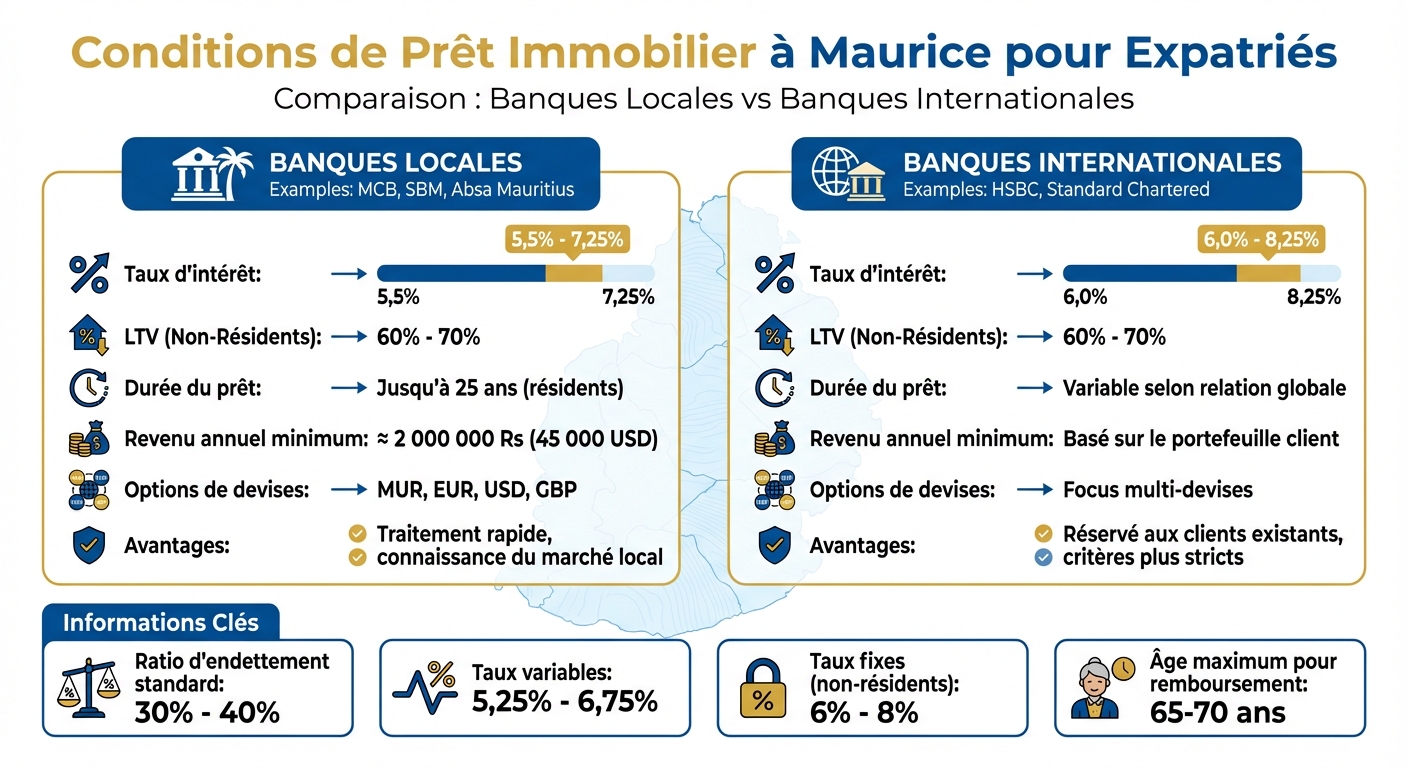
Comparison of property loan conditions in Mauritius: local vs international banks
Having covered the eligibility criteria, let's look at the banking institutions that offer solutions tailored to expats. In Mauritius, several banks provide specific financing options for non-residents. Among the local banks are the Mauritius Commercial Bank (MCB), the State Bank of Mauritius (SBM), and Absa Mauritius. These institutions are distinguished by competitive rates and a good understanding of the local property market, which allows them to process applications quickly.
As for international banks like HSBC and Standard Chartered, offers are often reserved for their existing clients. These banks provide multi-currency loans but apply stricter criteria and slightly higher rates, with an increase of 0.5% to 1% compared to local banks.
In general, banks require a minimum annual income of approximately 2 million Rs (about 45,000 USD) for foreign borrowers. The standard debt-to-income ratio is between 30% and 40%. Loans are often offered in EUR, USD, or GBP, allowing the loan currency to be aligned with the borrower's income currency, thus limiting the risk associated with currency fluctuations. These differences become evident when comparing conditions between local and international banks.
Comparison of Loan Conditions
Interest rates for foreign buyers vary depending on the type of bank. At local banks, rates fluctuate between 5.5% and 7.25%. For example, Absa Mauritius offers an annual rate from 5.05% (APR 5.347%). International banks, on the other hand, show rates ranging from 6% to 8.25%. Variable rates start around 5.25% to 6.75%, while fixed rates are between 6% and 8% for non-residents.
The loan-to-value (LTV) ratio for non-residents is limited to 60–70%, while permanent residents can benefit from an LTV of up to 80%. Furthermore, the maximum age for repayment is generally set at 65 or 70 years old. A recent trend shows the emergence of hybrid products combining a fixed rate for the first few years (2 to 5 years) followed by a variable rate.
| Characteristic | Local Banks (MCB, Absa) | International Banks (HSBC) |
|---|---|---|
| LTV (Non-Residents) | 60 % - 70 % | 60 % - 70 % |
| Interest Rate | 5.5 % - 7.25 % | 6.0 % - 8.25 % |
| Loan Term | Up to 25 years (Residents) | Variable depending on overall relationship |
| Min. Annual Income | ≈ 2,000,000 Rs | Based on portfolio |
| Currency Options | Rs, EUR, USD, GBP | Multi-currency focus |
Application and Fund Release Process
To start the process, you need to provide documents such as payslips, bank statements, an Equifax credit report (or equivalent), and, for apartments, a letter of consent from the syndic. Banks then evaluate the credit profile, gross monthly income, and estimated value of the property.
After this analysis, a conditional principle approval is issued. This is followed by the preparation of loan agreements and the registration of the mortgage on the property title. For off-plan projects (VEFA), funds are released in stages, according to the progress of the work. For already built properties, payment is generally made in a single instalment upon signing the deed of ownership.
For expats whose income is in euros, opting for a loan indexed to Euribor can offer attractive conditions while minimising exchange rate risk. Moreover, submitting an application between January and March can be advantageous, as local banks often launch promotions to meet their annual targets.
Government Programmes and Incentives (2024-2026)
In addition to comparing banking criteria and offers, it is crucial to consider the government aid available to maximise your investment. In Mauritius, several programmes specifically target foreign investors, offering financial advantages to reduce the costs associated with property acquisition.
Home Ownership Scheme
This programme allows an immediate rebate of 5% (capped at Rs 500,000) on the purchase price of a property. This reduction is directly applied to the acquisition amount, which is a significant advantage for expats wishing to invest in Mauritian real estate. However, if the property is resold within one year, the rebate must be repaid.
Home Loan Payment Scheme
For those who opt for bank financing, this programme also offers a 5% rebate (capped at Rs 500,000) on the total property loan amount. Applications for both programmes must be submitted online via the Mauritius Revenue Authority (MRA) website. The procedure includes verification by OTP code and providing bank details for direct payment of rebates. These initiatives aim to strengthen the appeal of property investment in Mauritius.
Advantages for Foreign Investors
In addition to financial incentives, expats have the opportunity to acquire freehold properties through the Property Development Scheme (PDS), Integrated Resort Scheme (IRS), and Real Estate Scheme (RES). These frameworks offer favourable conditions for purchase and expatriation. In the case of acquisitions under the IRS regime, a fixed government tax of 70,000 USD is imposed. Moreover, these projects include a bank guarantee of completion (VEFA), a major asset for securing the investment. Local banks generally finance up to 70% of the property value, thus facilitating access to financing.
sbb-itb-3115173
Monetary, Legal, and Tax Considerations
Beyond financing options and government incentives, monetary, legal, and tax aspects play a key role in the success of any property investment in Mauritius. A good understanding of these elements is essential to guarantee the profitability and security of your project.
Exchange Management
Mauritian banks offer solutions adapted to your income currency. For example, if you are paid in euros, you can opt for a loan in euros indexed to Euribor. This helps limit the risks associated with currency fluctuations between your income currency and your repayments.
It is also recommended to open a local multi-currency bank account (MUR and foreign currency). This simplifies daily transactions, optimises currency conversions, and reduces the high fees associated with international transfers. Furthermore, Mauritius allows the free repatriation of profits, dividends, and capital, ensuring a fluid and secure conversion of funds.
These financial precautions allow for a better understanding of the legal obligations specific to foreign buyers.
Legal Obligations for Foreign Buyers
Foreigners can acquire properties only through regulated schemes such as PDS, SCS, IRS, RES, or Ground +2 apartments with a minimum value of MUR 6,000,000. They must also obtain authorisation from the Economic Development Board (EDB), subject to application fees: MUR 25,000 for PDS/SCS projects and MUR 10,000 for R+2 apartments.
A local notary must be engaged from the outset of the transaction. The notary ensures legal compliance, drafts the deed of sale, and oversees its registration within 7 days of signing. Registration duties amount to 10% of the purchase price, with a minimum of 25,000 USD. It should be noted that for resales made by non-residents, transfer duties will increase from 5% to 10% for deeds registered from 1 July 2026.
Once these legal obligations are met, it's time to look at the tax advantages offered to investors.
Tax Advantages and Deductions
Mauritius stands out with an attractive tax regime: a single tax rate of 15% on income, and the absence of taxes such as property tax, council tax, capital gains tax on property, or inheritance tax on real estate. Furthermore, no withholding tax applies to dividends, under certain conditions.
Double taxation treaties concluded with several countries help avoid multiple taxation on the same income. Rental income, meanwhile, is taxed at a fixed rate of 15%.
Notary fees follow a decreasing scale:
- 2% on the first MUR 250,000,
- 1.5% on the next MUR 500,000,
- 1% on the next million,
- 0.5% beyond MUR 1,750,000.
To these fees, a VAT of 15% is added.
These tax advantages, combined with a clear legal framework, make Mauritius an attractive destination for property investors.
How to Obtain Financing with Soléa Realty
Soléa Realty is here to support expats at every stage of their property project. Thanks to its local expertise and strong network of partners, the agency simplifies access to financing and guarantees a successful transition for newcomers to Mauritius. Here's how its bespoke services cover everything from property search to full installation.
Property Search Service
With a free property search service, Soléa Realty offers access to exclusive properties in regulated programmes such as IRS, RES, PDS and Smart City. These programmes allow for benefiting from bank financing covering up to 70-80% of the cost and pave the way for a permanent residence permit for any investment exceeding USD 375,000. The agency identifies properties that maximise tax and residential benefits while ensuring that off-plan projects (VEFA) have a GFA (Guarantee of Future Completion), a key document for obtaining bank approval.
Next, discover our financing solutions tailored to your needs.
Personalised Financing Plans
Soléa Realty works closely with experts from MCB, AfrAsia Bank and ABSA. The team helps you choose the ideal currency for your loan (MUR, EUR or USD), depending on your income source, to minimise risks related to exchange rates. Rates can be indexed to Euribor for euro incomes. To ensure balanced financial management, the agency recommends a debt-to-income ratio of 40% for monthly incomes below MUR 200,000, and 50% for higher incomes. For example, for a villa at USD 500,000, an initial down payment of approximately 30% (i.e., USD 165,000, fees included) will be necessary.
Relocation Support and Advice
Soléa Realty offers comprehensive support to facilitate your relocation to Mauritius. The agency handles the opening of your local bank account and manages administrative formalities for obtaining your residence permit. It also connects you with local notaries to ensure your acquisition complies with all legal requirements. With Soléa Realty, your property project in Mauritius becomes a seamless and secure reality.
Conclusion
In summary, investing in Mauritius as an expat has become an accessible and secure undertaking, thanks to the many financial and tax advantages offered by the country. With attractive financing conditions and the option of multi-currency loans, the Mauritian property market stands out for its competitiveness.
Regulated schemes, such as IRS, RES, PDS and the Smart City programme, not only simplify access to financing but also allow for obtaining permanent residency, subject to a minimum investment. Furthermore, the absence of capital gains tax and inheritance tax on real estate further enhances Mauritius' tax appeal.
With this combination of regulatory, fiscal, and financial advantages, Soléa Realty positions itself as a key partner to bring your property project to fruition. The agency offers comprehensive support: identifying exclusive properties, connecting with reliable banks, developing a financing plan adapted to your income in various currencies, and handling administrative procedures. Thanks to a free search service and a network of proven partners, your property investment becomes clear and simple.
For a typical investment of 500,000 USD, it is advisable to plan for an initial down payment of approximately 165,000 USD, including notary and registration fees, with the remainder being financed by a bank. Soléa Realty scrupulously ensures compliance with legal and financial requirements, thus allowing you to start a new life in Mauritius with complete peace of mind.
FAQs
What criteria must I meet to obtain a property loan in Mauritius as an expat?
For expats wishing to acquire property in Mauritius, local banks and financial institutions evaluate several criteria before granting a loan:
- Required Age: You must be between 18 and 65 years old.
- Financial Stability: It is essential to provide proof of regular income, whether from Mauritius or abroad, as well as documents attesting to constant financial transfers.
- Repayment Capacity: Generally, your debt-to-income ratio must not exceed 40% of your monthly income, with a cap often set at 200,000 MUR per month.
In addition to these criteria, a personal down payment is essential. This generally represents between 20% and 30% of the property price, although this percentage may vary depending on the bank. Non-residents must also comply with the specific requirements of approved areas or programmes for property acquisitions and justify regular income, often denominated in foreign currencies such as the euro or US dollar.
What types of properties can expats buy in Mauritius?
Expats have the opportunity to invest in different types of properties in Mauritius thanks to specially approved government programmes. Here are the main options available:
- Integrated Resort Scheme (IRS): This programme offers luxury villas and apartments located in private complexes. These properties provide exclusive amenities such as golf courses, spas, and access to private beaches. By investing a minimum of 375,000 USD, the buyer and their family can obtain a permanent residence permit.
- Real Estate Scheme (RES): This programme allows for the acquisition of freehold residential properties, on plots ranging from 4,220 m² to 10 hectares. Here too, an investment exceeding 375,000 USD can grant a residence permit.
- Property Development Scheme (PDS) and Smart City Scheme: These options offer modern residences located in integrated developments or innovative urban areas. In addition to offering attractive tax advantages, these programmes also allow for obtaining a residence permit.
These programmes open up access to prestigious properties for non-residents while offering the possibility of enjoying the exceptional quality of life that Mauritius offers.
How does Soléa Realty assist expats in buying property in Mauritius?
Soléa Realty facilitates property purchases for expats by offering tailor-made solutions, perfectly aligned with their expectations. It supports foreign buyers in accessing financing options from local banks. These institutions offer loans in Mauritian rupees (MUR) or foreign currencies such as the euro, covering between 70% and 90% of the property price. Repayment periods can extend up to 25 years, depending on the specific conditions of each bank.
But that's not all. Soléa Realty also guides its clients through administrative and legal procedures, particularly for schemes like RES or IRS, which allow foreigners to acquire properties in approved areas. The agency provides detailed advice on eligibility criteria, currency requirements, as well as tax advantages, thus ensuring a smooth and secure purchase process for investing with confidence in Mauritian real estate.