February 9, 2026
How to Choose a Reliable Real Estate Partner
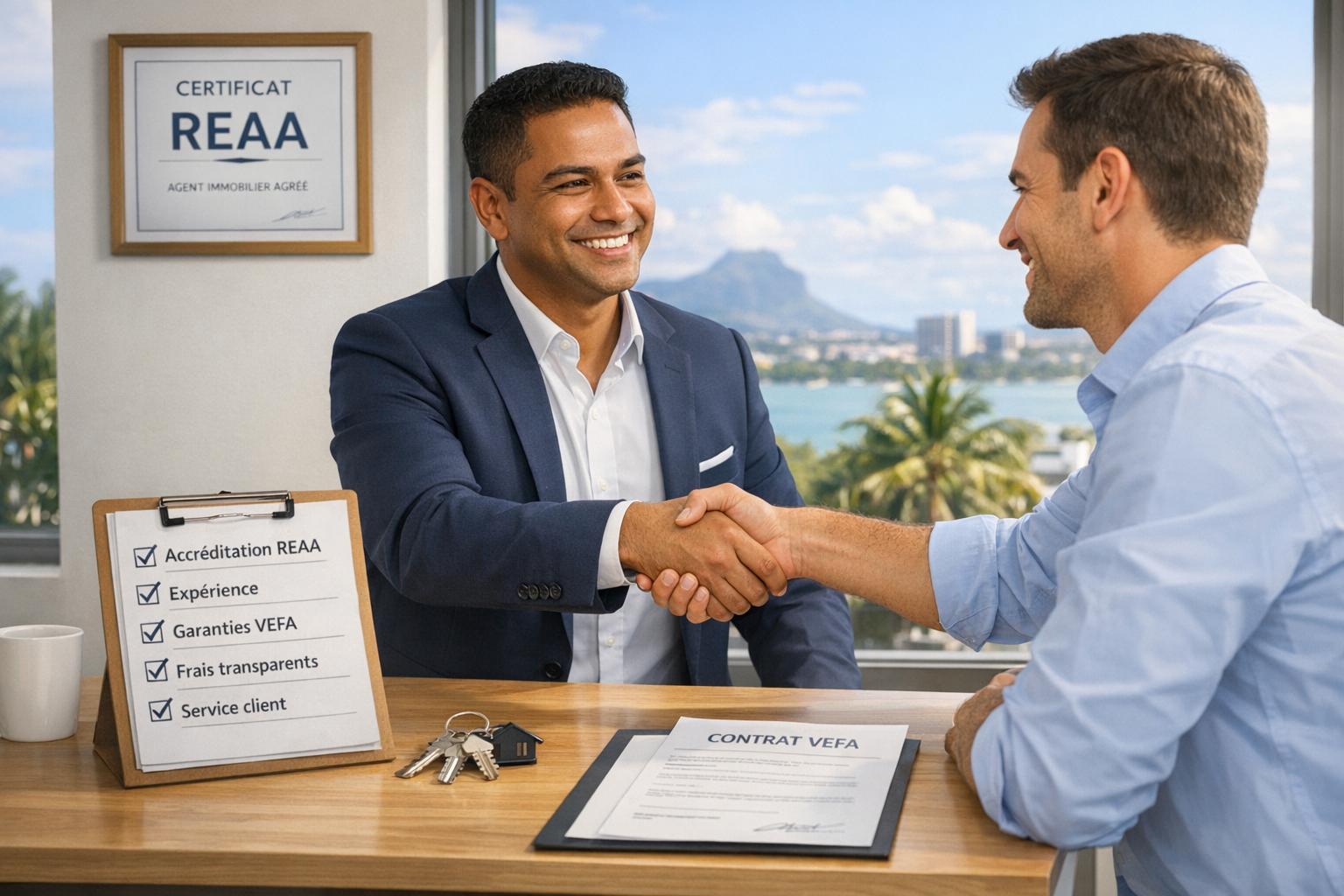
Investing in luxury real estate in Mauritius can be a great opportunity, but you need to choose a competent real estate partner to avoid pitfalls. Here are the key steps to secure your project:
- Check legal accreditation: Make sure the agent is registered with the Real Estate Agent Authority (REAA). Working with an unregistered agent can lead to legal and financial risks.
- Analyse experience: Prioritise partners with several years of activity and expertise in luxury real estate. They must understand the regional and legal specificities of the Mauritian market.
- Examine guarantees: For off-plan (VEFA) projects, check for a Financial Completion Guarantee (GFA) to avoid delays or abandonment.
- Study fee transparency: Request a detailed list of fees (notary, registration duties, etc.) in Mauritian rupees to avoid surprises.
- Consult customer reviews: Look for reliable feedback on platforms like Propertymap.mu or Mauritius Yellow Pages to assess the agency's reputation.
- Evaluate customer service: Test responsiveness and quality of replies from the first contact. A serious partner must be available and transparent.
With a rigorous approach and by working with reliable experts, you can invest with peace of mind in a growing market.
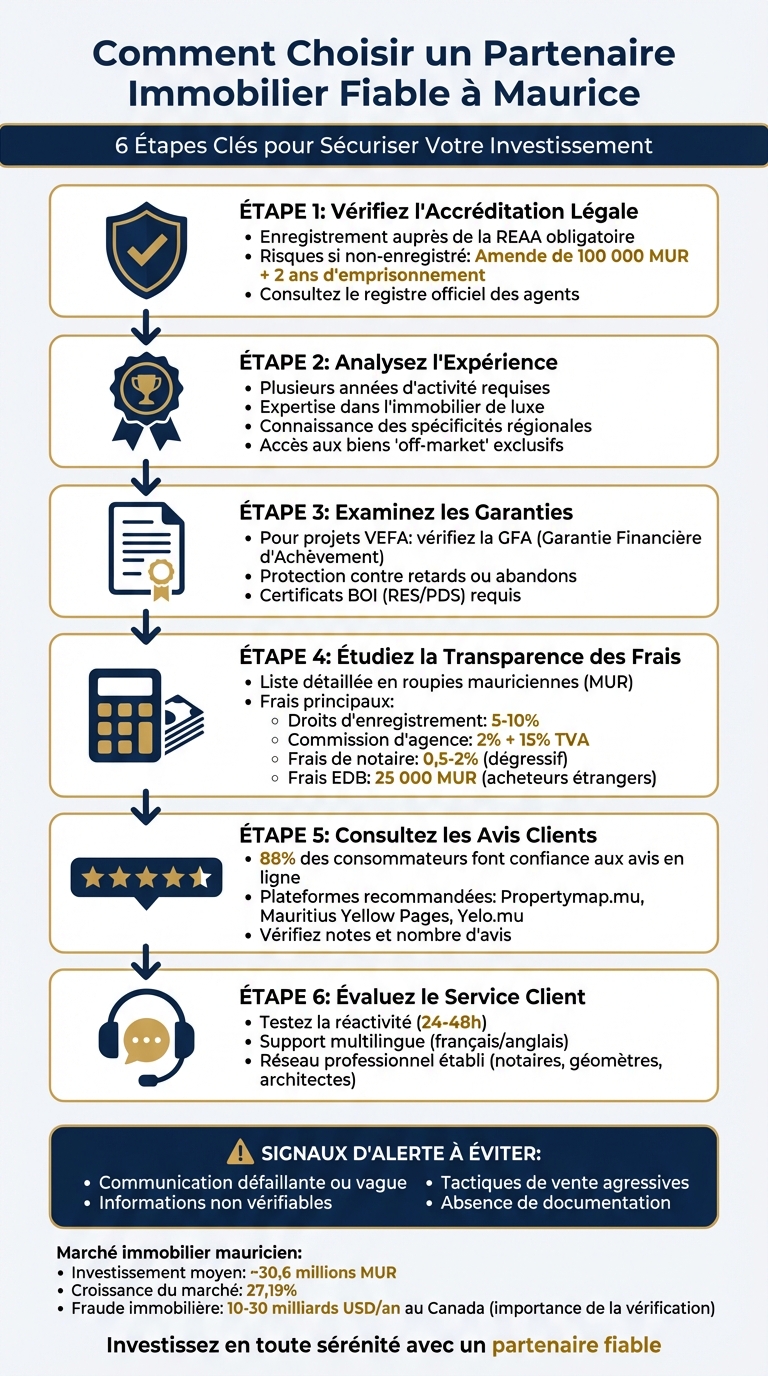
6 steps to choosing a reliable real estate partner in Mauritius
Buying in Mauritius: the truth behind dream villas!
sbb-itb-3115173
Check legal accreditation and licenses
Ensuring legal accreditation is an essential step to avoid scams and ensure your transaction complies with current regulations. Since the entry into force of the Real Estate Agent Authority Act 2020, all real estate agents, land promoters, and developers must be registered with the Real Estate Agent Authority (REAA) to operate legally in Mauritius. Collaborating with an unregistered agent can lead to significant legal risks.
Registered agents offer a certain financial security through guarantees such as bank deposits, bonds, or insurance to cover potential disputes. Furthermore, lack of registration exposes offenders to a fine of MUR 100,000 and up to 2 years imprisonment. A thorough check with official authorities is therefore essential.
Check registration with official authorities
The REAA provides an official Register of Real Estate Agents, accessible to the public for a consultation fee. This register contains essential information such as the name, address, qualifications of registered agents, as well as a list of suspended or struck-off agents. Before committing, ask for the agent's registration number and verify it in this register.
For a complete verification, also consult the registers of the AREA (Association of Real Estate Agents). This allows you to cross-reference information and identify any problematic history. Remember that no real estate transaction can be carried out legally without a written contract between the agent and the client, detailing the property, the terms of the transaction, and the duration of validity.
Ensure compliance with local property laws
Once registration is confirmed, verify that all necessary local certifications are in order. If you are investing in a real estate project, ensure your partner has certificates issued by the Board of Investment (BOI), such as RES (Real Estate Scheme) or PDS (Property Development Scheme) certificates. You can verify this information via the BOI's Property Acquisition and Management System (PAMS), which confirms whether the project has a valid Letter of Approval.
Registered agents are also subject to the supervision of the Financial Intelligence Unit (FIU), which ensures compliance with anti-money laundering (AML) and counter-terrorism financing (CFT) regulations. Failure to report suspicious transactions within 5 working days can result in a fine of up to MUR 1 million and a 5-year prison sentence. This surveillance framework strengthens the legitimacy of your transaction and protects your investments against any illegal activity.
Examine experience and market knowledge
A real estate partner's experience is measured by their years of activity and their ability to navigate the specificities of the Mauritian market. An experienced professional will have gone through different economic cycles while developing a deep understanding of prices, trends, and legal developments – key elements in the luxury real estate sector. Here's how to evaluate these essential criteria.
Check years of activity
Inquire about the agency's history: its creation date, the evolution of its services, and its potential move into specialised segments. For example, Villa Vie, founded in 1982, boasts 40 years of expertise, with a portfolio enriched by numerous successful projects.
« Few local agencies can claim so many years of expertise in the Mauritian real estate market. » - Villa Vie
Examine the agency's past achievements and request a list of completed projects versus planned ones to assess its success rate. A continuous and active presence on platforms like LinkedIn and Facebook can also indicate a solid and lasting integration into the market.
Look for luxury specialists
High-end properties require particular expertise. Professionals specialising in this field often offer access to exclusive « off-market » properties, which are not listed on public portals. Their support goes far beyond the real estate transaction: they can help enrol your children in international schools, open bank accounts, or obtain residence permits. Analyse their commitment by reviewing their completed projects and their marketing materials.
Evaluate regional market expertise
A thorough knowledge of regional specificities is equally crucial. A reliable partner must be able to explain the distinct characteristics of each region. For example:
- The North (Grand Baie, Pereybère) is popular for its tourism dynamism.
- The West (Tamarin, Rivière Noire, Flic en Flac) particularly attracts foreign buyers.
- The East is sought after for its peaceful landscapes and golf courses.
- The South seduces with its preserved authenticity.
« The Mauritian real estate professional has an in-depth knowledge of the local market, the specificities of coastal and inland regions, and the investment opportunities offered by this tropical paradise. » - Decordier Immobilier
In October 2025, Westimmo published a lifestyle map for long-term rentals, highlighting the North for its urban atmosphere and the East for its peaceful setting, ideal for golf and seaside living. This information helps expatriates choose their place of residence according to their life priorities.
In summary, choose an experienced partner, specialising in luxury real estate and with in-depth knowledge of the island's regions. At Soléa Realty, we are committed to offering personalised service based on these criteria to ensure the success of your investment.
Look for reputation and customer feedback
An agency's reputation largely depends on customer feedback. Did you know that 88% of consumers trust online reviews as much as personal recommendations? This statistic shows how crucial it is to carefully analyse this feedback before making your choice. In Mauritius, several tools and platforms allow you to evaluate an agency's reliability before committing.
Find verified customer reviews
To obtain reliable feedback, favour specialised platforms that guarantee authentic and verified reviews. Sites like Propertymap.mu, Mauritius Yellow Pages or Yelo.mu offer transparent evaluations, often accompanied by detailed rating systems. Let's look at a few concrete examples:
- Noemie Barragan of Fine & Country Mauritius: score of 5/5 based on 16 reviews and 3 years of experience.
- Laurent Tyack of Tyack Properties: score of 4.9/5 with 9 verified reviews and 17 years of activity.
- Karen Thornalley of PropertyFinder Ltd: perfect score of 5/5 on 11 reviews, with 8 years of experience, covering all regions of the island.
This information provides a clear view of the seriousness and expertise of professionals.
« What matters is the reputation a company has built in the market... it's far more important than a few comments left here and there online. » – Philippe de Beer, CEO, Park Lane Properties
For a complete evaluation, combine the available reviews on these platforms with testimonials on social networks and direct feedback. Also scrutinise the quality of the agency's marketing materials, such as photos and property descriptions. Realistic visuals and precise information reflect a genuine concern for the customer experience.
Consider linguistic support options
Beyond reviews, a good real estate partner must also offer appropriate linguistic support, particularly to meet the needs of an international clientele. In Mauritius, where luxury real estate attracts investors from all over the world, agencies often offer services in French and English. This multilingual capability is a major asset in complex processes such as opening bank accounts, managing legal formalities, or obtaining residence permits.
Check in testimonials if the agency has already assisted clients in their native language. This type of service can make all the difference to your experience.
At Soléa Realty, we attach particular importance to this support. Whether in French or English, we guide you every step of the way to make your real estate project as simple and smooth as possible.
Examine contracts and fee transparency
To avoid unpleasant surprises, ensure your contract and fees are clearly defined. The legal framework in Mauritius, which combines the French Napoleonic Code and British Common Law, requires particular attention. This step is a continuation of the analysis of your real estate partner's reliability and expertise. Before signing, take the time to review each clause and verify that all costs are explicitly indicated in Mauritian rupees (MUR).
Carefully examine the terms of the contract
The Preliminary Contract, often called a « Promise of Sale », is an essential document. It protects your deposit and defines the payment conditions. This contract must include precise details such as the purchase price, payment deadlines, and suspensive conditions before the signing of the authentic deed.
Your notary, as a legal expert, plays a key role. They verify the property's title history over a period of 30 years, inform you of your rights, and ensure everything complies to guarantee optimal security. Pay particular attention to these elements:
- Penalty clauses: In case of withdrawal, a penalty can lead to the loss of 10 to 25% of the deposit.
- Suspensive conditions: This includes, for example, obtaining a loan or EDB authorisation.
- Guarantees: These cover potential construction defects.
| Type of fee | Standard rate | Who pays |
|---|---|---|
| Registration duties | 5% - 10% of value | Buyer |
| Agency commission | 2% + 15% VAT | Buyer and seller |
| Notary fees | 0.5% - 2% (decreasing) + VAT | Buyer |
| EDB fees | MUR 25,000 | Foreign buyer |
| Legal due diligence | MUR 50,000 - 200,000 | Buyer |
Don't forget secondary fees such as those for a surveyor or inspections, which can quickly add up. It is also important to note that since 2020, cash payments are prohibited to combat money laundering. All transactions must be made by bank transfer or cheque in the notary's name.
At Soléa Realty, we make it a point of honour to provide you with a complete breakdown of all fees associated with your transaction from the outset. With us, there are no hidden costs, so you can proceed with complete confidence.
Test customer service and professional network
Once the contracts and fees have been reviewed, it's time to check the efficiency of your partner's customer service and the extent of their professional network. A good partner should offer quick support and a well-established network.
Evaluate response time and quality of support
From your first contact, test your interlocutor's responsiveness. Try to reach them by email, WhatsApp, or on platforms like Facebook or LinkedIn, and note how long it takes them to respond. A reasonable delay is between 24 and 48 hours.
During this initial exchange, evaluate their professionalism. Ask questions about their acquisition strategy, experience, or support method. A serious partner will take the time to understand your specific needs instead of pushing you into a quick decision. Also, ensure that a dedicated contact person will be available to guide you throughout the process.
Check connections with other professionals
A well-established network is a real asset. Your partner should be able to put you in touch with trusted notaries, surveyors, inspectors, architects, or contractors. Ask for at least two to three contacts per specialisation. This will allow you to compare and choose the professionals who best meet your expectations.
These connections are even more essential for personalised projects. For example, an experienced partner will collaborate with reliable architects and builders to design solutions tailored to your needs. At Soléa Realty, we work with a carefully selected network – including architects, engineers, and builders – to bring your real estate projects to life, while supporting you at every stage with transparency.
Recognise warning signs of unreliable partners
To protect your interests in a real estate transaction, it is essential to spot warning signs that a partner may not be reliable. Even if you have carried out all necessary checks, certain behaviours or practices can reveal potential problems. Being attentive to these signs can save you from costly mistakes and legal complications.
Watch for failing communication
A partner who is slow to respond or ignores your messages can be an indicator of a lack of professionalism. According to the OACIQ, a broker must be available and respond quickly to your communications. If this is not the case, it could pose a problem.
Moreover, withholding important information can signal a lack of transparency. Make sure you obtain all necessary documents, such as property history, information on municipal services, rights of way, and property taxes. If your main contact is absent, demand that a replacement be clearly identified to avoid any confusion. Vague or imprecise communication can also be associated with dubious practices, particularly unethical sales tactics.
Avoid aggressive sales tactics
High-pressure sales methods are often a sign of a lack of professionalism. For example, a 2023 report by the DGCCRF in France revealed that 62% of inspected real estate agencies had broken the law, mainly due to inaccurate advertisements or improperly disclosed fees.
Be wary of partners who hide property defects, insist on receiving payment before a visit, or refuse to show you certain properties without a valid explanation. Non-compliant exclusivity clauses should also be monitored: some agents include illegal clauses requiring you to pay fees even if you sell through another channel. This is only legal if an exclusivity contract has been duly signed. Take the time to read each clause, ask questions, and negotiate terms before signing.
Verify all claims
In the real estate sector, fraud can lead to huge losses, estimated at between 10 and 30 billion dollars per year in Canada. The best defence is to independently verify all information provided by your partner.
Use official tools to confirm the validity of your partner's license and review their disciplinary history.
"The more you know about fraud, the less likely you are to be a victim of it." - Nathalie Roy-Patenaude, Director of Professional Practice at the Canadian Institute of Valuers
Never rely solely on verbal statements. Ask for concrete evidence: municipal bills, tax receipts, land registry extracts, etc. These documents allow you to verify the accuracy of the information. The property's sales history can also be revealing: frequent changes of ownership or unjustified price increases can signal problems. Finally, be vigilant with partners who prevent any direct contact with the owner or who conceal conflicts of interest.
Conclusion
Let's recap the key points for successful real estate investment in Mauritius, where investments reach approximately MUR 30.6 million. Choosing a reliable partner is fundamental.
Accreditation and compliance: Ensure your partner is legally accredited by the Real Estate Agent Authority (REAA) and complies with local regulations. This verification is essential to avoid any legal or administrative problems.
Experience and expertise: Opt for a partner with solid market experience, particularly in luxury real estate, and capable of navigating through different economic cycles. In-depth knowledge of the region is a major asset.
Cost transparency: Request a detailed list of fees in Mauritian rupees from the outset. This includes registration duties, agency commissions, and notary fees. Due diligence fees, although a small percentage, are essential to secure your investment. If you are considering an off-plan (VEFA) project, always check the financial completion guarantee (GFA).
Quality of customer service: Evaluate professionalism from the first interactions. A good partner must have a solid professional network and a competent team to ensure the compliance and security of your transaction. Visit already completed projects, ask for references from former clients, and ensure the property is part of an EDB-approved programme.
Beware of warning signs: Be wary of vague communications, aggressive sales tactics, or unverifiable information. A trustworthy partner will always prioritise your long-term interests over a quick commission. They will honestly present the pros and cons of each option.
With an approach based on transparency, clear communication, and rigorous analysis, you will be able to navigate serenely in an expanding market (27.19% growth). By collaborating with competent experts, you will maximise your chances of success and profitability for your investment in Mauritius.
FAQs
What dangers are there in collaborating with an unregistered real estate agent in Mauritius?
Working with an unregistered real estate agent in Mauritius can lead to serious legal and financial consequences. According to Mauritian law, all real estate agents must be registered with the Real Estate Agent Authority (REAA). If an agent operates without this registration, they are breaking the law, which can result in severe legal penalties, including fines of up to MUR 100,000 and even imprisonment. As a client, you could also be involved in legal issues in the event of a dispute.
Another major problem is that these agents escape the regulatory controls imposed by the REAA. This opens the door to dubious practices such as price manipulation, fraud, or non-compliance with legal obligations. Furthermore, there is an increased risk of being exposed to illicit activities such as money laundering or terrorist financing, as registered agents are required to adhere to strict standards to prevent these situations.
To protect your interests and ensure the transparency of your transactions, take the time to verify that your real estate agent is registered with the REAA. This is a simple but crucial step to avoid unnecessary complications.
How to evaluate the reliability of a real estate agency in Mauritius?
To judge the reliability of a real estate agency in Mauritius, several steps can help you make an informed choice.
1. Consult reviews and testimonials
Experiences shared by former clients are often telling. You can find them on the agency's website or on specialised platforms. This feedback helps to better understand the level of professionalism and the quality of the services offered.
2. Analyse their experience and qualifications
Find out about the agency's background: how long it has been active, the certifications it holds, or the distinctions it has received. Partnerships with local experts, such as architects or builders, can also be a good indicator of their seriousness.
3. Ask questions directly
Do not hesitate to contact the agency to discuss their approach. This will allow you to check their transparency and their ability to meet your specific needs.
4. Rely on your personal network
Recommendations from trusted people, such as friends or relatives, can give you concrete and reliable feedback on a particular agency. This first-hand feedback is often very valuable.
By combining these different approaches, you will have a clearer overview to choose a real estate agency that meets your expectations.
What are the fees to expect for a real estate investment in Mauritius?
When considering buying a property in Mauritius, it is crucial to understand the associated fees to calculate the total cost of your investment. Here is an overview of the main costs to anticipate.
The registration duty, which represents 5% of the selling price, is payable at the time of signing the authentic deed. This is an unavoidable expense in any real estate transaction.
Next, notary fees generally range between 0.75% and 2% of the property price, plus 15% VAT. These fees cover legal formalities, including the drafting and validation of necessary documents.
If you go through an agency, real estate agency fees are often around 2.5% of the selling price, including VAT. These fees can be shared between the buyer and the seller, depending on the terms of the agreement.
Finally, depending on your situation or the type of project, other expenses may be added, such as administrative fees, transfer taxes, or costs related to obtaining permits or residency for foreign investors.
Anticipating these fees from the outset will help you better manage your budget and avoid unpleasant surprises.