January 3, 2026
Buying a villa in Mauritius: 7 key steps
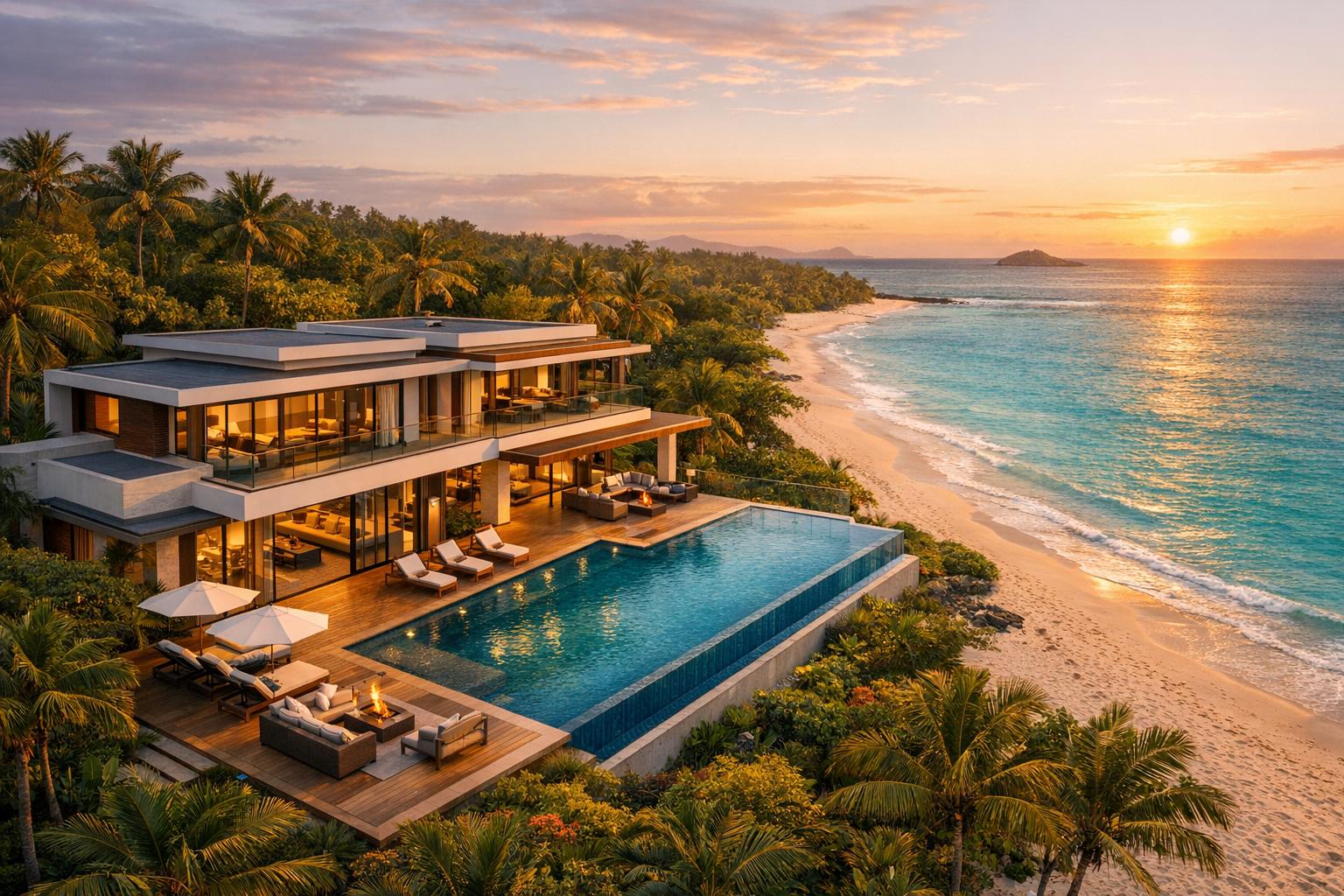
Buying a villa in Mauritius means enjoying a pleasant living environment, attractive tax benefits and a residence permit for a minimum investment of USD 375,000. Here is a summary of the 7 essential steps to successfully purchasing your property:
- Define your budget: Include the purchase price and allow for 8-10% in additional costs (notary, registration, etc.).
- Choose the location: North (Grand Baie), West (Tamarin), East (Anahita), Central (Moka) or South (Bel Ombre), according to your needs.
- Work with a real estate agent: Local expertise, simplified procedures and legal security.
- View and evaluate the villa: Check the condition of the property, legal standards and surrounding projects.
- Sign a promise of sale: Formalise the agreement with a 10% deposit.
- Legal checks and financing: Ensure the property is free of encumbrances and arrange your bank loan.
- Finalise the purchase: Signature of the deed of sale and handing over of keys.
Mauritius attracts many investors thanks to a limited tax rate of 15% and the absence of capital gains or inheritance taxes. Take the time to plan each step to secure your investment and fully enjoy the opportunities the island offers.
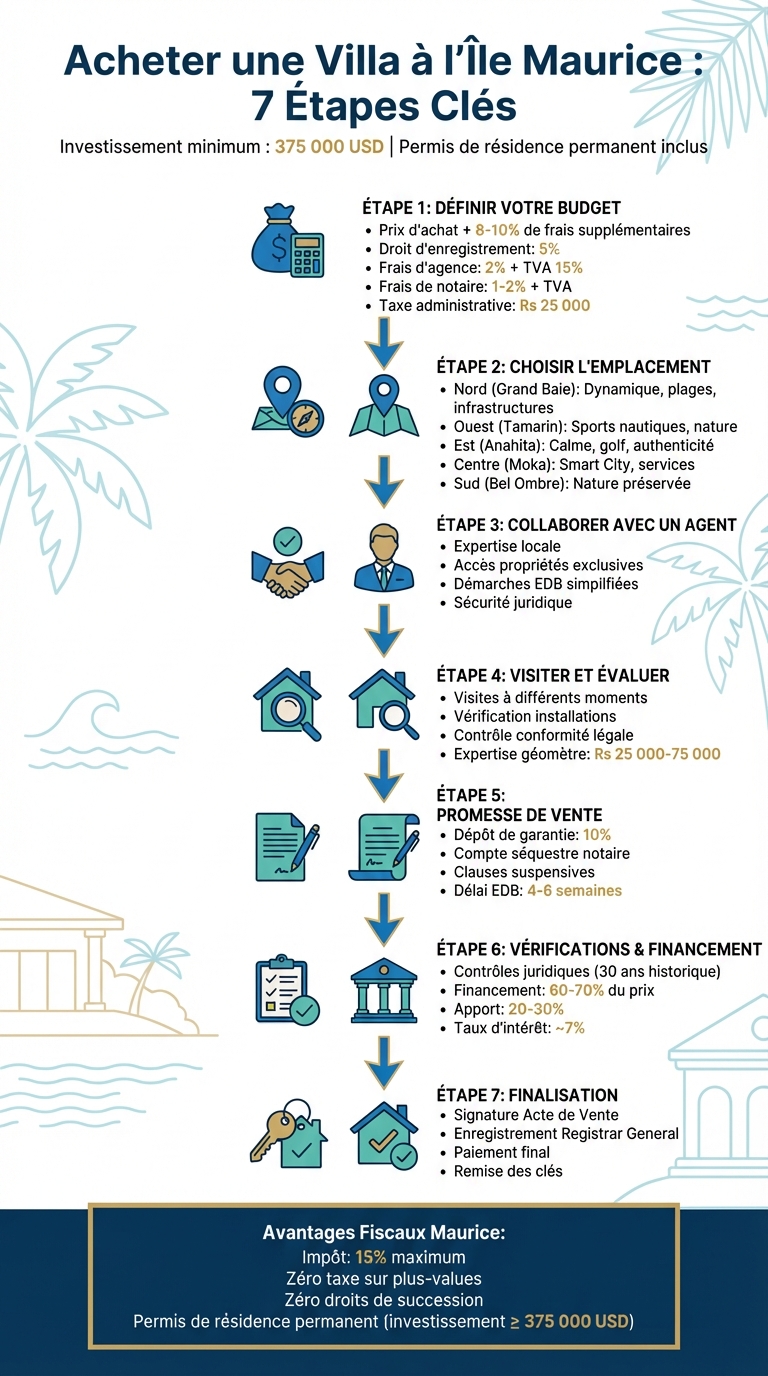
The 7 steps to buying a villa in Mauritius
Buying in Mauritius: the truth behind dream villas!
sbb-itb-3115173
Step 1: Define your budget and property requirements
Before embarking on the purchase of a villa in Mauritius, it is essential to clearly define your objectives and financial limits. This initial step will allow you to focus your efforts on properties that meet your needs while respecting your budget. It will also help you take advantage of the tax and residency benefits the island offers.
Identify your investment objective
Start by determining the main use of your future villa. This will directly influence the type of property and its location.
- Main residence: If you plan to live on the island, favour areas close to schools, medical services and shops. The North and West regions are particularly suitable for these needs.
- Holiday home: For a secondary residence, a beachfront villa or one in an IRS residence with high-end services would be ideal.
- Rental investment: If your goal is to generate rental income, focus on highly sought-after tourist areas. IRS, RES or PDS programmes often offer property management services to facilitate rental.
Should you aim to obtain a permanent residence permit, ensure your investment exceeds US$375,000.
Calculate your total budget
Your budget is not limited to the purchase price of the villa. Anticipate additional costs equivalent to 8 to 10% of the total amount. Here is an overview of the main costs to expect:
- Registration fee: 5% of the property value.
- Agency fees: 2% of the purchase price, plus a 15% VAT.
- Notary fees: According to a sliding scale or fixed at 1% + 15% VAT for IRS/PDS projects.
- Administrative fee: Rs 25,000 for acquisitions under special programmes, payable to the Economic Development Board.
If you need financing, local banks generally require an initial deposit of 20 to 30% of the purchase price for non-residents. Furthermore, do not forget to include recurring costs such as syndicate fees, garden and pool maintenance, as well as insurance, particularly in managed residential estates.
Once your budget is established and your priorities clearly defined, you will be ready to move on to the next step: choosing the perfect location for your villa.
Step 2: Choose the right location
The choice of location plays a key role in your quality of life and in the appreciation of your property investment. Each region of Mauritius offers distinct advantages, suited to varied needs. Take the time to examine the specifics of each area to guide your decision.
Popular areas for luxury villas
The North (Grand Baie, Pereybere, Pointe aux Canonniers) remains the flagship destination for foreign buyers. This region combines a dynamic atmosphere with direct access to idyllic beaches, high-end restaurants and sophisticated tourist infrastructure.
The West (Tamarin, Rivière Noire) attracts with its unique setting, blending a coastal lifestyle with spectacular mountain panoramas. It is a popular choice for water sports enthusiasts and those seeking a balance between modernity and nature.
The East, for its part, seduces with its calm and authenticity. Prestigious estates such as Anahita, which has welcomed over 250 families since its opening in 2006, offer villas surrounded by world-class golf courses and immense lagoons. This region is perfect for those seeking tranquillity and a more relaxed pace of life.
The Centre is gaining popularity thanks to “Smart City” projects such as Moka. These modern developments integrate housing, schools, offices and medical services in a well-organised urban setting. They are distinguished by their connectivity and access to essential services throughout the year.
The South (Bel Ombre, Mahébourg) attracts buyers seeking unspoiled nature and high-end, environmentally friendly projects, such as Heritage Villas Valriche. This region is ideal for those who prioritise an authentic and peaceful setting, away from busy tourist areas.
Once the region is selected, it is important to check the proximity of essential services before finalising your choice.
Assess access to services
While quality of life is an important criterion, the proximity of essential services is equally so. For a main residence, favour areas offering easy access to international schools, medical centres and shops. The North and Centre particularly stand out thanks to their well-developed infrastructure.
For a rental investment, focus on areas with high tourist demand. These locations generally guarantee a good return on investment. If you are considering buying a property under development or off-plan (VEFA), ensure that the developer offers a Financial Guarantee of Completion (GFA) to secure the delivery of promised infrastructure.
Finally, verify that the property is part of an approved programme (PDS, IRS, RES or Smart City). This guarantees your property rights as a foreign buyer.
Step 3: Partner with a real estate agent
Once you have found the perfect location, entrust your project to an experienced real estate agent. This choice can save you hassle and protect you from potential pitfalls associated with buying a luxury property in Mauritius.
Access in-depth expertise
At Soléa Realty, the team possesses detailed knowledge of the Mauritian real estate market, including current trends and regional specificities. Agents precisely evaluate the value of properties, identify any technical defects, and highlight necessary repairs. They also ensure the compliance of vendor documents, such as title deeds, cadastral plans, and tax receipts. This rigorous approach reduces risks and guarantees a smooth transaction.
In addition, Soléa Realty opens the doors to exclusive properties, including those not officially on the market. Agents negotiate to ensure the price accurately reflects the property's true value. Agency fees are fixed at 2% of the purchase price, plus 15% VAT.
For international buyers, this expertise translates into specific support, particularly in the necessary legal procedures.
Tailored support for foreign buyers
Navigating Mauritian legal requirements can be complex, but Soléa Realty guides you every step of the way. The agency assists you in obtaining the necessary approvals from the Economic Development Board (EDB), an essential step for non-citizens. It also helps you choose the investment programme that matches your needs, whether it's PDS, IRS, or Smart City projects, each offering specific benefits for obtaining a residence permit.
Agents coordinate with notaries to verify that no mortgage or charge weighs on the property. They also ensure that your reservation deposit (typically 10% of the price) is secured in an escrow account with the notary. Furthermore, Soléa Realty facilitates procedures with local banks, which can finance between 40% and 60% of the purchase price for foreign investors. Note that there is a processing fee of Rs 25,000 for certain specific programmes.
Step 4: View and choose your villa
Once you have identified properties that match your budget and needs, it's time for viewings. This is an essential step that allows you to assess the real condition of the property and ensure it meets your expectations before committing.
Organise in-depth viewings
Plan to visit the villa at different times of the day. This will help you evaluate elements such as sun exposure, noise levels, or potential nuisances. For example, a house may seem perfect in the morning but reveal problems such as excessive heat or ambient noise later in the day.
During your visits, pay attention to essential facilities: plumbing, electricity, ventilation, and other important equipment. Also, check that access to the property is convenient, particularly for staff or necessary services. Remember to inquire about development projects in the area – whether residential or industrial – as they can impact the value of your investment. If the villa is located within a residential estate, ask to consult the “Rules and Regulations Document”. This document details specific restrictions and common maintenance fees.
After examining the property in detail, it is crucial to verify its legal and technical compliance.
Verify legal compliance and building standards
Start by validating the title deed and ensure that the property description matches the official advertisement. Engage a notary to verify that there are no mortgages or unpaid charges on the property. This legal process generally takes between 6 and 8 weeks and costs approximately 1% to 2% of the total property value.
Also, examine restrictions related to constraint zones, such as easements or building limitations.
« In particular, check for constraint zones, i.e., rights that other parties (neighbours, former owners, public authorities such as CEB, CWA, the Mauritian government) hold over the land: rights of way, views, non-buildable zones, height restrictions, passage of electrical cables, etc. » – LexpressProperty
To secure your purchase, hire a professional surveyor. They will verify the exact boundaries of the property and detect any potential encroachment. Fees for this type of expertise generally range between Rs 25,000 and Rs 75,000.
Step 5: Sign the Promise of Sale
This stage marks a key moment in your acquisition journey, after selecting and viewing your dream villa. Once the property's compliance is validated, it's time to formalise your commitment by signing a promise of sale. This legally binding document establishes the precise terms of the transaction. Let's see how this process protects your investment.
Agree on conditions and pay the deposit
The promise of sale sets out essential elements: the final price, deadlines, and payment terms. It also includes a security deposit equivalent to 10%, which is placed in an escrow account administered by a Mauritian notary or in a dedicated bank account. Philippe de Beer explains:
« This deposit is held in escrow by the notary or in some cases in an escrow account with a bank, under your name and the name of the property project. You cannot dispose of the deposit as you wish, and it is governed by the conditions stated in the promise of sale that you sign. » – Philippe de Beer, Founder and Director, Park Lane Properties
For foreign buyers, the signing of the promise depends on the authorisation of the EDB (Economic Development Board), which is generally obtained within 4 to 6 weeks. As for the validity period, it varies: 3 to 4 months for an existing property, and up to 12 months for an off-plan sale (VEFA).
Include conditional clauses
To secure your investment, ensure that the promise of sale contains well-defined conditional clauses. These clauses allow the transaction to be cancelled and your deposit to be recovered if certain conditions are not met. These conditions include obtaining a bank loan, EDB authorisation, or confirmation that the property is free from any mortgage or charge.
In the context of a VEFA, demand a Financial Guarantee of Completion (GFA) issued by a bank, and benefit from a legal cooling-off period of 10 days after signing.
Warning: If you cancel the sale without activating a conditional clause, you will lose your deposit. Conversely, if the seller withdraws, they will have to refund double the deposit.
Step 6: Carry out legal checks and arrange financing
After signing the promise of sale, two key steps follow: legal checks and arranging financing. These procedures are essential to ensure that the villa is free of any encumbrance and that you have the necessary funds to complete the purchase with peace of mind.
Perform legal checks
The Mauritian notary plays a central role in this step. They meticulously examine the property's history over the last 30 years, verify that all registrations are compliant with the Registrar General, and ensure that no charges, mortgages, or disputes affect the property.
For foreign buyers, the notary also confirms that the property belongs to an approved programme (PDS, IRS, RES or Smart City) and that it is accompanied by a valid certificate issued by the EDB. A licensed surveyor may intervene to verify that the property boundaries match the title, thus avoiding any risk of encroachment. In addition, the notary requires the seller to provide discharge certificates issued by the municipality and the Wastewater Management Authority, certifying that no debts are outstanding.
Once these checks are complete, you can move on to the crucial step of financing.
Secure your financing
With the legal guarantees in hand, it's time to finalise the financial arrangements. Mauritian banks generally offer financing covering 60% to 70% of the price for non-resident buyers, provided an initial capital contribution of 20% to 30%. The debt-to-income ratio must not exceed 40% of your monthly income if it is less than Rs 200,000, and can go up to 50% for higher incomes.
To complete your application, prepare the following documents: a certified copy of your passport, your birth and marriage certificates, the signed promise of sale, proof of income, and a KYC (Know Your Customer) file. Life and disability insurance is also mandatory to guarantee the loan. Interest rates for loans in Mauritian Rupees are around 7%, with a maximum duration of 15 years for non-residents.
Also consider opening a bank account in Mauritius. This account is essential not only for obtaining a loan but also for simplifying your local transactions. If you are buying a villa off-plan (VEFA - Vente en l'État Futur d'Achèvement), the bank will require a Financial Guarantee of Completion (GFA) to ensure that the project will be completed, even in the event of financial difficulties on the part of the developer.
Step 7: Finalise the sale
After completing all the preliminary steps, you arrive at the final stage: the acquisition of your villa. Once the legal checks have been carried out and financing secured, it is time to sign the final deed and take possession of your property.
Sign the Deed of Sale
The Mauritian notary plays a key role in this stage. They invite both parties to sign the Deed of Sale (Final Deed of Sale). Before this meeting, they ensure that everything is in order: the title must be free of any charges, and the seller must present the necessary certifications. If you are a foreign buyer, this signing can only take place after obtaining official authorisation from the EDB. During the ceremony, the notary reads the deed for validation, then both parties sign. Afterwards, they register the deed with the Registrar General.
« The notary will receive a transcription number, which in turn formalises the sale and prevents any opposition from a third party. They will then provide an authentic copy of the title to the new owner. » - Villa Vie
This transcription number is essential: it proves that the sale is registered and recognised by the State. Be sure to request it from your notary for your personal records.
Make final payment and take possession
Upon signing, you must settle the outstanding balance of the purchase price. In exchange, the seller hands over the keys to the villa as well as the official documents, including the title deed, plans, and certificates. An authentic copy of the title will also be given to you, constituting legal proof of your acquisition.
In the case of an off-plan villa (VEFA - Vente en l’État Futur d’Achèvement), the final payment of 5% is made after verification of the works. At this point, the guarantees come into effect: a ten-year warranty for the structure and a 2-year warranty for separable equipment (such as taps or shutters). Furthermore, if your investment exceeds USD 375,000, you and your family automatically obtain a permanent residence permit, as long as you remain the property owner.
Costs and practical advice
Breakdown of acquisition costs
When buying a villa in Mauritius, several additional costs need to be anticipated. Here is an overview of the main associated costs:
- Registration fee: This amount is equivalent to 5% of the property value and is borne by the buyer. However, if you are a Mauritian first-time buyer, you benefit from an exemption on the first Rs 5 million of the property price.
- Notary fees: Calculated on a sliding scale, they include:
- 2% on the first Rs 250,000,
- 1.5% on the next Rs 500,000,
- 1% on the next million,
- 0.5% on the remaining balance. For IRS, RES or PDS projects, these fees are generally fixed at 1% of the sale price, plus 15% VAT.
- Agency fees: These represent 2% of the property price, plus 15% VAT. These fees are shared between the buyer and the seller. In the context of VEFA projects, these costs are often included in the displayed price.
- Administrative fees for foreign buyers: Foreign buyers must pay Rs 25,000 in non-refundable administrative fees to the Economic Development Board (EDB) for acquisitions under the IRS, RES or PDS schemes.
Here is a summary table to better visualise these costs:
| Type of fee | Estimated cost | Responsibility |
|---|---|---|
| Registration fee | 5% of value | Buyer |
| Land transfer tax | 5% of value | Seller |
| Agency fees | 2% + VAT (15%) | Buyer and seller |
| Notary fees | 0.5% to 2% + VAT | Buyer |
| EDB fees | Rs 25,000 | Foreign buyer |
Including these fees from the beginning of your budget planning is crucial. While they are unavoidable, there are ways to minimise their impact.
Reduce costs through incentive programmes
Certain schemes can help you optimise your budget. For example, if you are a Mauritian first-time buyer, the exemption on the first Rs 5 million of the property cost can significantly reduce the registration fee. Furthermore, opting for a new build can lower your energy expenses and long-term maintenance costs.
For foreign investors, buying a property of at least USD 375,000 in an approved project (PDS, IRS, RES or Smart City) allows you to obtain a permanent residence permit for you and your family. In addition, Mauritius levies no capital gains tax on property nor inheritance tax, which can improve the profitability of your investment. If you need financing, some local banks offer loans in your income currency, which can limit risks related to exchange rate fluctuations.
Conclusion
Buying a villa in Mauritius requires rigorous preparation and a good understanding of the key steps. By clearly defining your budget and priorities, choosing the ideal location, engaging qualified professionals, and adhering to legal procedures, you secure your investment while minimising risks. Each phase, from signing the preliminary sales agreement to the final deed, plays a crucial role in ensuring a smooth transaction compliant with the requirements of the Economic Development Board.
This careful organisation also allows you to fully take advantage of the tax benefits Mauritius offers. Real estate on the island benefits from attractive taxation, particularly with a capped tax rate of 15%, as well as the absence of capital gains and inheritance taxes. Furthermore, an investment exceeding USD 375,000 opens up the possibility of obtaining a permanent residence permit for you and your family. These conditions make Mauritius a particularly attractive destination for foreign investors.
Soléa Realty supports you throughout the process, from finding the perfect villa to your settling in, relying on its expertise and a solid network of trusted partners, such as notaries, architects, and builders.
Finally, remember to include approximately 8 to 10% in ancillary costs in your overall budget. By following these essential steps, you ensure a successful investment and a smooth acquisition.
FAQs
What are the tax advantages associated with buying a villa in Mauritius?
Mauritius stands out with a particularly attractive tax system for villa buyers. With an income tax rate set at 15%, well below that practised in many European jurisdictions, the country offers a rare opportunity to optimise one's finances. Moreover, thanks to double taxation avoidance agreements, investors avoid being taxed both in Mauritius and in their country of origin.
Among the most notable tax advantages are:
- A total exemption from capital gains tax on property, a major asset for those considering resale.
- The absence of taxation on dividends and inheritance tax between direct descendants, which simplifies wealth transfer.
- The possibility of freely repatriating income generated abroad, subject to the same fixed rate of 15%.
For foreigners who choose to reside in Mauritius for at least 183 days a year, fiscal residency status becomes accessible. This status opens the door to additional benefits, such as wealth tax exemption.
With this attractive tax framework and solid legal stability, buying a villa in Mauritius presents itself as a particularly appealing investment strategy.
How to choose the ideal region to buy a villa in Mauritius?
The choice of region to buy a villa in Mauritius depends on your preferences, lifestyle, and budget. If you are drawn to dream beaches and a lively atmosphere, the North could be perfect. This region is known for its popular beaches, vibrant nightlife, and often competitive prices, making it a popular choice.
The West, for its part, seduces with its spectacular sunsets, renowned surf spots, and strong rental demand thanks to a well-developed tourist infrastructure. It is an ideal region if you are looking for a good balance between investment and a pleasant living environment.
For a quieter atmosphere and preserved natural landscapes, the South is an excellent option. This region offers hiking trails, breathtaking panoramas, and a peaceful atmosphere, perfect for a secondary residence or a retreat away from the hustle and bustle.
The East, however, attracts those seeking high-end residences. With its secure residential complexes and proximity to the airport, it is a wise choice for expatriates or families looking for an exclusive and practical setting.
Before making a decision, carefully examine prices in Mauritian Rupees (for example, 1,200,000 MUR), visit several properties, and assess the proximity of schools, shops, and activities. Do not forget to consider the impact of tourist seasons, not only on the quality of life but also on resale value. This will allow you to choose the region that best meets your expectations while optimising your investment.
What are the legal procedures for buying a villa in Mauritius?
To buy a villa in Mauritius safely, it is essential to follow several legal procedures. The first step is to sign a preliminary sales agreement (also known as a promise of sale) and pay a reservation amount to a notary. Subsequently, you will need to submit a complete file to the Board of Investment (EDB). This file includes your passport, the certified preliminary sales agreement, an appraisal report, proof of funds, as well as KYC (Know Your Customer) documents. You will also need to pay processing fees amounting to 25,000 MUR.
After your application is approved by the EDB, you will be able to sign the final deed of sale (Deed of Sale). This document will then need to be registered with the Mauritian land registry. These steps ensure that your purchase complies with local laws and is legally secure.