January 15, 2026
Property Tax in Mauritius: What You Need to Know

Mauritius offers an attractive tax framework for property investors, with advantages such as the absence of wealth, inheritance, capital gains, and land property taxes. Here are the key points to remember:
- Current Taxes and Levies:
- VAT and Corporate Tax: 15%.
- Individual Income Tax: progressive scale (0% to 20% depending on income).
- Registration duties and Land Transfer Tax: 5% each (until 30 June 2026).
- Foreign Investments:
- Minimum of US$375,000 to obtain a residence permit.
- Foreigners can only buy properties in approved schemes (PDS, IRS, RES, etc.).
- Planned Changes for July 2026:
- Increase in registration duties and transfer tax to 10%.
- Introduction of a 10% tax on resale or 30% on capital gains.
- Rental Income:
- Taxed between 10% and 20% for individuals, 15% for companies.
- Possible deductions for certain management and maintenance expenses.
- Recent Restrictions:
- Since 2023, foreigners are prohibited from buying bare land or properties outside regulated schemes.
Mauritius remains a popular destination for property investment, but upcoming tax reforms require careful planning to optimise costs and benefits.
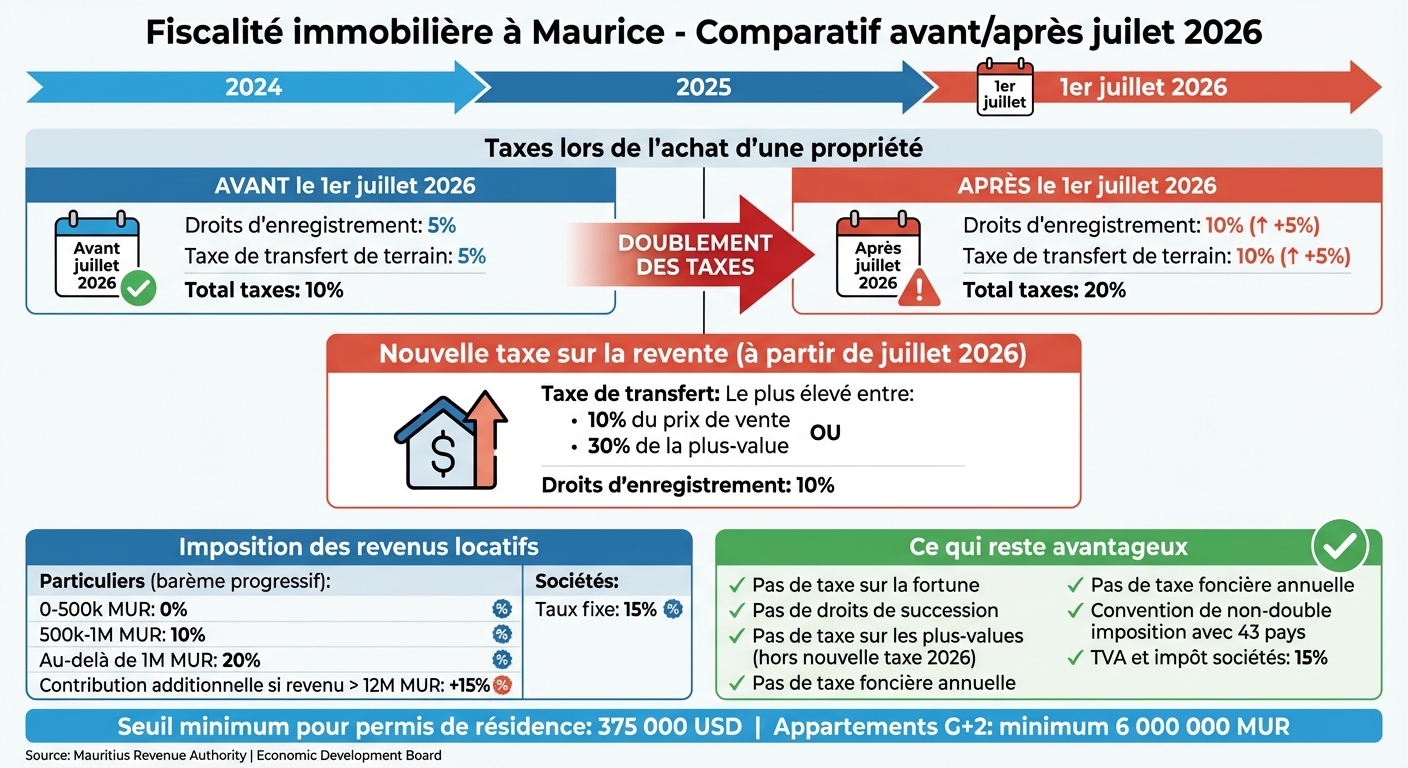
Evolution of Property Taxation in Mauritius 2024-2026
Mauritius Toughens its Stance: End of Tax Advantages? Budget 2025-2026
Taxes on Property Purchase in Mauritius
After discussing the tax advantages in Mauritius, let's look at the specific taxes related to buying a property. Non-citizens acquiring property on the island are subject to two main taxes: registration duties and land transfer tax. These taxes each amount to 5% for properties purchased under schemes approved by the Economic Development Board (EDB), such as the Property Development Scheme (PDS), Real Estate Scheme (RES), Integrated Resort Scheme (IRS), Smart City Scheme, or G+2 apartments.
In addition to these taxes, notary fees must be anticipated, calculated on a sliding scale: 2% for the first MUR 250,000, 1.5% for the next MUR 500,000, 1% for the next MUR 1,000,000, and 0.5% beyond MUR 1,750,000. These fees also include 15% VAT and fixed administrative fees (MUR 25,000 for PDS and Smart City schemes, and MUR 10,000 for G+2 apartments).
Under the old IRS regime, a fixed tax of US$70,000 was applied. This system has been replaced by the current standard registration duties regime.
Registration Duties and Transfer Fees
For a property transfer to be valid, it must be formalised by an authentic deed drawn up by a notary. The Mauritian tax system relies on self-declaration to the Mauritius Revenue Authority (MRA), where parties must submit the necessary documents and pay taxes at the time of registration.
It is important to note that the minimum investment threshold to obtain a permanent residence permit is set at US$375,000. For G+2 apartments, the minimum purchase price is MUR 6,000,000.
Tax Changes Planned for July 2026
A major change in tax rates is planned for 1 July 2026. On this date, registration duties and land transfer tax for non-citizens will increase from 5% to 10% each. This increase will apply to all EDB-approved schemes as well as G+2 apartments with a minimum value of MUR 6,000,000.
| Tax Type | Current Rate (before 1 July 2026) | New Rate (from 1 July 2026) |
|---|---|---|
| Registration Duties | 5 % | 10 % |
| Land Transfer Tax | 5 % | 10 % |
Investors who complete their purchase before 1 July 2026 can save 5% on each of these taxes, which represents a significant reduction in the total acquisition cost.
Taxes on Rental Income and Property Resale
Property investors, whether renting or reselling properties, must comply with specific tax obligations.
Rental income is considered business income. For individuals, this income is subject to a progressive scale: 0% for the first MUR 500,000, 10% for the bracket from MUR 500,000 to MUR 1,000,000, and 20% beyond MUR 1,000,000. In contrast, companies receiving rental income are taxed at a flat rate of 15%.
Property owners have the option to deduct certain expenses from their gross income, provided they are “wholly and exclusively incurred in the production of the gross income,” according to the Mauritius Revenue Authority. These expenses include maintenance, repair, insurance, and management fees, provided that necessary supporting documents are retained. Furthermore, rental losses can be carried forward for a period of five years to offset other income. Let's now examine in detail the taxation of rental income, and then that applicable upon resale.
Taxation of Rental Income
After looking at purchase-related taxes, let's see how rental income is taxed.
For taxpayers whose annual net income exceeds MUR 12,000,000, an additional contribution of 15% applies. This tax is added to the usual progressive rates, which can significantly reduce the net profitability of your rental investment.
However, an advantageous measure exists for young investors: those aged 18 to 28 are exempt from tax if their annual income, including rent, does not exceed MUR 1,000,000. This exemption is an interesting opportunity for first-time investors.
Land Transfer Tax on Resale
Although Mauritius does not impose a general capital gains tax, a new land transfer tax will come into effect from 1 July 2026. Non-citizens reselling a property acquired via approved schemes will have to pay a tax based on the higher of 10% of the sale price and 30% of the capital gain.
In parallel, registration duties fixed at 10% will also apply. These combined fees could significantly increase the exit cost for foreign investors.
sbb-itb-3115173
Regulatory Changes 2026 and Fiscal Impact
The year 2026 heralds significant transformations for the property sector in Mauritius. The government has introduced reforms that redefine the rules of property access for foreign investors. These adjustments aim to attract high-potential economic profiles while increasing tax revenues. These new measures are in line with previous tax reforms, further clarifying the framework for foreign investments.
Restrictions on Property Purchase for Foreigners
Since December 2023, the rules regarding the acquisition of properties by non-citizens have been tightened. The possibility for foreign residents to buy bare land or properties valued over US$500,000 outside approved schemes has been removed. Now, foreigners can only buy under regulated schemes such as IRS, PDS, RES, SCS, IHS, or G+2.
Furthermore, a new restriction prohibits non-citizens from acquiring apartments built on state-owned land or located on the Pas Géométriques, even in buildings of two storeys or more. This limitation significantly reduces opportunities in certain urban areas.
Changes in Tax Advantages for Smart City Projects
Since 5 June 2025, Smart City projects no longer benefit from several tax advantages. Certificates issued no longer offer income tax exemption for eight years, nor exemption from customs duties on construction materials or land conversion taxes.
« This marks a significant turning point for urban infrastructure developers and investors. »
The only remaining advantage is VAT reimbursement, but this will end on 30 June 2027. This gradual removal reflects a desire to focus tax incentives on public interest projects.
Revised Requirements for Residence Permits
The framework for residence permits has also been modified to better regulate property investment. The minimum duration to obtain permanent residency has increased from 3 to 5 years with an Occupation Permit (OP). In addition, investors must now achieve a cumulative turnover of MUR 20,000,000 over five years, compared to MUR 4,000,000 per year after the third year under the old rules.
For retirees, the annual amount to be transferred to a local bank account is now US$24,000 (i.e., US$2,000 per month), totalling US$200,000 over five years, compared to just US$54,000 over three years previously. As for self-employed individuals, their initial investment has been raised from US$35,000 to US$50,000.
| Permit Type | Old Requirement | New Requirement |
|---|---|---|
| Permanent Residence (Investor) | 3 years with OP; MUR 15 million/year | 5 years with OP; MUR 15 million/year or MUR 75 million cumulative |
| Occupation Permit (Investor) | US$50,000; MUR 4 million/year after year 3 | US$50,000; MUR 20 million cumulative over 5 years |
| Occupation Permit (Self-employed) | US$35,000 | US$50,000 |
| Permanent Residence (Retiree) | US$54,000 over 3 years | US$200,000 over 5 years |
Tax Advantages and Optimising Your Investment
Current Tax Advantages for Investors
Mauritius still offers an attractive tax environment, even after recent reforms. Tax residents benefit from an income tax rate of 15%, while non-residents are subject to a rate varying between 10% and 15%, depending on their income. Moreover, thanks to a double taxation avoidance agreement signed with 43 countries, including France, investors avoid being taxed in both jurisdictions.
Tax Strategies for French Investors
For French investors, these general advantages translate into specific opportunities. For example, the bilateral tax treaty allows real estate located in Mauritius to be excluded from the calculation of the Impôt sur la Fortune Immobilière (IFI – Wealth Tax on Real Estate) for French tax residents.
« According to the tax treaty, real estate in Mauritius is exempt from the calculation of the wealth tax of a French tax resident and does not need to be declared under the ISF. » – deluxe-immo.com
A key point to consider is the main tax residence. If you spend less than 183 days a year in Mauritius, you retain your tax residence in France and can benefit from this exemption. Conversely, if you exceed this threshold, you will be subject to the Mauritian tax regime, which also has its own advantages.
How Soléa Realty Supports Your Compliant Investments

Taking these tax optimisations into account, Soléa Realty offers personalised support to maximise your investments. The agency guides you through acquisitions via regulated schemes such as PDS, IRS and RES, while facilitating the obtaining of a residence permit for an investment of US$375,000 or more. To ensure a structure adapted to your patrimonial objectives, the team works closely with tax and legal experts.
Soléa Realty also offers strategic advice on the ideal time to finalise your acquisition. For example, concluding a transaction before 1 July 2026 allows you to benefit from the current registration duties rate of 5%, instead of the 10% planned thereafter, which can represent significant savings.
Conclusion
Mauritius continues to be a destination of choice for property investment, even in the face of changes planned for 2026. The island offers unique tax advantages, such as the absence of capital gains tax, inheritance tax, and annual property taxes. Added to this is a uniform tax rate of 15% on rental income, as well as double taxation avoidance agreements with 43 countries, making the investment particularly attractive.
However, it is essential to prepare now for the tax reforms scheduled for July 2026. The increase in registration duties for non-citizens and the introduction of a new resale tax represent additional costs that could impact your investment projects. Proactive planning can help you minimise these impacts and optimise your returns.
With a tax system becoming increasingly complex and increased requirements to obtain or maintain a residence permit, professional expertise becomes essential. Adhering to declaration deadlines is crucial to avoid financial penalties. Ultimately, successful property investment in Mauritius relies on in-depth knowledge of regulations and a tax strategy tailored to your objectives, supported by personalised assistance.
FAQs
What tax changes will affect foreign investors from July 2026?
From 1 July 2026, foreign investors will have to pay a registration duty and land transfer tax of 10%, compared to the current 5%, for the purchase of properties under EDB schemes, such as PDS, RES, SCS, IHS, or for apartments with a value greater than or equal to MUR 6,000,000.
This increase aims to standardise taxes related to property transactions in these specific regimes. It could also influence the investment decisions and strategies of foreign buyers.
How is rental income taxed in Mauritius for individuals and companies?
In Mauritius, rental income is considered Mauritian source income and is subject to tax. Here's how it works:
- For individuals: Rents received are added to the taxpayer's total income and taxed according to a progressive scale, with rates ranging from 0% to 20%, depending on the annual amount. Non-residents, on the other hand, only pay taxes on rental income generated locally.
- For companies: Rental income is treated as operating income and subject to a fixed tax rate of 15%. In addition, expenses related to the management or maintenance of the property can be deducted from taxable income.
It is important to note that there is no annual property tax or capital gains tax in Mauritius, which can represent a tax advantage for property investors.
What are the conditions for a foreigner to buy property in Mauritius?
Non-citizens can acquire property in Mauritius only under schemes approved by the Economic Development Board (EDB). These schemes include the Integrated Resort Scheme (IRS), the Real Estate Scheme (RES), and the Property Development Scheme (PDS). They authorise the purchase of villas, apartments, or residential land, but strictly exclude agricultural land and undeveloped areas.
To qualify for a residence permit, the acquisition must reach a minimum amount of US$375,000. This permit offers several advantages, including the possibility to rent out the property, as well as to freely repatriate rental income or funds from the sale. However, the buyer is required to comply with the tax obligations in force in Mauritius.
These provisions aim to channel foreign investments towards high-end residential projects, while ensuring strict administrative and fiscal control.