January 3, 2026
Residency Permit in Mauritius: How to Obtain It

Mauritius is attracting more and more expatriates and investors thanks to its stability, attractive taxation, and quality of life. Here are the main ways to obtain a residency permit on the island:
- Occupation Permit: For investors (minimum USD 50,000), professionals (monthly salary ≥ Rs 60,000) or self-employed individuals (initially USD 35,000).
- Residency Permit for Retirees: From 50 years old, with a minimum monthly transfer of USD 1,500.
- Property Investment: Acquisition of a property worth at least USD 375,000 in approved schemes (PDS, IRS, RES, Smart City).
- Permanent Residency Permit (PRP): Valid for 20 years after 3 to 5 years of residency and meeting financial thresholds.
As of December 2025, a USD 50 application fee applies. All procedures are done via the NELS platform. By choosing the right option and meeting the criteria, you can enjoy the many advantages Mauritius has to offer.
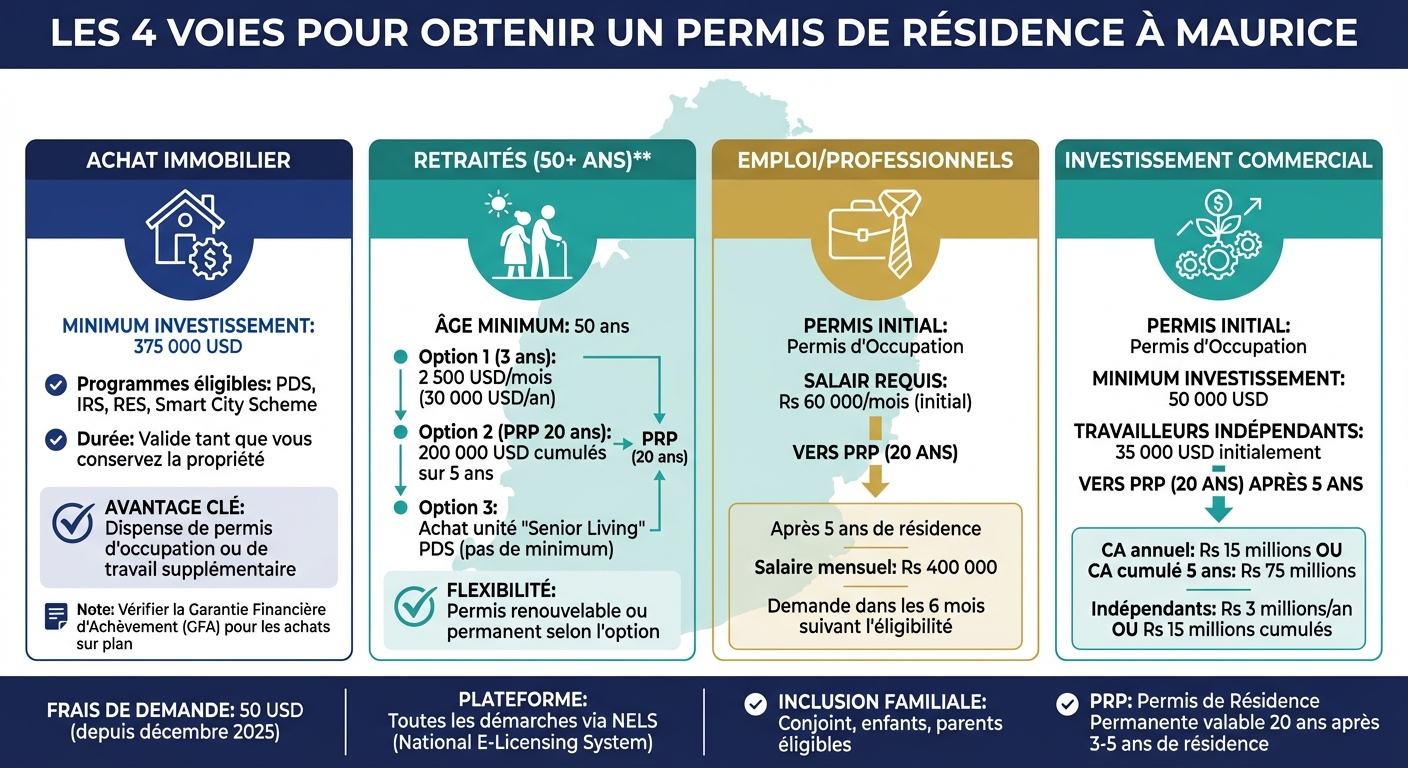
4 ways to obtain a residency permit in Mauritius: criteria and required investments
Visa and residency permit in Mauritius (2025): all you need to know
How to obtain a residency permit
Mauritius offers four main ways to obtain a residency permit, each tailored to specific profiles. Here is a detailed overview to guide you through the process.
Residency permit by property purchase
To obtain a residency permit through property, you must invest a minimum of USD 375,000 in an approved scheme, such as PDS, IRS, RES or the Smart City Scheme. Apartments located in G+2 buildings are also eligible, provided their price exceeds this threshold. This permit remains valid as long as you retain ownership. In addition, it exempts you from applying for an additional occupation or work permit to invest or carry out a professional activity in Mauritius.
If you are considering buying off-plan (Sale in Future State of Completion), ensure that the developer holds a Financial Guarantee of Completion (GFA), which guarantees the completion of the project. Let's move on to specific options for retirees.
Residency permit for retirees
Retirees aged 50 and over have several options. For a permit renewable every three years, simply transfer USD 2,500 per month (i.e., USD 30,000 per year) to a local bank account. This option suits those looking for a flexible medium-term solution.
For a more stable option, after five years of residency and a cumulative transfer of at least USD 200,000, you can apply for a Permanent Residency Permit valid for 20 years. Another possibility is to acquire a residential unit in a PDS project dedicated to “Senior Living,” with no minimum price requirement. Finally, professionals and investors also have ways to convert their initial permit into permanent residency.
Residency permit by employment
Professionals can obtain an Occupation Permit, which combines work authorisation and residency. After five years, if they have earned a monthly salary of at least MUR 400,000 during this entire period, they are eligible for a Permanent Residency Permit valid for 20 years. The application must be submitted within six months of meeting these criteria.
Residency permit by commercial investment
Investors who create or participate in a business in Mauritius also start with an Occupation Permit. After five years, they can apply for a 20-year Permanent Residency Permit, provided they generate a minimum annual turnover of MUR 15 million, or a cumulative turnover of at least MUR 75 million over five years. For self-employed individuals, it is necessary to justify an annual income of at least MUR 3 million or a cumulative turnover of MUR 15 million.
Eligibility conditions and required documents
This section explains in detail the criteria to be met and the documents required for each type of permit, to help you prepare thoroughly before starting your application process.
General requirements
For each application, it is imperative to meet the financial criteria specific to the chosen category. For example, for a 20-year Permanent Residency Permit (PRP), you must have held an Occupation Permit or a Residency Permit for 3 to 5 years. Financial conditions include a monthly salary of at least Rs 400,000 (for professionals) or an annual turnover greater than or equal to Rs 15 million (for investors). In addition, a clean criminal record and compliance with local laws are mandatory conditions, regardless of the category.
Required documents
Once your personal documents are gathered, it is essential to add proof of family ties if you are including family members. Here are the main documents required depending on your situation:
- For all applicants: Valid passport, medical certificates, and bank statements proving your income or transfers.
- For a property purchase: Proof of an investment of at least USD 375,000 in an approved scheme.
- For retirees: Proof that you are 50 years or older and that you have transferred a cumulative amount of at least USD 200,000 over a period of 5 years.
- For professionals: Employment contract confirming a monthly salary equal to or greater than Rs 400,000.
Please note: a non-refundable application fee of USD 50 will apply from 1 December 2025. All applications must be submitted via the National E-Licensing System (NELS).
Inclusion of family members
Mauritius highlights policies that promote family reunification, allowing applicants to include their relatives in their application.
“Mauritius' immigration policies strongly encourage family reunification. Dependants, including spouse, opposite-sex de facto partner, children, and parents, are eligible for a permanent residency permit.” – residency.mu
You can include your spouse, de facto partner (of the opposite sex), children, and parents. Marriage or birth certificates are required to prove these family ties. Dependants will benefit from the same validity period as the main applicant's permit, whether the applicant is an investor, retiree, professional, or self-employed individual. These elements form the essential basis for starting your permit application.
sbb-itb-3115173
Application process: step-by-step
Once your eligibility is confirmed and your documents are ready, here are the steps to follow to submit your application. All applications for Occupation Permits and Residency Permits must be made via the National E-Licensing System (NELS), an online platform that simplifies administrative procedures and allows you to track your application in real time.
Step 1: Choose the type of permit
Before starting on the NELS portal, identify the permit that corresponds to your situation (retiree, professional, or investor). Make sure you meet the specific criteria related to your category. If you are aiming for a 20-year Permanent Residency Permit (PRP), verify that you have already held a permit for the required duration (often 5 years) and that you meet the associated financial criteria.
Step 2: Prepare your documents
Gather all necessary documents before uploading them to the portal. This includes a valid passport, recent bank statements, as well as certificates (medical, marriage, birth) translated into English or French if necessary. If you are including family members in your application, also gather their documents for smoother processing.
Step 3: Submit your application to the EDB
Log in to NELS to fill out and submit the online form. Note that from 1 December 2025, a fee of USD 50 will apply to submit your application. The Economic Development Board (EDB) does not charge any other processing fees. Once your application is approved, you will need to pay the statutory fees directly to the Mauritian government.
Step 4: Track your application
After submission, the EDB will review your application and send you an approval letter if your application is accepted. For Permanent Residency Permits, make sure to submit your application within 6 months of your eligibility. You can track the status of your application on NELS and quickly provide any additional documents requested.
Step 5: Obtain the permit
Once your application is approved, you will receive an official notification. If necessary, collect your physical permit from the Prime Minister's Office (Defence and Home Affairs Division) in Port Louis. Once you have your permit, complete your settlement by registering with the local authorities if required for your permit category.
Important considerations
Recent regulatory changes
From 1 December 2025, a non-refundable fee of USD 50 must be paid via NELS. In addition, the Permanent Residency Permit (PRP) is now valid for 20 years, renewable, provided an initial permit has been held for 5 consecutive years and certain financial criteria are met: a monthly income of Rs 400,000 for professionals or an annual turnover of Rs 15 million for investors. These adjustments aim to simplify and secure the residency process in Mauritius.
Another notable development: spouses of Occupation Permit holders can now work or invest in Mauritius without needing an additional permit. These changes strengthen Mauritius' attractiveness in administrative and fiscal terms.
Tax advantages and financial planning
To obtain Mauritian tax resident status, you must have a valid residency permit (excluding Premium Visa) and spend more than 183 days on the island during the fiscal year, which runs from 1 July to 30 June. Since July 2023, the progressive tax system provides for a 0% rate on the first Rs 390,000 of annual income, with a maximum rate of 20% for incomes exceeding Rs 2,390,000. In addition, Mauritius does not levy annual property tax or inheritance tax.
Once resident, it is essential to obtain a Tax Account Number (TAN) from the Mauritius Revenue Authority (MRA) to formalise your tax status. You can also optimise your taxation by deducting certain professional expenses and declaring your dependants. Finally, thanks to double taxation agreements signed with several countries, your income will not be taxed twice.
Support from Soléa Realty
Navigating these regulatory and fiscal aspects can be complex, but local expertise makes all the difference. Soléa Realty supports you in selecting eligible properties for EDB-approved schemes, such as PDS, IRS, RES, and Smart City. The agency also handles the preparation of your application and facilitates each step with the EDB.
For off-plan purchases, Soléa Realty verifies that the developer has a Financial Guarantee of Completion (GFA), thus ensuring the security of your investment. The agency also advises you on integrating your relatives (spouse, children under 24, parents) into your application and connects you with essential contacts for your fiscal transition and full settlement on the island.
Conclusion
Settling in Mauritius by obtaining a residency permit is a well-structured process, requiring rigorous preparation and a good understanding of the different options available. Each type of permit responds to specific financial and administrative criteria, and submitting a complete application from the outset is essential to avoid delays and ensure a smooth procedure.
After a period of 3 to 5 years of residency, and by respecting the required thresholds in terms of income or turnover, you could be eligible for a Permanent Residency Permit valid for 20 years. This status offers long-term stability, accompanied by tax advantages and an exceptional quality of life, which make Mauritius an ideal destination for expatriates and investors.
Calling on local experts can greatly simplify the process. These professionals can help you choose eligible properties in approved schemes (PDS, IRS, RES, Smart City), collaborate effectively with the EDB, optimise your tax planning, and correctly include all your family members in your application.
By following these steps carefully and benefiting from appropriate advice, your residency project in Mauritius can become a reality within a reasonable timeframe, thus offering you the opportunity to fully enjoy all that the island has to offer.
FAQs
What are the financial criteria for obtaining a residency permit in Mauritius?
Financial requirements vary depending on the chosen permit. Here is an overview of the required amounts:
- Investor: An initial investment of at least USD 50,000 is required to start a commercial activity. After three years, the annual turnover must reach a minimum of MUR 4,000,000. To obtain a permanent residency permit, you must prove a gross annual income of MUR 15,000,000 over three consecutive years or a cumulative turnover of MUR 45,000,000.
- Self-employed: A capital of USD 35,000 is essential to launch a liberal activity. After three years of activity, the business must generate an annual income of MUR 800,000 or MUR 3,000,000 to access a permanent residency permit.
- Retiree: It is required to transfer a monthly pension of at least USD 1,500, which is equivalent to USD 18,000 per year. For a permanent residency permit, the cumulative amount over three years must reach USD 54,000.
- Property acquisition: Buying a property under the PDS, IRS or RES schemes requires an investment exceeding USD 375,000. This amount grants residency as long as the property is owned.
In summary, the required amounts vary from USD 35,000 to USD 375,000, with specific income or pension thresholds for each type of permit. These conditions must be met to maintain or renew the permit.
How can I include my family in my residency permit application in Mauritius?
To include your spouse, children, or other dependants in your residency permit application in Mauritius, you have two main options: the Family Occupation Permit or the occupation permit with family members as dependants.
The Family Occupation Permit allows you to include your spouse, dependant children, parents or other dependants. However, this requires a one-time, non-refundable payment of USD 250,000 (or its equivalent in convertible currency) to the COVID-19 Projects Development Fund. This permit guarantees a 10-year right of residency for all enrolled family members.
If you opt for an occupation permit (whether for an investor, professional or self-employed person), you can also attach your spouse, children (under 24 years old, including adopted children) and parents as dependants. Since 2020, your spouse even has the option to work or invest in Mauritius without needing a separate work permit.
In both cases, it is essential to prepare the required documents, including passports, birth certificates and proof of dependency ties. Once your application is submitted and approved by the competent authorities, each family member will receive a residency card, valid for the same duration as the main permit.
What are the tax advantages for residents in Mauritius?
Mauritius attracts with its particularly attractive tax regime for its residents. Among the main advantages are:
- Income tax capped at 15%: This fixed rate is much lower than in many other countries.
- No taxation on capital gains and dividends: Investors and entrepreneurs can fully enjoy their profits.
- No inheritance tax: An important advantage for estate planning.
In addition, Mauritius has signed several double taxation agreements with other countries, thus allowing residents to avoid paying taxes on the same income in two different jurisdictions.
To obtain accurate and up-to-date information on current tax regimes, it is advisable to consult the official resources of the Mauritius Revenue Authority or contact a local tax advisor. These experts can guide you through the subtleties of the Mauritian tax system and help you optimise your situation.