January 12, 2026
5 mistakes to avoid when buying property in Mauritius

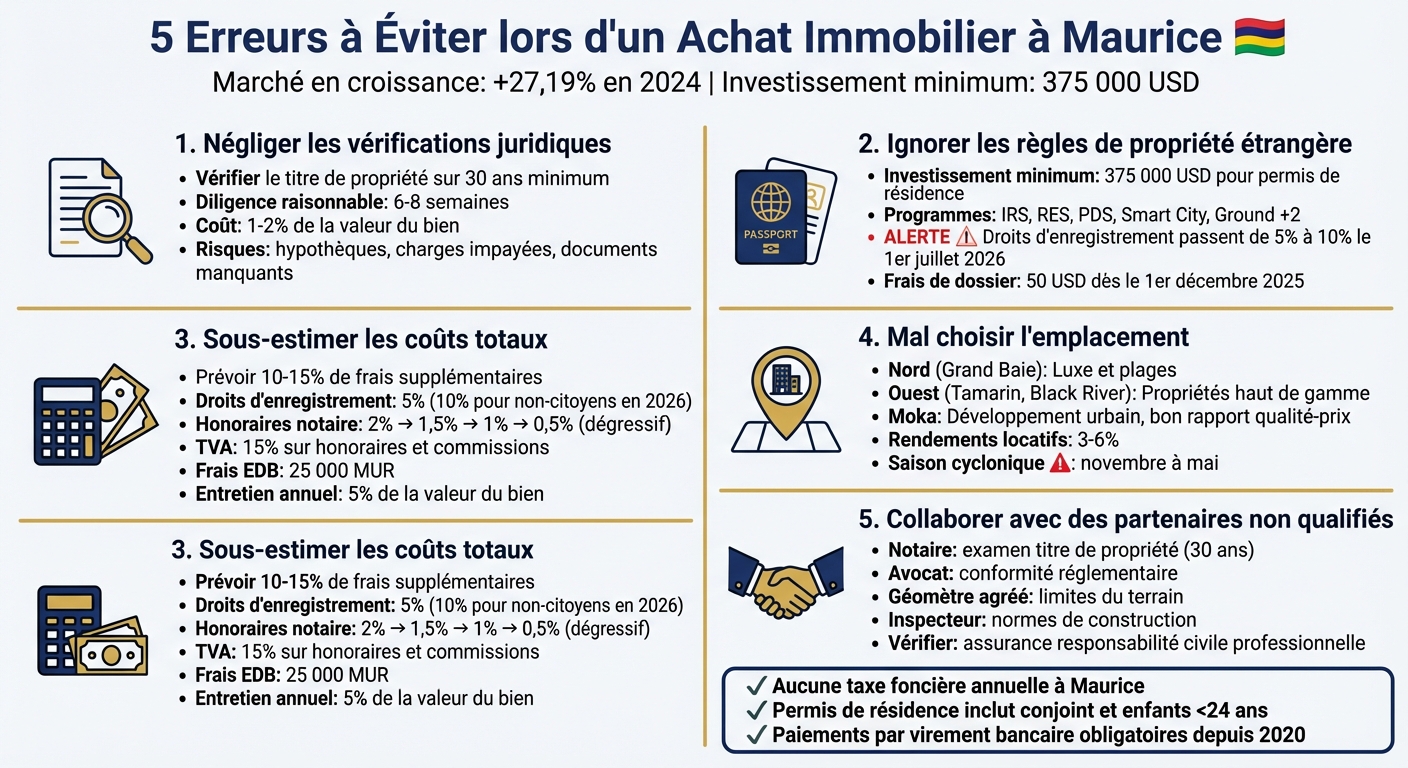
Buying property in Mauritius offers attractive advantages, such as a favourable tax regime and the possibility of obtaining a residency permit for a minimum investment of USD 375,000. However, common mistakes can jeopardise your project. Here are the 5 main pitfalls to avoid:
- Neglecting legal checks: Verify the property title for 30 years and ensure there are no mortgages or unpaid charges.
- Ignoring rules for foreigners: Respect investment thresholds and choose approved schemes such as PDS or Ground +2 apartments.
- Underestimating total costs: Prepare a budget including registration duties (5%, soon 10% for non-citizens), notary fees, and other charges.
- Poor location choice: Analyse regions according to your objectives (residency, rental). For example, the North for luxury or Moka for urban opportunities.
- Collaborating with unqualified partners: Engage experienced notaries, lawyers, and surveyors to secure your investment.
Mauritius is a growing market (+27.19% in 2024), but a rigorous approach is essential to make a successful purchase. Avoid these mistakes and maximise your investment.
5 mistakes to avoid when buying property in Mauritius
Buying in Mauritius: The truth behind the dream villas!
sbb-itb-3115173
1. Neglecting legal checks and validating the property title
Failing to carry out legal checks before a property purchase can have serious consequences. In Mauritius, the legal system, which combines the French Napoleonic Code and British Common Law, requires a thorough understanding and local expertise. A detailed examination of the property history covering at least 30 years is essential to identify problems such as irregularities in property transfers, gaps in the chain of title, or sellers who are not legally authorised to sell.
The financial implications can be significant. Without meticulous verification with the Registrar General's Office, you could end up with unsettled mortgages, judicial charges, unpaid property taxes, or missing documents, such as approvals from the Economic Development Board (EDB) or certificates for the Property Development Scheme (PDS). These omissions render the transaction illegal and can compromise obtaining a residency permit. Comprehensive due diligence, which usually takes 6 to 8 weeks, costs between 1% and 2% of the property value.
« Due diligence is the cornerstone of a secure real estate investment in Mauritius, offering essential protection against legal, financial, and technical risks that could jeopardise the security of the investment. » - Immo Des Hauts Team
To avoid these pitfalls, it is crucial to surround yourself with a competent and specialised team. Engage a Mauritian notary to examine the property title, a lawyer to ensure regulatory compliance, and a licensed surveyor to verify the physical boundaries of the land. Notary fees are calculated on a sliding scale: 2% on the first MUR 250,000, 1.5% on the next MUR 500,000, 1% on the additional million, and 0.5% beyond MUR 1,750,000, with 15% VAT. These professionals will also ensure that the property has a valid occupation certificate and that construction complies with approved plans.
Since 2020, all transactions must be carried out by bank transfer or cheque directly to the notary's account – cash payments are prohibited. If you are buying an off-plan property, demand a Garantie Future d'Achèvement (GFA) (Future Completion Guarantee) issued by a bank. This rigorous approach is essential to protect your investment. Let's now move on to the common mistake related to unfamiliarity with purchasing rules for foreigners.
2. Unfamiliarity with foreign property and residency rules
Understanding the property acquisition rules in Mauritius is essential to avoid costly mistakes. The country offers several schemes suitable for foreign buyers, notably the Integrated Resort Scheme (IRS), the Real Estate Scheme (RES), the Property Development Scheme (PDS), the Smart City Scheme, as well as Ground +2 apartments (in buildings with at least two floors above ground).
To obtain a permanent residency permit, a minimum investment of USD 375,000 is required. This permit remains valid as long as you retain ownership and also covers your spouse and children under 24 years old. These conditions are accompanied by upcoming tax and administrative changes.
« As long as the non-citizen holds property under the scheme, the residency permit remains valid for them and their dependents. » – RE/MAX 24 Mauritius
Please note: from 1st July 2026, registration duties and land transfer tax will increase from 5% to 10% for non-citizens. If you are considering a purchase, it is advisable to conclude the transaction before this date to reduce your costs. Furthermore, from 1st December 2025, a non-refundable application fee of USD 50 will apply to all applications.
Foreign buyers must also adhere to specific restrictions. For example, properties located on state land or "pas géométriques" (coastal buffer zones) are strictly prohibited for non-citizens. Ensure that any property project has approval from the Economic Development Board (EDB) and that the purchase amount meets the USD 375,000 threshold if your primary goal is to obtain residency. While some Ground +2 apartments are accessible from MUR 6,000,000, only those exceeding this threshold allow for obtaining a residency permit.
3. Underestimating total purchase and ownership costs
When considering a property purchase, do not limit yourself to the initial purchase price. Allow for between 10% and 15% in additional costs to cover various ancillary expenses. These include registration duties, currently set at 5% of the sale price. However, for non-citizens, these duties will increase to 10% from 1st July 2026.
Notary fees, meanwhile, are calculated on a sliding scale:
- 2% on the first MUR 250,000,
- 1.5% on the next MUR 500,000,
- 1% on the subsequent million,
- and 0.5% beyond that.
These fees are subject to 15% VAT, as are real estate agency commissions. Agencies typically charge between 2% and 2.5% of the sale price. For foreign buyers, a processing fee of MUR 25,000 to the Economic Development Board should also be anticipated. Finally, administrative stamp duties, ranging from MUR 2,500 to MUR 10,000, are added.
If you are financing the purchase with a bank loan, other fees apply. Banks generally charge application fees equivalent to 0.5% to 1% of the borrowed amount, plus valuation costs.
Long-term maintenance costs
Beyond initial fees, you must consider recurring maintenance expenses. Fortunately, Mauritius does not impose an annual property tax. However, if your property is located in a managed residence, such as a PDS or a Smart City, management fees apply to cover services such as 24-hour security, maintenance of common areas, and shared infrastructure.
According to estimates, it is advisable to budget approximately 5% of the property's value per year for routine maintenance and unforeseen repairs. Home insurance and utility charges (water, electricity, internet) must also be included in your budget.
« Budget at least 5% of your home's value annually for maintenance and unforeseen repairs. » – MCB
4. Ignoring differences between regions and market conditions
Mauritius is a patchwork of regions, each with its own assets influencing property values and rental potential. For example, the North (Grand Baie, Pereybère) and the West (Tamarin, Black River) are renowned for their luxury properties, attracting those seeking idyllic beaches and modern infrastructure. Conversely, places like Moka stand out for their rapid urban development and property opportunities offering good value for money.
Rental yields vary greatly depending on location. High-end properties generally record yields between 3% and 6%. Coastal properties attract tourists, especially during peak season, but require more maintenance due to the effects of salt air and humidity. Meanwhile, inland areas like Moka benefit from more consistent demand, particularly from expatriates and professionals, with more moderate maintenance costs.
Proximity to infrastructure also plays a key role in resale value. Factors such as international schools (Northfields, Le Bocage), modern hospitals (Wellkin Hospital in Moka), and leisure facilities (golf courses, marinas) are criteria that strongly influence buyers. Furthermore, large-scale infrastructure projects, such as the Metro Express or highway extensions, add long-term value to certain localities. These factors, combined with climatic conditions and governmental initiatives, shape the appreciation potential of your investment.
It is also essential to consider climatic specificities. The cyclone season, which runs from November to May, can affect rental occupancy rates and require specific precautions. Properties located near low-lying coasts are more vulnerable to floods and erosion. It is therefore advisable to visit locations at different times of the year to assess climatic variations, such as stronger winds on the East Coast compared to the West.
Finally, inform yourself about future development projects. These can either enhance your property's value or reduce its appeal by changing the environment or the view. Properties located in "Smart Cities" such as Moka, Mon Trésor, or Cap Tamarin benefit from a planned approach, combining residential, commercial, and leisure spaces. These planned zones are becoming increasingly sought after in the Mauritian real estate market. Thus, carefully choosing the region and understanding its local specificities is essential to maximise your property investment.
5. Selecting partners without verifying their qualifications and experience
After discussing legal checks and costs, it is equally important to ensure that your partners have the necessary skills. In Mauritius, buying property requires the involvement of qualified experts. Failure to verify their qualifications and experience can lead to costly mistakes.
A notary is essential to examine the property title for a period of at least 30 years and prepare the authentic deed. Your Mauritian lawyer must have a perfect knowledge of the island's hybrid legal system, which combines the French Civil Code and British Common Law, as well as the laws governing property restrictions for non-citizens. A licensed surveyor ensures that land boundaries are well-defined, while a building inspector ensures that the structure complies with current standards.
For foreign buyers, it is crucial to work with partners who are familiar with the procedures of the Economic Development Board (EDB). Any property acquisition by a non-citizen requires authorization from this institution. Furthermore, professionals must comply with the Financial Intelligence and Anti-Money Laundering Act (FIAMLA), which requires verifying the buyer's identity and the source of funds. If you are buying off-plan (VEFA), ensure that the developer has a Garantie Future d'Achèvement (GFA) (Future Completion Guarantee) issued by a local bank.
It is also important to compare the fees of different professionals and verify that each holds valid professional indemnity insurance. This insurance is essential to protect you against potential errors or omissions. Take the time to check the references and experience of your partners, especially with foreign clients. Finally, ensure that deposits are placed in the notary's escrow account until the signing of the deed of sale.
Collaborating with experienced professionals who are well-informed about the specificities of the Mauritian market is a wise choice. Their expertise can help you avoid costly mistakes and secure your investment in a booming market, with a growth of 27.19%. Let's now move on to the final recommendations for protecting your investment.
Conclusion
Acquiring property in Mauritius can be a rewarding experience, but it requires careful navigation to avoid costly mistakes. The pitfalls mentioned previously can not only compromise your investment but also lead to legal complications. In an constantly evolving market, every decision is important.
Be sure to verify the property title for a period of at least 30 years to avoid any disputes or hidden charges. Familiarise yourself with the different investment schemes to guarantee your right of residence and avoid restrictions applied to non-citizens. Develop a realistic budget, taking into account fees such as registration duties (between 5% and 10%), notary fees, and EDB fees, which amount to approximately MUR 25,000.
The choice of location is also crucial. Analyse regions based on your objectives, whether for a primary residence, a rental investment, or retirement. A good location can optimise the value of your investment. Moreover, it is essential to surround yourself with competent professionals - a notary, a local lawyer, a surveyor, and a building inspector - to ensure that all technical, legal, and administrative aspects are managed correctly.
Adopting a thoughtful and structured approach will allow you to turn your property project in Mauritius into a success. This market rewards meticulous preparation and penalises hasty decisions. Take the necessary time for each step and call on experts with experience in transactions involving foreign buyers. By avoiding these mistakes, you maximise your chances of making your acquisition a safe and fruitful investment.
FAQs
What are the tax advantages of buying property in Mauritius?
Investing in property in Mauritius offers tax benefits that make it an attractive choice for expatriates and investors. No capital gains tax on property or annual property tax: this significantly reduces the costs associated with reselling or holding a property long-term. Furthermore, the absence of inheritance tax and wealth tax simplifies wealth transfer.
For tax residents, income tax is progressive, with a maximum rate of 20% for incomes exceeding MUR 2,390,000. Non-residents, on the other hand, benefit from a fixed tax rate of 15% and are not subject to tax on dividends, whether from local or international sources. Additionally, thanks to double taxation treaties concluded with several countries, rental income and capital gains can be optimised.
Mauritius also offers specific advantages to foreign investors, particularly through the PDS, IRS, and Smart City schemes. These projects often allow for preferential tax rates, thereby increasing the profitability and security of property investments on the island.
How to choose the right location for a property investment in Mauritius?
To succeed in property investment in Mauritius, location plays a key role. Areas offering good potential for appreciation and strong rental demand should be prioritised. Coastal regions such as Grand Baie, Flic-en-Flac, or Belle Mare are particularly popular with expatriates and tourists. In contrast, localities like Moka or Quatre Bornes attract more due to their quality school and commercial infrastructure.
Amenities: a criterion not to be overlooked
Proximity to amenities is a determining factor. Look for properties located near international schools, health centres, main roads, or ongoing development projects. If you are a non-resident, favour properties in areas like the IRS or RES, which offer reliable legal guarantees and simplify obtaining a secure title deed.
Market analysis and budget
Comparing average prices is essential to assess the feasibility of your project. For example, a high-end apartment can cost between Rs 10,000,000 and Rs 30,000,000. It is also advisable to follow market trends over several years to better understand their evolution. Remember to visit properties at different times of the day to assess the environment and security.
Get accompanied by experts
To guarantee a transaction without unpleasant surprises, call upon a notary or a recognised real estate agency. These professionals will help you navigate the legal and administrative aspects, ensuring a smooth acquisition.
Which experts should you consult to secure a property purchase in Mauritius?
To succeed in your property purchase in Mauritius, it is crucial to surround yourself with experienced professionals who will guide you at each step:
- Notary or lawyer specialised in property law: They are responsible for drafting official documents, verifying the legal compliance of the transaction, and obtaining the necessary authorisations from the EDB.
- Licensed real estate agent: This expert helps you find properties that match your needs and assists you in negotiations to obtain the best conditions.
- Tax or financial advisor: They advise you on optimising your financing and anticipating any additional costs related to the purchase.
Engaging these professionals will allow you to secure your investment, comply with all legal obligations, and avoid costly mistakes during the process.