January 3, 2026
Property Investment in Mauritius: Complete Guide 2026
Mauritius, in 2026, is an attractive destination for luxury real estate thanks to its political stability, tax advantages, and permanent residency opportunities. Here are the essential points for investing:
- Tax advantages: A single tax rate of 15%, no property tax, no inheritance tax, and double taxation treaties with 43 countries.
- Permanent residency: Accessible from USD 375,000 invested in approved programmes such as PDS, Smart City or Ground+2.
- Popular areas: Grand Baie, Tamarin, and Roches Noires, offering high-end properties and attractive rental yields (4% to 10%).
- Expected fees and changes: Registration duties for non-residents increasing from 5% to 10% from July 2026.
- Types of properties available: Villas, penthouses, building plots, and off-market properties.
Investing before July 2026 allows you to avoid the increase in registration duties. Mauritius remains a solid option for long-term investments, combining quality of life and advantageous taxation.
Buying in Mauritius: the truth behind dream villas!
Legal Requirements for Foreign Property Buyers
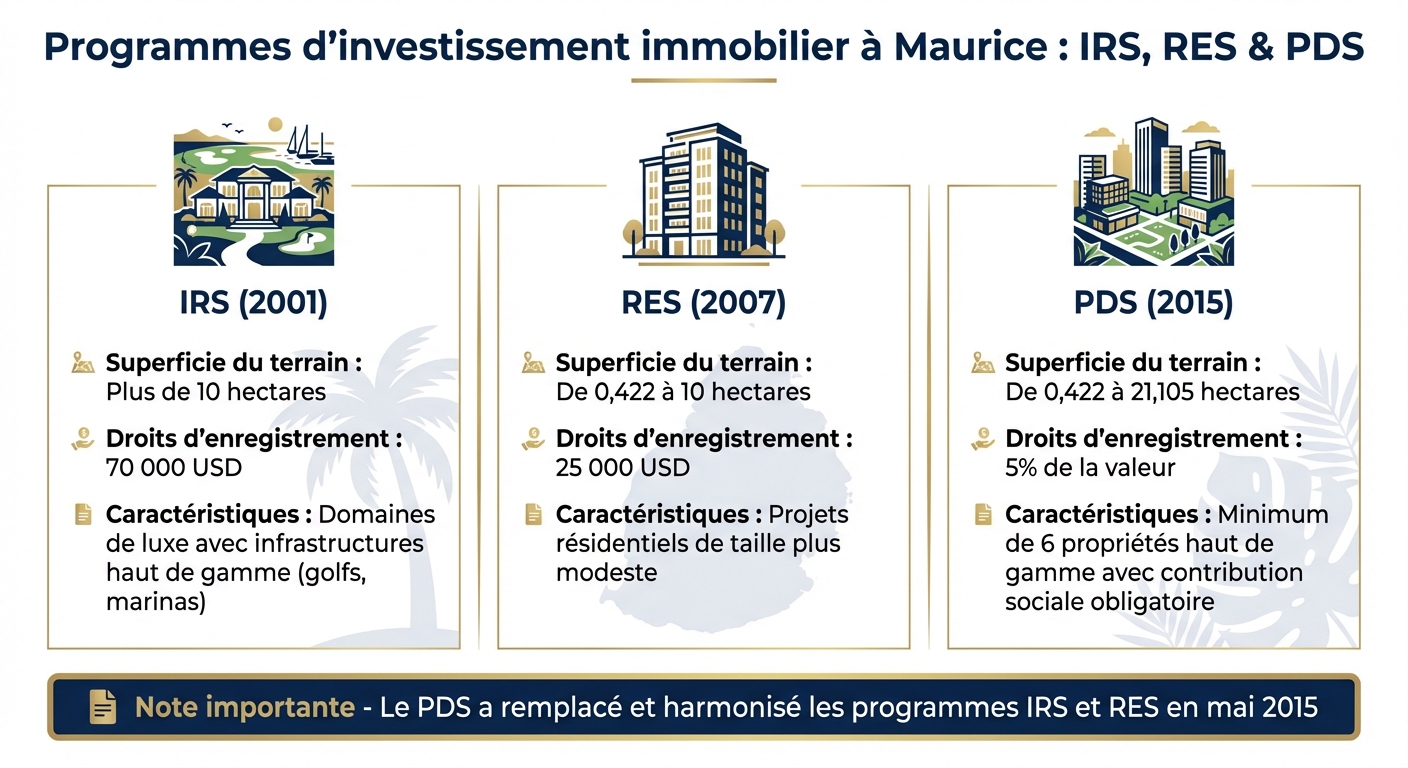
Comparison of property investment programmes in Mauritius (IRS, RES, PDS)
Who Can Invest and Required Documents
Foreign investors are limited to purchasing properties within programmes approved by the EDB, such as PDS, Smart City, IRS, RES, and Ground+2 apartments. As of July 2025, the acquisition of properties outside these programmes is no longer permitted.
The EDB conducts KYC (Know Your Customer) checks and requires proof of funds. Necessary documents include a recent police record extract and a medical certificate proving the absence of contagious diseases. To secure the purchase, reservation fees must be deposited into a notary escrow account.
Note: co-ownership is allowed. If several investors, whether partners or spouses, each invest at least USD 375,000 in the same property, they can all obtain a permanent residence permit.
Let's now look in detail at the main investment programmes.
The PDS, IRS and RES programmes in detail
The Property Development Scheme (PDS), introduced in May 2015, replaced and harmonised the former IRS and RES programmes. These programmes allow for the freehold acquisition of luxury properties, such as villas, penthouses and apartments.
| Programme | Land area | Registration fees | Key features |
|---|---|---|---|
| IRS (2001) | Over 10 hectares | USD 70,000 | Luxury estates with high-end infrastructure (golf courses, marinas) |
| RES (2007) | From 0.422 to 10 hectares | USD 25,000 | Smaller residential projects |
| PDS (2015) | From 0.422 to 21.105 hectares | 5% of value | Minimum of 6 high-end properties with mandatory social contribution |
The Smart City Scheme offers mixed developments integrating residential, commercial and office spaces. Non-citizens who already hold an occupation or residence permit can also acquire serviced plots of land. Furthermore, Ground+2 apartments are accessible with a minimum investment of approximately MUR 6 million (approximately USD 130,000) in buildings with at least two floors.
These programmes are not limited to offering prestigious properties: they also open the way to residence and visa opportunities.
Residency and Visa Options via Property Investment
A minimum investment of USD 375,000 in an approved programme automatically grants a 10-year permanent residence permit. This permit extends to the buyer, their spouse, dependent parents, and children (including step-children and adopted children) up to 24 years old, provided they are not working.
The permit remains valid as long as the investor retains ownership. Furthermore, holders of this permit are exempt from the obligation to obtain an occupation or work permit if they wish to invest or work in Mauritius. To benefit from tax advantages linked to residency, it is necessary to spend at least 183 days per year in the country.
As of 1 December 2025, a non-refundable application fee of USD 50 is required for all residence permit applications. Retirees aged 50 and over can obtain a 10-year permanent residence permit by purchasing a PDS Senior Living unit starting from USD 200,000.
Best Areas to Buy Luxury Real Estate in Mauritius
Location plays a key role in the quality of life and profitability of a property investment. In Mauritius, several regions attract with their varied assets and unique atmosphere. The local property market saw a 27.19% year-on-year increase in the third quarter of 2024, with foreign buyers spending an average of MUR 30.6 million (approximately USD 645,111) per property.
Grand Baie
Located in the heart of the North, Grand Baie combines the charm of island life with the vibrancy of an urban centre. This cosmopolitan location offers an impressive range of high-end services, from elegant boutiques to refined restaurants, not forgetting renowned shopping centres such as La Croisette and Sunset Boulevard.
“Grand Bay (or Grand Baie) embodies the harmonious fusion of relaxed island life and vibrant energy.” - Park Lane Properties
For expatriate families, the proximity of renowned international schools such as Northfields International High School and Greencoast International School is a major asset. The beaches of Mont Choisy, Péreybère and Trou aux Biches – among the most beautiful on the island – attract both locals and foreign visitors. Golf enthusiasts are also catered for with the 18-hole course at Mont Choisy Le Golf.
In terms of connectivity, Grand Baie is approximately 30 minutes from Port Louis thanks to modern infrastructure. On the investment side, rental demand remains strong, with attractive yields oscillating between 4% and 10%. Projects like Mont Choisy Smart City, which combines housing, shops and leisure, further enhance the appeal of this region.
Tamarin and Rivière Noire
The west coast, with its breathtaking landscapes, appeals to those seeking a blend of luxury and nature. Tamarin and Rivière Noire offer stunning ocean views and lush green settings where prestigious developments such as high-end villas and golf estates are integrated. For example, modern two-bedroom apartments are available there from USD 407,000.
The Harmonie Golf & Beach Estate project perfectly illustrates this region, combining environmental preservation with luxurious amenities. The area also boasts modern infrastructure, such as beach clubs, spas, and property management services. Moreover, owners benefit from a flat tax rate of 15% and an IFI exemption thanks to bilateral tax agreements.
Roches Noires and Azuri
On the east coast, Roches Noires and Azuri stand out with exclusive residential projects, often associated with golf courses. Azuri, a unique Smart City project in this region, offers an autonomous living environment combining homes, shops, and leisure facilities. This “city within a city” concept includes championship golf courses, clubhouses, and sports facilities reserved for residents.
Residents find a perfect balance between tropical tranquillity and urban atmosphere, all supported by modern and luxurious infrastructure.
These regions clearly demonstrate the investment potential and opportunities offered by the Mauritian property market.
Types of Luxury Properties Available
The Mauritian market offers a variety of high-end properties, including villas, penthouses, building plots, and off-market properties. These offers are designed to meet the expectations of foreign investors and are located within secured estates or Smart City projects approved by the EDB.
Villas and penthouses
Luxury villas are among the most sought-after properties. They are located in approved programmes and offer high-end amenities: private swimming pools, bedrooms with en-suite bathrooms, and plots of approximately 2,000 m². Some prestigious villas include guest pavilions and direct access to the beach or a golf course. For example, off-plan villas at Harmonie Golf & Beach Estate start from MUR 97,500,000.
Penthouses, meanwhile, appeal with their spacious terraces, rooftop pools, and “lock-up-and-go” concept, ideal for non-residents. In Grand Baie, a three-bedroom penthouse is offered at MUR 17,500,000, while beachfront apartments in Tamarin and Rivière Noire range between MUR 28,975,000 and MUR 35,500,000. Ultra-luxury residences, such as those in Cap Malheureux, can reach MUR 135,000,000 for an architectural villa of 283 m² on a plot of 1,128 m².
| Property type | Main features | Price range (MUR) |
|---|---|---|
| Luxury apartment | G+2, communal pool, coastal view | 13 M – 30 M |
| Penthouse | Rooftop terrace, private pool, sea view | 17.5 M – 40 M+ |
| Luxury villa | Private garden, pool, 3-5 en-suite bedrooms | 35 M – 135 M+ |
| Villa in golf estate | Guest pavilion, golf course, large plots | 90 M – 150 M+ |
Off-market properties
For those seeking exceptional properties, off-market properties offer exclusive opportunities. These properties are not publicly listed, ensuring complete confidentiality. They are often located in sought-after areas such as Grand Baie or Tamarin.
“Mauritius remains a destination of choice, both from a lifestyle and investment perspective, ticking both boxes.” - Timo Geldenhuys, Director, Mauritius Sotheby's International Realty
Soléa Realty, thanks to its expertise and network, facilitates access to these rare properties. The agency offers personalised portfolios, tailored to each buyer's specific criteria. In the ultra-luxury segment, where 80% of transactions are cash, this bespoke approach is essential.
Plots for Custom Builds
The purchase of building plots allows investors to design customised projects. However, foreigners can only acquire serviced plots in Integrated Resort Schemes (IRS) or Smart City projects, in compliance with the conditions set by the EDB. These plots include necessary infrastructure (water, electricity, sanitation) and follow strict architectural guidelines to preserve the harmony of the estate.
“Turnkey” construction costs start from MUR 2,500 per square foot, with structural work from MUR 1,300 per square foot. Soléa Realty collaborates with renowned architects and contractors to ensure quality projects, while complying with local regulations. Investors are advised to allow an additional 10% margin to cover unforeseen circumstances related to evolving construction costs.
sbb-itb-3115173
Tax Advantages and Rental Income Potential
Tax advantages for owners
In Mauritius, the tax framework is particularly attractive. The country applies a flat rate of 15% on all income, whether personal, corporate or rental. Furthermore, there is no capital gains tax, no inheritance tax, and no property tax.
Owners also benefit from the absence of wealth tax. For French residents, properties located in Mauritius are not taken into account in the calculation of the Impôt sur la Fortune Immobilière (IFI) (French property wealth tax), thanks to a bilateral tax treaty between the two countries. In addition, Mauritius has signed double taxation agreements with over 43 countries, ensuring that investors do not pay taxes twice on the same income.
The Mauritian tax system also allows great freedom in terms of fund transfers. Profits, dividends and capital can be repatriated without restrictions, as there is no exchange control. For those who wish to further optimise their taxation, obtaining Mauritian tax residency is possible by residing in the country for more than 183 days per year.
| Type of tax | Rate in Mauritius | Key advantage |
|---|---|---|
| Income tax | 15% | Flat rate on personal and rental income |
| Wealth tax | 0% | No wealth tax |
| Exchange control | None | Free repatriation of capital |
Expected rental yields
In addition to tax advantages, real estate in Mauritius offers attractive rental yields. Depending on the type and location of the property, investors can expect yields of 4% to 10%.
Certain areas, such as Grand Baie in the north and Tamarin-Rivière Noire in the west, experience strong rental demand, particularly due to their popularity with tourists. High-end properties, such as beachfront villas, penthouses, and properties located in golf estates, attract affluent clientele consisting of expatriates and tourists, which helps maximise rental income.
However, it is important to consider acquisition costs, which include:
- 5% registration duties,
- 5% transfer tax,
- and 15% VAT on new properties.
The 2025-2026 budget forecasts an increase in registration duties to 10% for non-citizens purchasing properties in IRS, RES, PDS and Smart City programmes. To optimise your returns, it is advisable to favour areas with high tourist demand and to entrust rental management to professionals.
These tax advantages and rental income prospects make Mauritius an essential destination for real estate investors seeking luxury opportunities.
How to buy a property with Soléa Realty
Finding your property
The first step with Soléa Realty begins with a personalised consultation. The agency analyses your needs: budget, investment objectives, and lifestyle preferences. This approach gives you access to exclusive offers that are not available on the public market, allowing you to discover properties before they are widely circulated.
Next, Soléa Realty assists you in choosing the property programme that suits you from those approved by the EDB: Property Development Scheme (PDS), Integrated Resort Scheme (IRS), Real Estate Scheme (RES), Smart City Scheme or Ground+2 apartments. Once your property is selected, the agency secures your investment by depositing a down payment into an escrow account with a notary. The notary then submits an authorisation request to the Economic Development Board (EDB), accompanied by your KYC documents, passport copies, and necessary proof of funds.
Building custom projects
Once your property is found, Soléa Realty helps you bring your ideas to life by creating a custom project. The agency facilitates the acquisition of building plots and collaborates with qualified architects and contractors to design and build your ideal home. They handle complete project management, allowing you to remain at ease throughout the process.
The construction contract is established under the Vente en l'État Futur d'Achèvement (VEFA) (Sale in Future State of Completion) regime, which includes a bank guarantee of completion (GFA). This guarantee protects your investment by ensuring that the project will be completed.
Once your house is under construction, you can already start planning your relocation and the management of your new property.
Relocating to Mauritius and property management
After the purchase and registration of the property, Soléa Realty remains by your side. Depending on the type of investment, some purchases may include benefits such as obtaining a residence permit.
The agency also helps you settle in by facilitating access to schools, insurance, and advising you on the best residential areas. If you have invested in a rental property, Soléa Realty offers property management services. These services cover monitoring rental returns, managing expenses, and tax compliance. Regular inspections are also carried out to ensure that your property retains its full value over time.
How the 2025-2026 budget affects real estate
The 2025-2026 national budget has introduced several significant changes for foreign investors in luxury real estate in Mauritius. One of the major adjustments concerns registration duties for non-citizens, which have doubled from 5% to 10% for purchases made under the PDS, IRS, RES, Smart City programmes, and Ground+2 apartments. This represents a notable increase in the costs to be anticipated for any property acquisition.
The new measures also affect capital gains tax on resale. Non-citizens will now have to pay the higher amount between 10% of the sale price and 30% of the capital gain realised. According to Villa Vie, this adjustment aims to limit short-term speculation and encourage longer-term investments. Clearly, the goal is to favour sustainable projects rather than quick transactions.
Another significant change: the abolition of the programme allowing the purchase of properties outside regulated frameworks for more than USD 500,000. Additionally, tax incentives for Smart City projects launched after 5 June 2025 have been cancelled. This includes VAT exemption on infrastructure and 8 years of income tax exemption. However, projects already certified before this date retain their benefits.
These adjustments also affect specific segments such as retirees. The duration of the residence permit for retirees has been reduced from 10 to 5 years, with stricter conditions: a minimum residency of 180 days per year in Mauritius and a monthly transfer of at least USD 2,000 (i.e., USD 24,000 per year).
Despite these restrictions, luxury real estate in Mauritius continues to appeal. Laetitia Melidor, from Mauritius Sotheby's International Realty, highlights:
“Mauritius remains a globally attractive destination, and now more than ever, smart investing means staying ahead of the curve.”
For investors, there are still opportunities to seize before these measures are fully implemented. Furthermore, the threshold for obtaining residency remains unchanged at USD 375,000. In addition, the government has planned a massive investment of 128 billion rupees in national infrastructure over five years, a factor that could contribute to the long-term appreciation of properties.
What investors need to know for 2026
Luxury real estate in Mauritius remains an attractive option, even with recent tax adjustments. Currently, a minimum investment of USD 375,000 allows you to obtain a permanent residence permit. This permit remains valid as long as you own the property and extends to your spouse and children under 24.
However, it is important to take into account upcoming tax changes. From 1 July 2026, registration duties will increase from 5% to 10%. This means, for example, an additional cost of USD 25,000 for a property worth USD 500,000. In addition, a resale tax will be introduced, calculated as the higher amount between 10% of the sale price and 30% of the capital gain. These changes must be considered in your long-term profitability projections.
Despite these adjustments, Mauritius continues to attract due to its appealing tax environment. Advantages include:
- 0% property tax
- 0% inheritance tax
- 15% flat tax rate for tax residents.
To benefit from this tax status, it is necessary to reside at least 183 days per year on the island. In parallel, the government plans a massive investment of 128 billion rupees in infrastructure over five years, a factor that should support the valuation of properties.
To secure your investment, favour approved programmes such as PDS, Smart Cities, or G+2 projects. The VEFA (Vente en État Futur d’Achèvement - Sale in Future State of Completion) regime also offers a bank guarantee of completion, a pledge of security for buyers. Local banks offer attractive financing, covering up to 70% of the value for properties under construction and 80% for existing properties.
Soléa Realty is here to assist you every step of the way: from selecting exclusive properties to completing custom projects with trusted architects, and providing comprehensive assistance for your relocation to Mauritius. Contact our team for tailored support and take advantage of opportunities before the tax changes of July 2026.
FAQs
What are the tax advantages for investing in real estate in Mauritius in 2026?
In 2026, Mauritius stands out with a particularly favourable tax environment for property investors. The single tax rate of 15% applies to various types of income, including rental income for holders of a residence permit obtained through property investment. And that's not all: property capital gains are generally not taxed, allowing investors to retain a larger share of their profits upon resale.
Another major asset? The absence of inheritance tax, which greatly simplifies the transfer of family wealth. Furthermore, transfer duty, payable by the buyer, remains competitive compared to many other countries. In addition, Mauritius has signed double taxation agreements with over 40 countries, allowing foreign investors not to be taxed twice on their income or gains.
With a stable economy, clear taxation, and these numerous advantages, real estate in Mauritius is proving to be a particularly attractive option for investors in 2026.
How to obtain a permanent residence permit by investing in real estate in Mauritius?
To acquire a Permanent Residence Permit (PRP) in Mauritius through property investment, two essential conditions must be met:
- Hold an Occupation Permit (OP) as an investor for at least three consecutive years before submitting your application.
- Invest in a property with a minimum value of USD 500,000 (or the equivalent in convertible currency). This investment must be made within the framework of specific programmes such as the Property Development Scheme (PDS), the Real Estate Scheme (RES), or the Integrated Resort Scheme (IRS).
Once these criteria are met, you can submit your PRP application to the competent authorities. Your application will need to include the necessary documents, such as proof of your investment and financial justifications. This permit grants you a right of residence for 20 years, renewable, and also extends to your family, including your spouse, children, and dependent parents.
What are the best regions to invest in luxury real estate in Mauritius in 2026?
Mauritius is full of sought-after locations for luxury property investment, particularly on its north-west coast, renowned for its paradisiacal landscapes and prestigious infrastructure.
Here are two particularly popular regions:
- Trou aux Biches: This highly popular seaside area offers exclusive residences, such as penthouses and villas with breathtaking sea views. These properties generally include private pools and high-end amenities.
- Parc Cap Marina: Also located in the north, this residential complex stands out with its elegant villas featuring private beaches, as well as modern facilities such as a spa, gym, kids' club, and integrated hotel management.
These areas combine an enchanting tropical setting, access to international services, and attractive tax advantages, thus attracting investors seeking prestigious properties.