March 25, 2026
Checklist: Overseas Property Purchase in Mauritius
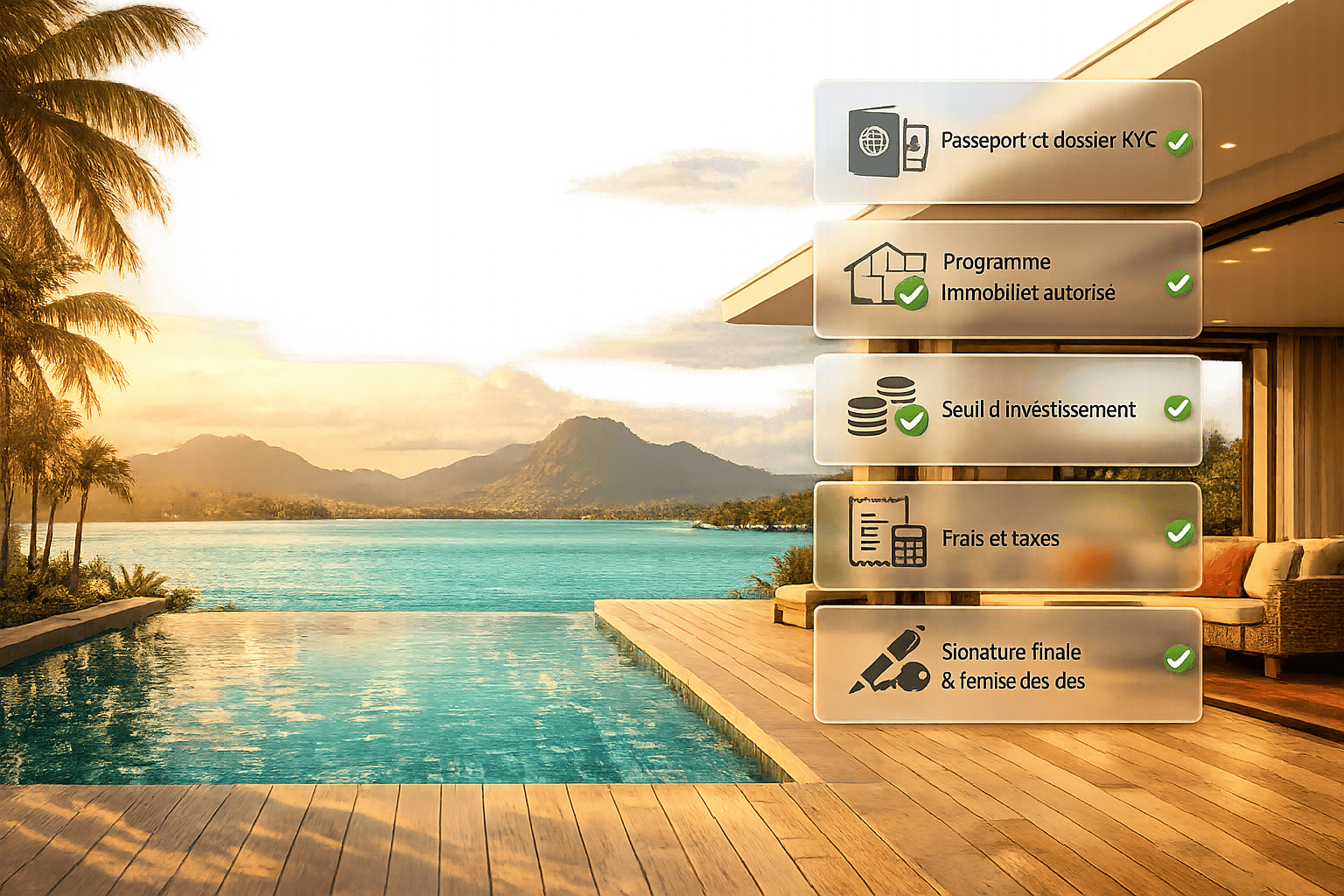
Buying property in Mauritius as a foreigner can offer attractive tax advantages and access to a permanent residence permit. Here are the key points to remember:
- Available Programmes: Foreigners can invest via approved programmes such as the Property Development Scheme (PDS), Integrated Resort Scheme (IRS), Smart City Scheme (SCS), or R+2.
- Minimum Investment: USD 375,000 to obtain a residence permit, or MUR 6,000,000 (approximately USD 175,000) for an R+2 apartment.
- Tax Advantages: No wealth tax, no capital gains tax on property, and limited inheritance tax.
- Additional Fees: Allow for 5% registration duties (10% from 1st July 2026), notary fees (0.75% to 2% + VAT), and agency fees (2.5% + VAT).
- Administrative Process: Mandatory authorisation from the Economic Development Board (EDB), KYC verification, and transfer of funds via a local bank account.
- Required Documents: Valid passport, proof of address, clean criminal record, and financial supporting documents (bank statements, savings certificates, etc.).
Tip: Cash payments often speed up the process. Once authorisation is obtained, funds can be transferred to finalise the purchase.
Mauritius combines economic stability, a pleasant climate, and an attractive tax system, making the island a prime destination for property investors.
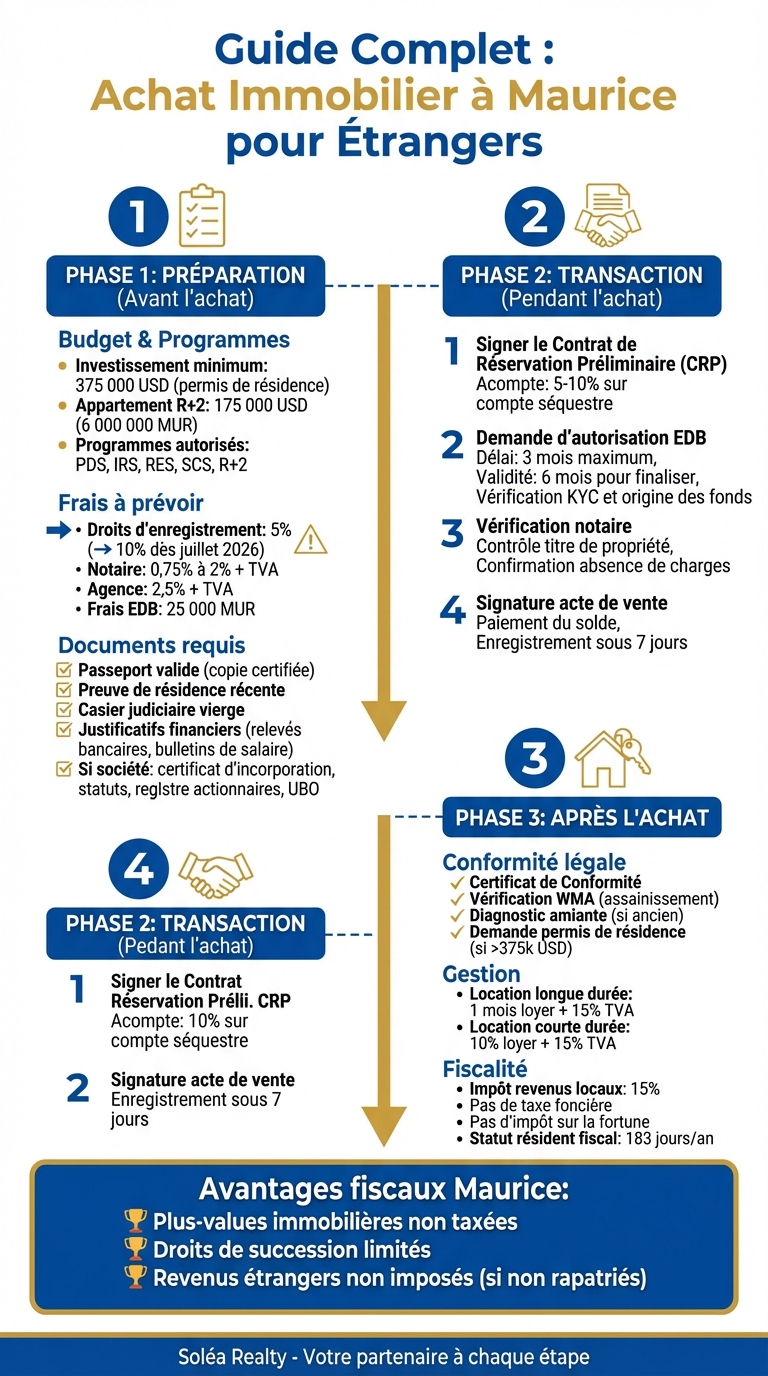
Property purchase process in Mauritius for foreigners: steps and required documents
Buying in Mauritius: The Truth Behind Dream Villas!
sbb-itb-3115173
Checklist: Preparation Before Purchase
Before committing to a property purchase, it is crucial to prepare your financial and administrative file. This step ensures a secure transaction compliant with current regulations in Mauritius, while also facilitating the process.
Define your budget and financing plan
To obtain a permanent residence permit, a minimum investment of USD 375,000 is required. If you plan to buy an apartment under the R+2 regime, the entry threshold is set at USD 175,000 (approximately MUR 6,000,000).
Remember to include the following additional costs in your budget:
- Registration fees: 5% (this rate will increase to 10% from 1st July 2026)
- Notary fees: Between 0.75% and 2% + VAT
- Agency fees: 2.5% + VAT
- EDB fees for resales: MUR 25,000 (approximately USD 555)
Funds must be transferred from your country of origin to a local bank account before finalising the transaction.
Tip: Foreign buyers who pay cash often see their process accelerated. Once EDB approval is obtained, funds simply need to be transferred to conclude the purchase.
If you opt for an off-plan purchase (VEFA), a deposit of up to 25% will be required. This amount is held in an escrow account. Once your financing plan is established, make sure to check your eligibility before proceeding further.
Confirm your eligibility to purchase
The purchase is open to non-resident individuals, companies registered under the Companies Act 2001 (including foreign companies), trusts with a qualified trustee, and foundations. However, each purchasing structure requires KYC (Know Your Customer) certification issued by a local bank or a notary. This certification confirms your identity, activities, and the origin of your funds.
Properties accessible to foreigners are limited to the following approved programmes: Property Development Scheme (PDS), Integrated Resort Scheme (IRS), Real Estate Scheme (RES), Smart City Scheme (SCS), and R+2 apartments. Conversely, the purchase of agricultural land or undeveloped land outside these programmes is strictly prohibited.
Contact the Economic Development Board (EDB)
The EDB plays a central role as a one-stop-shop for property acquisitions by foreigners. Although their official guides are a good resource for choosing the right programme for your project, the official application for authorisation generally occurs after the signing of the Preliminary Reservation Contract (CRP). Once the complete file is submitted, processing usually takes 3 months or less. The Letter of Authorisation issued remains valid for 6 months, during which the final deed of sale must be signed.
Your Mauritian notary will be your main contact with the EDB. They will ensure that all documents are properly certified and compliant. The EDB will conduct a KYC verification and analyse the origin of funds to comply with international anti-money laundering standards. To avoid any administrative delays, prepare your KYC file as soon as the case is opened. This will simplify the subsequent steps and make the process smoother.
Checklist: Documents Required for Property Purchase
Preparing all necessary documents from the outset can greatly facilitate EDB approval and avoid delays. This also ensures compliance with standards set by the FIU and the FIAMLA Act.
Personal identification documents
To begin, a valid passport is essential. You will need to provide a certified copy of it, as well as recent proof of address, such as a utility bill. Civil status certificates (birth certificate, marriage certificate, or divorce decree) must be less than three months old. If you are married, you will also need to submit your spouse's identification documents (passport and birth certificate), even if they are not a co-purchaser. A clean criminal record or a certificate of no conviction is also required. Ensure all copies are recent to avoid rejection.
Once these documents are validated, you will need to demonstrate that you have the necessary funds.
Proof of financial documents
Proof of funds (POF) is essential to show that you can cover the cost of the purchase as well as associated fees. This includes a questionnaire detailing the origin of your capital, whether it comes from an inheritance, company profits, the sale of a property, retirement income, etc. Accepted documents for this proof include:
- Recent bank statements
- Bank confirmation letters
- Payslips
- Savings certificates
- Dividend statements
- Mortgage offers
A compliance officer will examine these documents to verify their authenticity before proceeding with the process.
Legal certificates and attestations
A recent certificate of no conviction (criminal record) is mandatory for any application to the EDB. If this document comes from abroad, it must be apostilled or notarised to be accepted by the Mauritian authorities. These measures are in place to ensure compliance with international anti-money laundering standards.
Documentary requirements: individual buyers vs. companies
The required documents vary depending on whether you are buying as an individual or through a company. Here is a summary table of the differences:
| Type of Document | Individual Buyer | Corporate Buyer (Ltd, SA, SARL) |
|---|---|---|
| Identity/Existence | Notarised Passport & Birth Certificate (<3 months) | Certificate of Incorporation |
| Governance | N/A | Up-to-date Articles of Association & Up-to-date Minutes |
| Ownership | N/A | Register of Shareholders & UBO identification |
| Marital Status | Marriage/Divorce Certificates | N/A |
| Background | Recent Criminal Record | Disclosure of Ultimate Beneficial Owners (AML) |
| Financial Proof | Payslips, Bank Statements | Company Profits, Dividend Certificates |
For acquisitions via a company, the identification of ultimate beneficial owners (UBO) is mandatory. You will need to provide documents such as the certificate of incorporation, updated articles of association, the register of shareholders, as well as recent board meeting minutes. If you cannot be present to sign the documents, a power of attorney can be used to designate a representative.
These documents are essential to initiate the subsequent stages of the acquisition process.
Checklist: Steps in the Property Purchase Process
Finding and selecting your property
Start by defining your objectives: do you want a main residence, a secondary home, or a rental investment? This will influence your choices between a villa, an apartment, or other types of property.
Explore online property portals, local newspapers, and reputable agency websites to analyse prices by region. For example, Grand Baie is popular for its beaches, while Port Louis offers a dynamic and lively setting. Take the time to visit several options to better understand the market and compare available properties.
For a more precise approach, collaborate with Soléa Realty. Their expertise will help you get a clear market assessment and negotiate under the best conditions. Also, ensure the property complies with authorised investment programmes, such as PDS, RES, or IRS. Once you have made your choice, formalise it with a written offer to purchase. This offer must include the proposed price, financing method, and any specific conditions.
After selecting your property, you will need to proceed with the necessary administrative steps.
Finalise the legal formalities
Sign a preliminary agreement and pay a deposit, typically between 5% and 10%, which will be placed in an escrow account. If you are buying an off-plan property, the developer is required to provide a bank guarantee of completion to secure your investment.
Next, it is imperative to obtain official authorisation from the Economic Development Board (EDB). This entity verifies your background and the origin of your funds. Once the approval letter is received, you have 6 months to finalise the purchase. Concurrently, the notary conducts a thorough verification of the property title to ensure that the property is free of any charges or disputes. Note that EDB processing fees amount to approximately MUR 25,000.
Finalise the property sale
The final step is to finalise the sale in front of a notary. They read the deed of sale and oversee the transaction. The balance of the purchase price is then settled, either by bank cheque payable to the notary or by transfer to their professional account.
Once the deed is signed, ownership is officially transferred to you. The notary then takes care of registering the deed with the Registrar General within 7 days. After registration, you will receive a certified copy of the deed with the official endorsement. If you cannot be present for the signing, it is possible to designate a representative via a power of attorney.
All these steps, whether verifications, authorisations, or guarantees, aim to ensure a safe and transparent transaction.
| Type of Fee | Standard Amount | Beneficiary |
|---|---|---|
| Registration Duties | 5% of purchase price | Registrar General (via notary) |
| Notary Fees | ~1% + VAT (15%) | Notary |
| Agency Commission | 2% + VAT (15%) | Real Estate Agency |
| EDB Processing Fees | ~MUR 25,000 | Economic Development Board |
Checklist: After Purchasing Your Property
Once the transaction is finalised, it is important to ensure that your property complies with all legal obligations and to organise its management efficiently. Here are the key steps to follow.
Confirm legal compliance
As soon as the deed of sale is signed, obtain a Certificate of Conformity to guarantee that your property complies with urban planning standards. Also, check with the Wastewater Management Authority (WMA) that the connection to the sewerage system is in order. A written attestation specifying connection to the "main sewer" or the conformity of the septic tank (in rural areas) is essential.
If your property is old, have an asbestos survey carried out before starting renovation work. Furthermore, if your investment exceeds USD 375,000, you can begin the process to obtain a residence permit from the EDB once the deed is signed.
Organise your property management
If you do not reside in Mauritius permanently, it is advisable to entrust the management of your property to an approved company. This company can take care of technical maintenance (such as the pool and garden), security, and potentially renting out your property.
For long-term rentals (more than 12 months), management fees generally amount to one month's rent + 15% VAT. For short-term rentals (less than 10 months), expect 10% of the rent + 15% VAT.
“A foreign investor has the right to rent out their property, directly or via an approved manager, allowing them to receive freely repatriable rental income.”
– Michael Zingraf Real Estate
Choose an agency with good knowledge of the local market to access serious tenants and reliable service providers. In tourist areas, such as Pereybere, some agencies offer concierge services that can maximise your income through seasonal rentals on specialised platforms.
Finally, in addition to the daily management of your property, remember to consider tax optimisation and fund transfers.
Optimise your taxation and fund transfers
In Mauritius, the tax rate on local income, including rent, is set at 15%, with no annual property taxes, council tax, or wealth tax. To obtain tax resident status, you must reside on the island for at least 183 days a year. Furthermore, income from abroad is not taxed as long as it is not repatriated to Mauritius.
It is important to declare your income annually to the Mauritius Revenue Authority (MRA), even if you benefit from an exemption. To facilitate the legal repatriation of your funds, collaborate with your notary to properly document the origin of capital during "due diligence" verification. This will simplify future transfers. Consulting a local tax expert can also help you structure your finances according to your country of origin and investment objectives.
Benefit from Soléa Realty’s support
After your purchase, Soléa Realty remains by your side. The team assists you with your relocation procedures, connects you with reliable property managers, and informs you about exclusive investment opportunities. Thanks to its network of local partners, including architects, contractors, and tax experts, Soléa Realty offers personalised support to enhance your assets and facilitate your integration in Mauritius.
Complete Checklist: Your Property Purchase Guide
Here is a summary of the essential steps to navigate the property purchase process in Mauritius with confidence. This guide offers a quick and practical overview.
Before purchasing:
- Clearly define your budget and check your eligibility based on the chosen property programme (PDS, RES, Smart City, or R+2).
- Prepare all necessary documents, including your identification and financial proofs (see the list of required documents).
- If purchasing through a company, ensure you have the articles of association, shareholder register, and identification documents for ultimate beneficial owners (UBOs).
During the transaction:
- Sign the Preliminary Reservation Contract (CRP) and pay a deposit of 5% to 10% into a secure escrow account.
- Submit your authorisation application to the EDB (Economic Development Board), pay the MUR 25,000 fee, then await approval (valid for 6 months).
- The notary will verify the property title and confirm that there are no charges or mortgages on the property.
- If you are purchasing an off-plan property (VEFA - Vente en État Futur d’Achèvement), obtain the Financial Completion Guarantee (GFA) from the bank.
- Finalise the purchase by signing the authentic deed of sale and settling the balance as well as registration fees (5%, increasing to 10% from 1st July 2026).
After purchasing:
- Ensure you obtain the Certificate of Conformity and check the necessary connections with the Wastewater Management Authority.
- If your investment exceeds USD 375,000, begin the process to obtain your residence permit.
- Organise the management of your property via a specialised company and consult an expert to optimise your tax obligations.
- Take out comprehensive insurance covering risks related to cyclones and floods.
Soléa Realty is by your side every step of the way, from finding the ideal property to your relocation. With access to exclusive properties and a network of reliable partners (notaries, tax specialists, property managers), you benefit from tailored support.
Review these points before concluding your transaction to ensure a compliant and smooth process.
FAQs
Which programme (PDS, IRS, RES, Smart City, R+2) is best suited for my project?
The programme you choose depends entirely on your objectives and personal situation. Here's an overview of the available options:
- PDS (Property Development Scheme) and IRS (Integrated Resort Scheme): These programmes are ideal for luxury properties or secondary residences. They also offer attractive tax advantages for foreign investors.
- RES (Real Estate Scheme): This programme may be suitable if you are looking for a main residence in Mauritius, while enjoying a pleasant setting.
- Smart City: Designed for modern urban projects, this programme focuses on intelligent and integrated spaces, perfect for a contemporary lifestyle.
- R+2: This is a specific regulation concerning residential buildings constructed on multiple floors, from the second level upwards.
To determine which option best suits your needs, it is always wise to consult a local expert. They can guide you based on the specifics of your project and current regulations.
What KYC documents or proof of funds are often rejected by the EDB?
The EDB frequently rejects certain types of KYC documents or proof of funds, mainly due to non-compliance or questionable authenticity. Here are some typical examples:
- Non-certified copies: Documents submitted without official certification are not accepted.
- Lack of clear proof of funds' origin: If the documents provided do not transparently and legally justify the source of funds, they will be rejected.
It is therefore essential to provide complete, certified documents that clearly demonstrate the legitimacy of the funds to avoid any rejection.
How much time should be allowed between the CRP and signing with the notary?
The period between signing the Preliminary Reservation Contract (CRP) and the notarised deed is generally between 4 and 6 weeks. This timeframe corresponds to the administrative and legal steps required within the property purchase process in Mauritius, allowing the acquisition to be finalised in accordance with the rules.