March 27, 2026
Investing in Villas, Penthouses or Apartments: A Guide
Mauritius attracts real estate investors thanks to its tax advantages (single rate of 15%, no capital gains tax or inheritance tax), economic stability and quality of life. This guide compares three main options: villas, penthouses and apartments, taking into account their costs, returns and investor profiles.
Key points:
- Villas: Luxury, space, and high rental yield (5-8%). Ideal for families or investors seeking prestige and long-term value appreciation. Average investment: MUR 28-38M.
- Penthouses: Modern properties offering exceptional views and exclusive services. Suitable for discerning urban buyers. Average price: MUR 28-35M.
- Apartments: More accessible option with prices starting from €430,000, generating stable rental income. Simplified management and attractive to expatriates.
Quick comparison:
| Property Type | Average Cost | Rental Yield | Management | Permanent Residence |
|---|---|---|---|---|
| Villas | MUR 28-38M+ | 5-8 % | Complex | Yes (> 375,000 USD) |
| Penthouses | MUR 28-35M | 4-6 % | Simplified | According to programme |
| Apartments | €430,000 - €2.9M | 4-6 % | Very simple | No (except PDS) |
To optimise your investment, evaluate your objectives: rental income, permanent residence or asset diversification. Investing before July 2026 could reduce costs related to registration fees (currently 5%, rising to 10%).
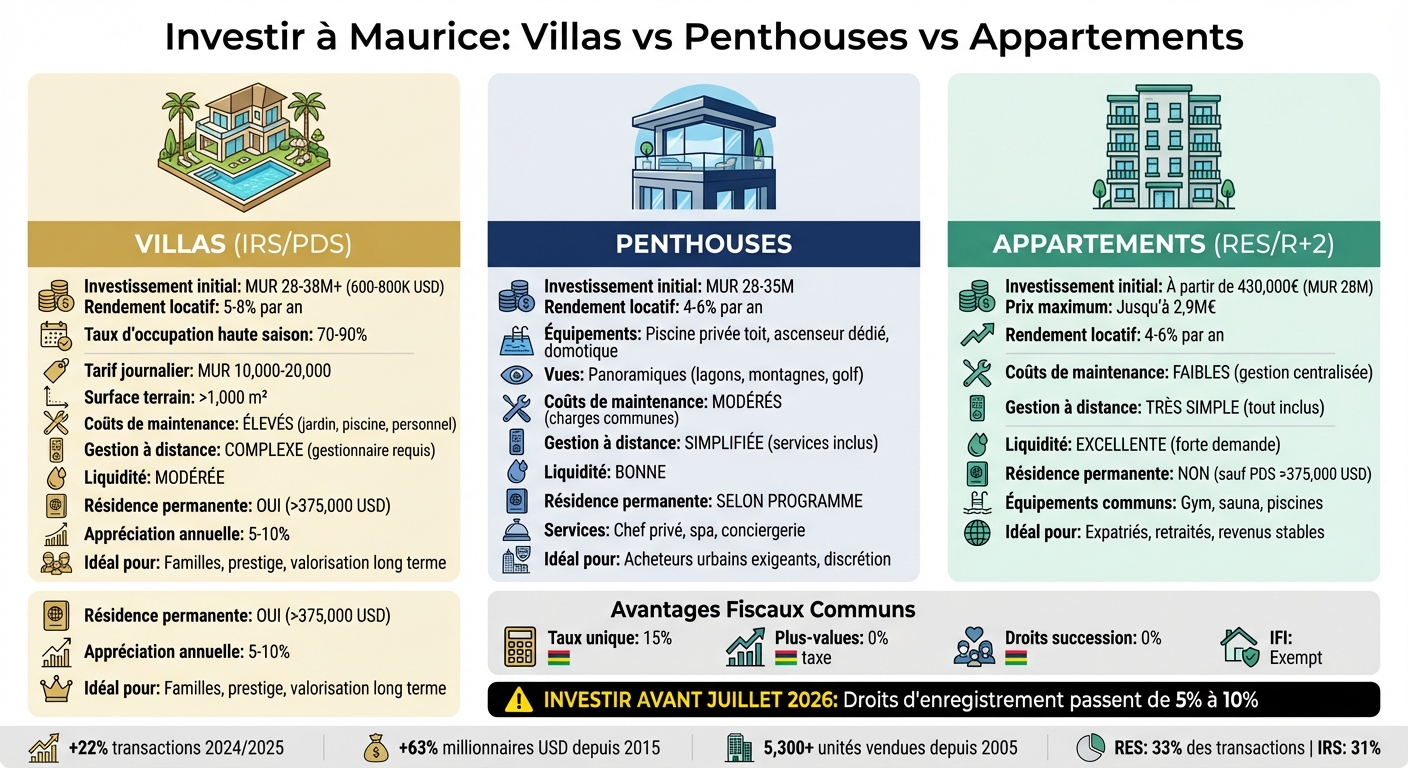
Mauritius real estate investment comparison: Villas, Penthouses and Apartments
Buying in Mauritius: the truth behind dream villas!
sbb-itb-3115173
Villas: Luxury real estate investment
Villas represent a major part of the luxury real estate market in Mauritius. Since 2005, more than 5,300 residential units have been sold under programmes for foreign buyers. Currently, the average price of a new villa is around MUR 28 million (approximately 600,000 USD). In contrast, resold villas average MUR 38 million (approximately 800,000 USD). This price difference illustrates a constant appreciation of the market, with an estimated annual growth of between 5% and 10% according to the residential property price index.
Characteristics and advantages of villas
Villas are distinguished by their space and privacy, often located on plots of more than 1,000 m². Unlike apartments or penthouses, these independent properties have no shared walls or direct neighbours. This allows for private swimming pools, tropical gardens, and sometimes even direct access to the beach. In addition, they include practical services such as 24-hour security, maintenance of common areas and concierge services.
PDS (Property Development Scheme) and Smart City programmes allow investors to customise their villa by working with trusted architects and builders. Options include modern amenities such as solar panels or home automation systems. Soléa Realty supports its clients in these tailor-made projects, from design to installation. This flexibility particularly attracts expatriate families and entrepreneurs wishing to combine home and office.
Rental yield of villas
Demand for luxury villas remains high, fueled by European tourists during the Mauritian winter and expatriates seeking family residences. In high season, occupancy rates vary between 70% and 90%, with daily rates ranging from MUR 10,000 to MUR 20,000, generating annual returns of 5% to 8%.
Let's take a concrete example: a PDS villa purchased for MUR 40 million in 2020 can generate a rental yield of 7% to 12% per year. Upon resale in 2026, it could show a capital gain of 25%, completely tax-exempt. Long-term rentals, often signed with expatriates, offer financial stability through multi-year leases.
The best locations for villas in Mauritius
Certain regions of Mauritius stand out particularly for villa purchases. On the north coast, Grand Baie and Péreybère are very popular for their cosmopolitan atmosphere and developed tourist infrastructure. These areas benefit from rental premiums of up to 20% above the national average.
On the west coast, Rivière Noire and Tamarin attract with their turquoise lagoons, spectacular sunsets and private marinas. These localities attract approximately 70% of foreign direct investments via PDS and IRS programmes. Buyers also appreciate the proximity to golf courses, international schools and the airport.
For non-resident investors, experts advise favouring villas located in managed residences. This facilitates remote management and ensures peace of mind. Finally, with the planned increase in registration fees from 5% to 10% from 1st July 2026, investing now could reduce purchase-related costs.
After exploring the advantages of villas, let's move on to penthouses, which offer a high-end urban alternative.
Penthouses: High-end urban properties
After exploring investment in villas, let's see how penthouses represent a luxurious and modern urban option.
What distinguishes penthouses
Penthouses combine elegance, privacy and exclusive services. Perched on top of buildings, they offer breathtaking views of lagoons, mountains or golf courses. These properties stand out for their high-end amenities, such as private rooftop pools, dedicated lifts, and finishes in prestigious materials such as marble, solid wood or natural stone. In addition, modern technologies, such as home automation systems for managing lighting, air conditioning and audio, as well as secure biometric access, reinforce their appeal to investors seeking comfort and simplicity.
Growing demand for penthouses
Penthouses appeal to a high-end international clientele seeking discretion, quality of life and exceptional views. The north of Mauritius is particularly popular due to its proximity to beaches and golf courses, thus attracting discerning buyers. Moreover, eco-luxury is becoming a strong trend: the use of ecological materials and energy-efficient technologies increases the value of properties while minimising their environmental impact. Projects such as Casa Alegria, Ocean Point or certain developments in Péreybère, which often limit the number of units to two, illustrate this orientation towards discreet and refined luxury.
The profile of penthouse buyers
Typical buyers are wealthy individuals and professionals looking to invest in an idyllic setting. Mauritius's advantageous tax environment, with its capped tax rate of 15% and absence of capital gains tax, is a major attraction. In addition, these properties offer services worthy of the best hotels: private chefs, spas, wellness treatments, and tailor-made concierge services. For many foreign investors, buying a penthouse is also an opportunity to obtain a residence permit, particularly through integrated projects such as Mon Trésor or Azuri, which attract with their prestigious infrastructure: golf, kitesurfing and turquoise lagoons.
If you are considering investing in a penthouse in Mauritius, the Soléa Realty team, experts in luxury real estate, is at your disposal to support you with a tailor-made service. This overview of penthouses is part of a global approach to help you define the ideal property according to your investment objectives.
Apartments: Accessible luxury investment
High-end apartments represent an interesting entry point into the luxury real estate market in Mauritius. They perfectly complement options such as villas and penthouses in a diversified investment strategy. Let's see what makes these properties so attractive.
The advantages of apartment investment
Luxury apartments provide access to the premium segment at a more affordable cost. For example, a one-bedroom apartment in Mont Choisy is available from €430,000, while villas generally start around €600,000. These properties often include common facilities such as gyms, saunas and swimming pools, managed by the co-ownership. This reduces maintenance constraints while maintaining a high level of comfort.
In strategic locations such as Mont Choisy Golf or beachfront in Pereybère, these apartments generate attractive rental income. A two-bedroom apartment with sea view in Grand Gaube costs around €575,000, while a beachfront apartment in Pereybère can reach €2,900,000, offering exclusive amenities such as a private sauna and direct beach access. Furthermore, investing in RES, IRS or PDS programmes allows foreign buyers to obtain a permanent residence permit.
The profile of apartment buyers
Buyers of these properties are mainly expatriates wishing to settle in Mauritius or retirees seeking a practical and comfortable lifestyle. The island's advantageous taxation and its strategic position between East and West further enhance the appeal of these properties. Moreover, the high concentration of real estate projects in the north, particularly in Grand Baie, Pereybère and Mont Choisy, meets a growing demand for a lifestyle combining luxury and convenience.
Apartments in your investment portfolio
Beyond buyer profiles, these properties play a key role in diversifying a real estate portfolio. By including luxury apartments, you spread the risks while optimising your returns. With prices ranging from €430,000 to €2,900,000, these properties offer great flexibility for capital allocation. They also attract strong rental demand, especially from tourists and temporary expatriates, which facilitates resale and generates regular income.
To maximise the value appreciation of your investment, prioritise properties located “pieds dans l’eau” (waterfront) in premium areas such as Pereybère or those with golf access. The Soléa Realty team is here to guide you in choosing apartments that match your wealth objectives.
Financial and tax considerations
After exploring the characteristics and returns of different types of real estate, it's time to look at the financial and tax implications of these investments in Mauritius. Understanding the tax framework is essential to maximise the benefits of your investment. Here's an overview of upcoming tax changes in 2026 and a comparison of costs associated with different property types.
2026 tax changes for real estate buyers
From 2026, foreign buyers will be required to pay a registration fee equivalent to 10% of the purchase price. In addition, there will be extra fees ranging from 5% to 7%, covering professional fees, duties and VAT. Furthermore, it will be mandatory to provide proof of the origin of funds transferred via local banks, in accordance with the directives of the Economic Development Board (EDB).
Cost comparison: villas, penthouses and apartments
Acquisition costs vary considerably depending on the property type and the chosen real estate programme:
- Smart City Apartments: between 350,000 USD and 1,200,000 USD.
- PDS Villas: between 450,000 USD and 2,500,000 USD or more.
- IRS Properties: from 500,000 USD and potentially exceeding 3,000,000 USD.
In premium areas, rental yields generally range between 6% and 10%, and a 5% to 10% increase in property prices is expected by 2026. Local banks facilitate purchases for foreign investors with loans covering up to 70% of the property's value.
This information provides a better understanding of the associated costs and helps in choosing an investment aligned with your financial objectives.
Residence rights for foreign buyers
A minimum investment of 375,000 USD in an approved programme (PDS, IRS or Smart City) grants a lifetime permanent residence permit. This permit also includes the spouse and children under 24 years old. Processing times for applications vary between 3 and 6 months. However, it is important to note that R+2 apartments do not automatically offer permanent residence, unless the investment exceeds the 375,000 USD threshold in an approved PDS programme. The validity of the permit remains effective as long as the property is owned.
How to compare property types
Property comparison table
To evaluate villas, penthouses and apartments, it is essential to examine key criteria. The table below highlights the main differences between these three property categories:
| Criterion | Villas (IRS/PDS) | Penthouses | Apartments (RES/R+2) |
|---|---|---|---|
| Initial Investment | MUR 38 million+ (resale) | MUR 28-35 million | From MUR 28 million |
| Rental Yield | 5-7 % (seasonal rental) | 4-6 % (mixed) | 4-6 % (long-term rental) |
| Maintenance Costs | High (garden, pool, staff) | Moderate (common charges) | Low (centralised management) |
| Liquidity | Moderate (longer sales cycle) | Good | Excellent (strong demand) |
| Remote Management | Complex (manager required) | Simplified (services included) | Very simple (all-inclusive) |
| Permanent Residence | Yes (investment > 375,000 USD) | Depending on the programme | No (except PDS > 375,000 USD) |
In 2024/2025, real estate transactions in Mauritius increased by 22%, with the RES programme representing 33% of transactions and IRS 31%. These figures demonstrate sustained demand for different types of properties. This table effectively summarises the major distinctions discussed earlier.
Aligning properties with your investment goals
Based on this data, it is possible to align real estate choices with your priorities. Here are some points to consider:
- Financial capacity: Villas require significant capital, while apartments offer a more accessible option. Penthouses fall between these two extremes.
- Income objectives: Villas are ideal for high income through tourist rentals, apartments guarantee stable income, and penthouses allow a combination of both.
- Permanent residence: To obtain a residence permit, you must invest in IRS or PDS programmes with a minimum of 375,000 USD.
- Management and maintenance: Villas require more supervision or costly services, while apartments and penthouses offer simpler solutions through centralised management.
To maximise value appreciation, favour villas located in popular areas such as Rivière Noire or Tamarin. Apartments, meanwhile, ensure financial stability, and penthouses offer an attractive balance between return and cost. This analysis helps you refine your investment strategy according to your priorities and objectives.
Conclusion
Key takeaways
As discussed in this guide, by 2026, understanding the distinctions between villas, penthouses, and apartments is essential for optimising your real estate investments in Mauritius. PDS villas are ideal for those seeking prestige, privacy, and long-term appreciation, while also allowing the obtention of a residence permit for investments exceeding 375,000 USD (approximately 17 million MUR). Penthouses, meanwhile, attract an affluent clientele drawn to panoramic views and a sought-after urban setting. Finally, R+2 or GR+2 apartments offer a more accessible option, with regular rental yields and simplified management.
Mauritius's tax framework is particularly attractive to investors: a flat rate of 15% on rental income, no capital gains tax (except in cases of speculation), and no wealth tax for French residents or inheritance tax in direct line. These tax advantages, combined with a stable political environment and modern infrastructure, enhance the appeal of the Mauritian real estate market.
Choosing the right investment depends on your objectives: villas to maximise capital appreciation, penthouses to meet high-end demand in urban areas, and apartments for regular income with low maintenance. With a 63% increase in the number of USD millionaires since 2015, reaching approximately 4,800 individuals today, demand remains strong and sustained. This underscores the importance of a strategic approach tailored to each property type.
How to proceed
Start by defining your priorities and budget: do you want stable rental income, permanent residence, or appreciation of your assets? Once your objectives are established, explore the different programmes available, such as PDS, Smart City, or R+2 options, according to your financial needs and ambitions.
For tailor-made support, contact Soléa Realty today. Specialists in exclusive properties in Mauritius, Soléa Realty guides you every step of the way, from property selection to installation, in collaboration with reliable architects and local partners. Rely on their expertise to maximise your investments in a structured and tax-advantageous market.
FAQs
Which programme (PDS, IRS, Smart City, R+2) should I choose based on my objective?
The choice of a real estate programme in Mauritius depends on your objectives: main residence, rental investment or commercial project. Here is an overview of the available options:
- PDS (Property Development Scheme): This programme offers luxury properties, often accompanied by tax advantages. In addition, an investment exceeding 500,000 USD allows for obtaining a residence permit.
- IRS (Integrated Resort Scheme): Ideal for those seeking high-end projects, generally located in prestigious settings.
- Smart Cities: These projects focus on technology and modern solutions aimed at sustainability, offering an innovative living environment.
- R+2 (Ground floor plus 2 floors): An interesting option for smaller projects, such as apartments in small buildings (up to two floors).
Each programme meets specific needs, whether it's luxury, modernity or simplicity.
What total costs should I expect for the purchase (duties, notary, charges)?
When you buy a property in Mauritius, several additional costs are added to the purchase price. Here are the main costs to expect:
- Registration fees: These represent 5% of the total value of the property.
- Notary fees: Mandatory to formalise the transaction, these fees can vary depending on the value of the property and the services required.
- Potential additional charges: These include real estate agency fees, which generally amount to around 2% of the property price, excluding VAT.
These amounts may differ depending on the specific characteristics of the property and the conditions of each transaction. Be sure to evaluate these costs to avoid surprises during the purchase.
How to rent and manage a property remotely to secure returns?
To ensure effective remote property management while maintaining good returns, technological solutions are your best allies. For example, rental management applications offer a practical interface for communicating with tenants or on-site managers. These tools also automate important tasks such as maintenance or security management, thus reducing the risks of errors or delays.
In parallel, it is essential to work with trusted local managers. Their on-the-ground presence ensures regular monitoring, rapid intervention in case of problems, and smooth daily management. This combination of technology and human collaboration can make all the difference in remote management of your property.