February 16, 2026
5 Indigenous Plants For Luxury Gardens in Mauritius
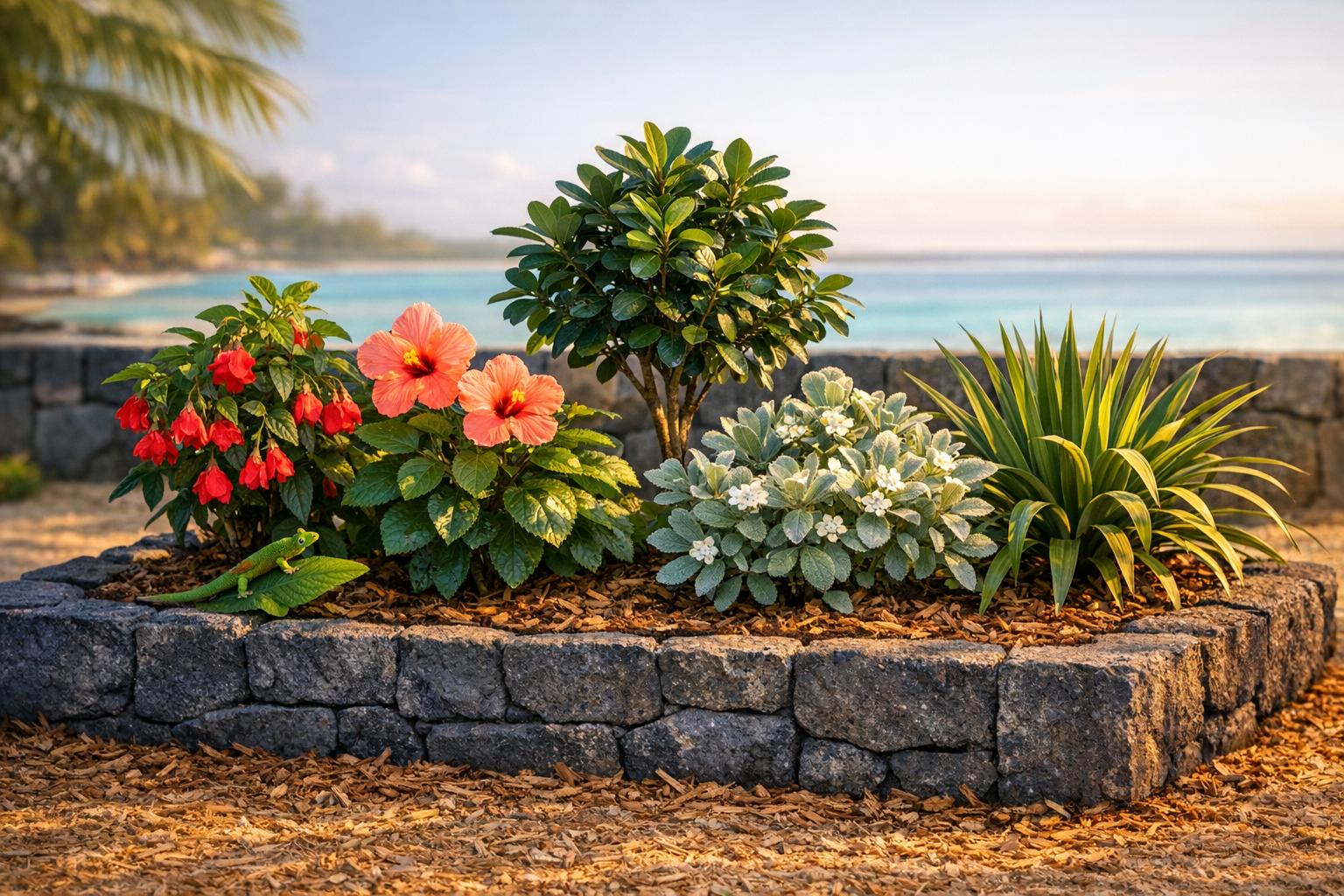
Mauritius is rich in endemic plants, with 273 unique species adapted to its tropical climate. Incorporating these plants into your garden is not just a matter of aesthetics, but also a way to preserve local biodiversity. Here are five native trees and plants that transform any space into a natural haven while supporting Mauritian wildlife:
- Bois de Natte (Labourdonnaisia glauca): Contrasting foliage, a refuge for endemic birds, and resistant to the humid tropical climate.
- Takamaka (Calophyllum tacamahaca): Distinctive trunk, peaceful shade, and essential for species like the Echo Parakeet.
- Baobab (Adansonia grandidieri and Cyphostemma mappia): Imposing silhouette, nectar-rich flowers, and water storage in its trunk.
- Bottle Palm (Hyophorbe lagenicaulis): Native to Round Island, ideal for small spaces and contributes to conservation.
- Black Ebony (Diospyros tessellaria): Precious wood, resistant to cyclones, and supports local biodiversity.
These plants beautify gardens while playing a key role in the conservation of the Mauritian ecosystem. Their maintenance is simple, and they integrate perfectly into modern landscaping projects. By choosing them, you actively participate in protecting Mauritius' natural heritage.
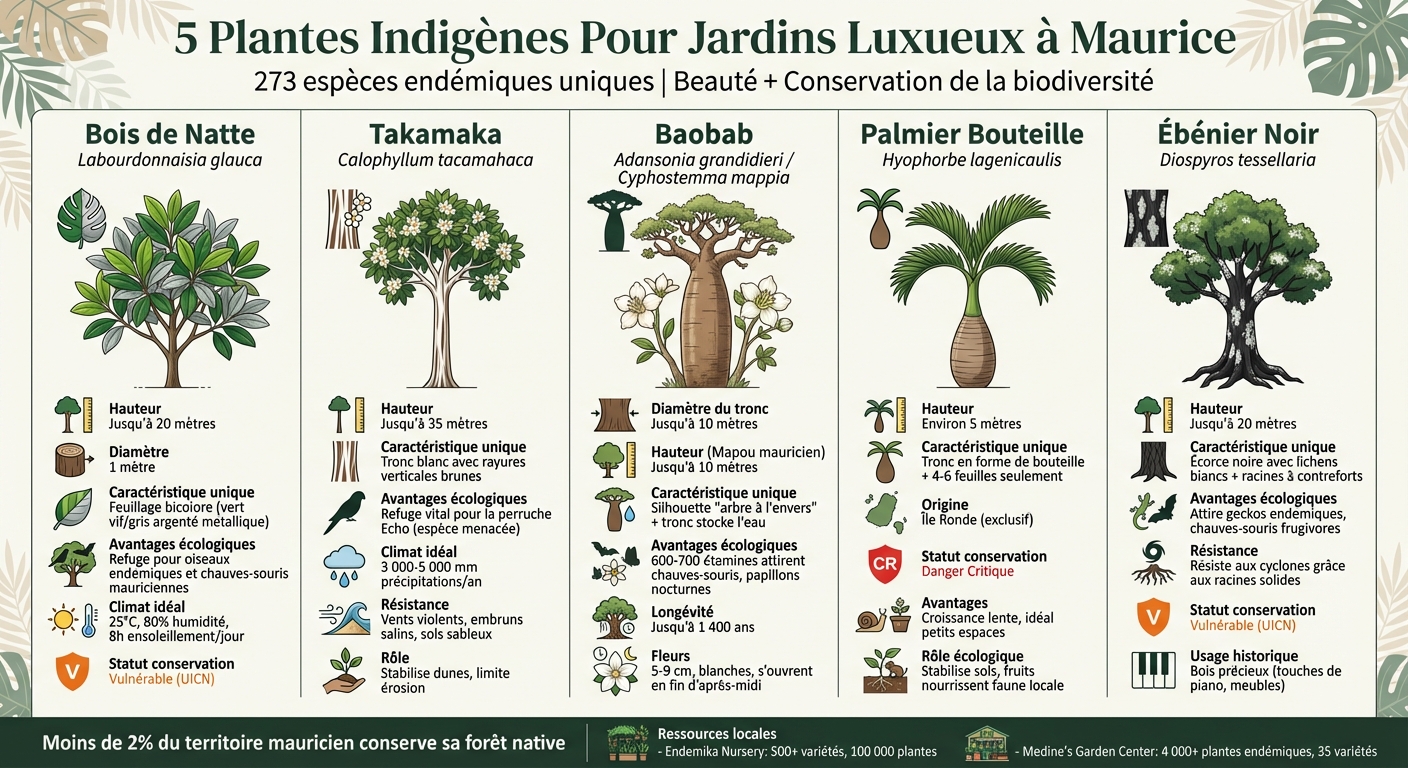
5 Mauritian Native Plants: Features and Benefits for Luxury Gardens
Beautifying Mauritius and encouraging the planting of native plants
sbb-itb-3115173
1. Bois de Natte
The Labourdonnaisia glauca, known as Bois de Natte, stands out with its unique foliage: a vibrant green on top and a metallic silvery-grey underneath. This contrast creates a captivating visual effect, particularly in high-end gardens where the play of light and movement catches the eye. But this is not its only asset.
Elegance and presence in gardens
The Bois de Natte enchants with its natural structure. Its branches spread horizontally, reminiscent of woven mats, which explains its name. With a height of up to 20 metres and a diameter of 1 metre, this tree commands a majestic presence. Its grey bark, marked by vertical fissures as it ages, adds a touch of character. In addition, its bell-shaped white flowers and olive-like fruits bring a seasonal touch of elegance.
A key role in Mauritian biodiversity
Classified as “Vulnerable” on the IUCN Red List, the Bois de Natte plays an essential role in the local ecosystem. Its dense foliage and trunk cavities provide precious refuges for endemic birds. Mauritian bats, unique endemic vertebrates that feed on this tree, ensure the dispersal of its seeds. By planting this tree in a garden, you directly contribute to the preservation of the island's biodiversity.
Resilience to the Mauritian climate and maintenance
Ideal for Mauritius' humid tropical climate, the Bois de Natte thrives at an average temperature of 25°C and 80% humidity. It flourishes in moist, loamy soil, with at least 8 hours of direct sunlight per day. For maintenance, regular pruning during the growing season helps maintain its shape, and balanced fertilisation (N-P-K 10-10-10) ensures its health. Once well established, this endemic tree remains robust and perfectly adapted to its natural environment.
2. Takamaka
The Calophyllum tacamahaca, known as Takamaka, is an emblematic tree of the Mascarene Islands, often associated with high-end gardens. With its white trunk adorned with vertical brown stripes and elegantly formed canopy, it stands out with its imposing presence. Its dark green leaves add a touch of lush greenery, while its delicate white flowers, adorned with bright yellow stamens, release a subtle fragrance that attracts pollinators. All of this makes it a perfect choice for those seeking natural and discreet beauty.
A natural and soothing elegance
Takamaka creates a peaceful and refined atmosphere. On beachfront properties, its branches can extend over the water, offering an impressive visual spectacle. Some trees reach impressive heights of 35 metres, creating shaded areas ideal for relaxation or contemplation spaces.
A key role for biodiversity
Endemic to Mauritius and Reunion, Takamaka is essential to local wildlife. It provides a vital refuge for the Echo Parakeet, a rare and endangered species. Due to its ecological importance, it is used in conservation projects led by the Ministry of Agriculture, which aims to restore native forests affected by invasive species. Planting a Takamaka contributes directly to the preservation of the Mauritian ecosystem.
Resilience and maintenance
Takamaka adapts perfectly to Mauritius' humid tropical climate. It thrives in areas receiving between 3,000 mm and 5,000 mm of rainfall per year and resists strong winds, sea spray, and sandy soils in coastal regions. Its roots play a crucial role in stabilising dunes and limiting erosion. However, during its growth phase, it requires protection from invasive species, which can hinder its development. Once well established, this tree becomes a durable and majestic element in any landscape.
3. Baobab
The Baobab, with its imposing trunk that can measure up to 10 metres in diameter, is a true visual spectacle in prestigious gardens. Its unique silhouette, with branches that resemble roots, has earned it the nickname "upside-down tree". During its defoliation period, its refined appearance is fully revealed. Its pendant white flowers, measuring between 5 and 9 cm, open in the late afternoon, offering a blend of visual beauty and a delicate fragrance.
An architectural touch for exceptional gardens
Among the eight baobab species, Adansonia grandidieri stands out with its cylindrical trunk and flat crown, making it a true natural work of art. This horizontal shape integrates perfectly into high-end properties. In Mauritius, the Cyphostemma mappia, also called "Mapou" or "Mauritian Baobab", is a local alternative. With its swollen trunk and zigzag branches, it reaches a more modest height (up to 10 metres) and harmonises ideally with luxury villa gardens or hotel developments. These qualities make it a perfect choice for the island's tropical conditions.
A refuge for nocturnal wildlife
Beyond its aesthetics, the baobab plays a key role in the local ecosystem. Its nectar-rich flowers attract nocturnal pollinators such as bats and moths, and in Madagascar, even lemurs participate in this process thanks to the flowers' 600 to 700 stamens. The Mauritian Mapou has a fascinating characteristic: its varied leaves, which bear witness to an ancient adaptation to resist grazing by the now-extinct giant tortoises. Its small, red, velvety fruits are a food source for local birds and insects.
A plant adapted to the tropical climate
The baobab is perfectly adapted to Mauritius' hot and humid climate, with dry winters that allow its fibrous trunk to store water – its diameter can even vary depending on rainfall. However, it requires deep, well-drained soil, as stagnant water is fatal to it. Once well established, it requires little maintenance and can live for several centuries, with some specimens reaching up to 1,400 years old. For more restricted spaces, the Mauritian Mapou is an ideal option. It propagates easily by cuttings in water or in a humid, shaded environment. A perfect solution to beautify high-end gardens with a local and durable touch.
4. Bottle Palm
The Bottle Palm (Hyophorbe lagenicaulis) is easily recognised by its unique bottle-shaped trunk, which widens at its base and tapers upwards. This natural and elegant design makes it a highly prized plant in high-end gardens. Unlike many other palms, it retains only four to six open leaves at a time, giving it a sleek and modern appearance. Young palms display reddish or orange-tinted leaves before turning dark green at maturity. But beyond its distinctive appearance, this palm also embodies a symbol of conservation.
A Mauritian treasure in danger
The Bottle Palm is native exclusively to Round Island, a small volcanic islet off Mauritius. Unfortunately, it is now classified as Critically Endangered in its natural habitat. It is one of nine native palm species of Mauritius, seven of which are endemic to the island. By choosing to plant it in private gardens, owners actively participate in the preservation of a species threatened by habitat loss. Local nurseries, such as Medine's Garden Center and La Pépinière by Beachcomber, play a key role in its propagation and safeguard.
Easy to maintain, perfect for tropical gardens
With its slow growth and modest needs, the Bottle Palm is both aesthetic and practical. Adapted to Mauritius' tropical climate, it requires little maintenance once well established. However, its swollen trunk does not store water, so excessive watering can be harmful, especially when grown in pots. It tolerates heat well but remains vulnerable to temperatures close to 0°C, which can be fatal. Its moderate size, reaching about 5 metres, and slow growth make it an excellent choice for small spaces or as a centrepiece in villa gardens.
An essential ecological role
Like other native plants, the Bottle Palm plays a crucial role in preserving the Mauritian ecosystem. In addition to beautifying landscapes, it supports local biodiversity. It serves as a habitat and food source for wildlife, helps stabilise soils, and contributes to water resource management. With less than 2% of Mauritian territory still covered by its native forest, every Bottle Palm planted becomes a concrete gesture to protect the island environment. Its 2.5 cm fruits, which change colour when ripe, feed local birds and insects, thus strengthening natural food chains.
5. Black Ebony
The Black Ebony (Diospyros tessellaria) is a true natural icon. With its black bark dotted with white lichens and buttress roots, it offers an almost sculptural appearance. Formerly, its dense and precious wood was used to make piano keys and high-end furniture, testifying to its importance in Mauritian heritage.
A beauty that stimulates the senses
In addition to its elegance, the Black Ebony enchants with its small white flowers with a delicate fragrance and its rectangular leaves that play with light, creating a magical atmosphere, particularly at sunrise and sunset. With a height of up to 20 metres, it becomes an impressive focal point in any garden.
Robustness and ecological role
"The bark of the trunk is black and often covered in thin white lichens and the tree has buttress roots enabling it to withstand strong cyclones." - Heritage Bel Ombre
Its ability to resist cyclones thanks to its strong roots makes it an ideal choice for areas prone to bad weather. Its flowers attract endemic geckos, fruit bats, and pollinating insects, playing a key role in maintaining local biodiversity. Classified as "Vulnerable" on the IUCN Red List, planting this tree directly contributes to the preservation of a species threatened by invasive plants. The Black Ebony thus perfectly embodies the balance between aesthetics and ecological contribution.
Ease of maintenance and exceptional adaptation
Ideally adapted to the Mauritian climate, this tree thrives in both high-altitude rainforests and low-altitude forests. It propagates easily in nurseries and integrates easily into forest restoration or landscaping projects. Its slow growth reinforces its heritage character, and being a dioecious species, it is advisable to plant several trees to ensure effective reproduction. The Black Ebony perfectly illustrates the balance between natural elegance and respect for the environment in Mauritian gardens.
How to Design Gardens with Native Plants
Creating an elegant garden with local plants requires a carefully considered approach, combining modern aesthetics with respect for the Mauritian ecosystem. To start, identify emblematic trees such as the Bois de Natte or the Black Ebony, which can serve as focal points in your design. These majestic trees provide structure and character, while immediately conveying an impression of refinement. If you are looking for a contemporary and sleek style, opt for straight lines embellished with a specimen tree or endemic grasses planted in groups. For a more natural look, use organic curves and layer different plant species. This method allows you to adapt the design to the unique microclimate of your property.
Local nurseries in Mauritius offer a wide selection of native plants and valuable advice on choosing species adapted to your land. For example, Endemika Landscaping offers comprehensive services for residential landscaping projects, from creative design to the final implementation of green spaces.
"Endemika Landscaping... has quickly become the 'one stop shop' for landscaping matters in Mauritius." – Endemika Landscaping
Every aesthetic decision also contributes to preserving and enhancing local biodiversity.
For owners of prestigious villas, Soléa Realty (https://solea.mu) collaborates with architects and specialised partners to develop tailor-made landscaping solutions. These projects highlight Mauritian authenticity while increasing the value of your property. A good strategy is to start by landscaping a specific area, such as a driveway or a sunny spot, incorporating native plants. This targeted approach allows you to test the layout before gradually extending it to the entire garden, while respecting your aesthetic and financial priorities.
Conclusion
Incorporating native plants into your garden goes far beyond a simple aesthetic choice. These local species transform your outdoor space into a true sanctuary of biodiversity, while reflecting Mauritian identity. Naturally adapted to the island's tropical climate and soils, they require less maintenance and are more resistant to local conditions. Some, like the Bois de Natte, even offer practical benefits. With 273 strictly endemic species, every private garden becomes a valuable ally in conservation efforts.
The importance of these plants is often highlighted by local experts.
"Endemic plants... are vital to the ecosystem and an essential component of the cultural identity of Mauritius." – Medine's Garden Center
In addition to beautifying your property, this approach actively participates in the preservation of the island's unique ecosystem.
To bring this type of project to fruition, turn to specialised nurseries such as Endemika Nursery in Petit Raffray, which offers more than 500 varieties and has 100,000 plants since 1998, or Medine's Garden Center in Bambous, with a collection of more than 4,000 endemic plants spread across 35 varieties. These professionals will guide you in choosing rare and emblematic species, such as the Bottle Palm or the Black Ebony, which will bring a touch of elegance and exclusivity to your garden while contributing to the preservation of Mauritius' natural heritage.
Creating a native garden is investing in a living space that tells the island's story while participating in its ecological future.
Soléa Realty is committed to blending nature and elegance to enhance every Mauritian property and build an environmentally respectful future.
FAQs
Where to buy native plants in Mauritius?
In Mauritius, places such as Medine’s Garden Center in Bambous and Endemika Nursery, known for its endemic plants, offer a vast selection of local species. Furthermore, the Forestry Service provides a list of species available at its centres. For those who prefer simplicity, online platforms allow ordering plants adapted to the Mauritian climate, with the possibility of home delivery for maximum convenience.
Which plant to choose depending on my terrain (seaside, altitude, small garden)?
For a seaside location, choose plants capable of resisting harsh conditions, including salt and strong winds. For example, the Raffia palm is an excellent option for this type of environment.
At altitude, opt for endemic species adapted to cooler temperatures and winds, such as the Polyscias maraisiana, which thrives well in these conditions.
For a small garden, favour compact plants that do not take up too much space but add colour and life. Options like the Porcelain Rose or hibiscus are perfectly suitable.
Remember to adapt your choice of plants to the specific soil type and climate of your region to ensure their proper growth.
How to protect these plants from invasive species?
To preserve native plants, it is crucial to implement targeted actions. Among these, manual weeding remains an effective method to eliminate invasive species while minimising environmental impact. The use of adapted plant protection products, when necessary, must be done with caution to avoid damaging local plants.
Another solution is to replant local vegetation after removing invaders. This not only restores natural habitats but also strengthens ecosystem resilience. At the same time, it is essential to regularly monitor invasive species to prevent their re-emergence.
Finally, involving local communities in these initiatives plays a key role. Raising awareness among residents and encouraging them to actively participate strengthens conservation efforts. Together, these measures contribute to preserving biodiversity and supporting the restoration of natural ecosystems sustainably.