March 16, 2026
Exchange Rate: Impact on Property Purchases

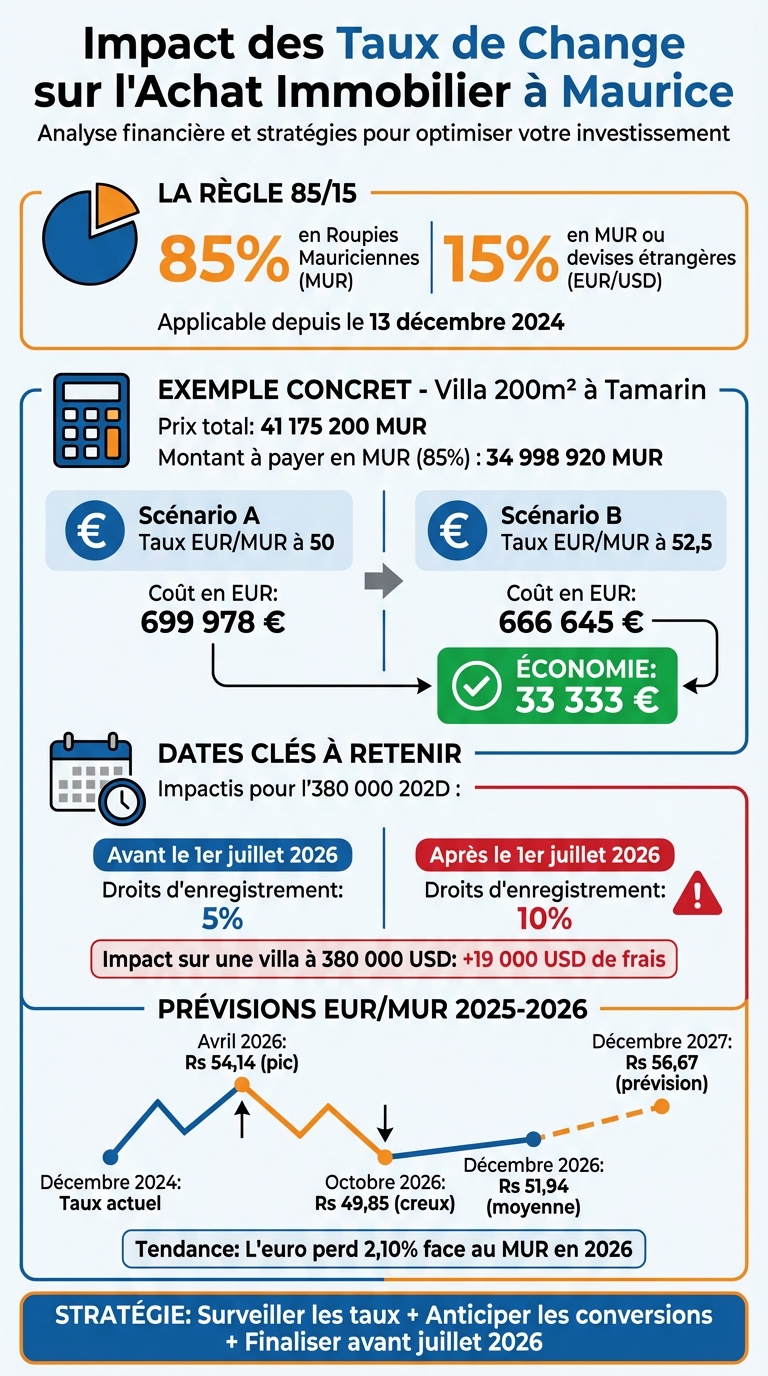
The exchange rate plays a key role in property investments in Mauritius, especially for foreign buyers. Since December 2024, 85% of the price of an off-plan property (VEFA) must be paid in Mauritian Rupees (MUR), making fluctuations in EUR/MUR or USD/MUR rates decisive for the final cost. A weak MUR reduces expenses in foreign currencies, while a strong MUR increases them.
Key points:
- 85/15 Regulation: 85% of the amount in MUR, 15% in MUR or foreign currencies.
- Example: A 200 m² villa at 205,876 MUR/m² costs 41,175,200 MUR. If the EUR/MUR rate changes from 50 to 52.5, the buyer saves approximately 33,333 EUR.
- Increase in registration duties: Will rise from 5% to 10% starting from 1st July 2026.
- Forecasts 2025-2026: The Euro could fall against the MUR, complicating purchases for Europeans.
To optimise costs, monitoring exchange rates, anticipating conversions, and finalising before July 2026 are essential strategies.
Impact of EUR/MUR exchange rates on property purchase in Mauritius
How Exchange Rate Variations Affect Property Costs
Example: A Weak MUR Benefits Foreign Buyers
The obligation to pay 85% of the price in Mauritian Rupees (MUR) makes every transaction sensitive to exchange rate fluctuations. When the MUR loses value against the Euro or Dollar, foreign buyers see their purchasing power increase.
Let's take a concrete example: a 200 m² villa in Tamarin, listed at an average price of 205,876 MUR/m², amounts to a total of 41,175,200 MUR. Of this sum, 85% (i.e., 34,998,920 MUR) must be paid in MUR. If the EUR/MUR exchange rate changes from 50 to 52.5, this represents a cost reduction of approximately 5% for the buyer, or a saving of around 33,333 EUR. For a similar villa in Flic en Flac, where prices can reach 411,509 MUR/m², savings can exceed 65,000 EUR.
Conversely, a strengthening of the MUR increases the bill in foreign currencies. These examples highlight the direct impact of monetary fluctuations on property costs, reinforcing the importance of analysing market trends.
Historical Exchange Rate Trends and Market Effects
Since the COVID-19 pandemic, exchange rate variations have played a key role in the recovery of the Mauritian property market, particularly from 2022 onwards. This recovery has been supported by strong demand from France, South Africa, and Germany. A relatively weak MUR during this period made property investments particularly attractive for buyers with Euros or Dollars.
In 2023, property transactions involving foreign buyers jumped by 21.4%, from 532 units in 2022 to 646 units. Part of this increase can be explained by opportunities created by exchange rate differences, allowing for advantageous asset arbitration. Fabienne Pallany François, Sales Administrator at Mauritius Sotheby’s International Realty, highlights the effect of these variations on purchasing behaviour:
For foreign buyers, 'cash' purchases often accelerate the process.
These cash transactions, favoured by a weak MUR, boosted the market while maintaining stable growth of 4.2% in 2023, thus avoiding the risks of overheating observed in other regions.
sbb-itb-3115173
Payment Rules and Regulations for Property Buyers
Payment Requirements 2024: 85% in MUR and 15% in Foreign Currencies
From 13 December 2024, non-citizens wishing to acquire property under approved schemes (IRS, RES, IHS, PDS and SCS) will have to adhere to a new payment structure. Henceforth, 85% of the purchase price must be settled in Mauritian Rupees (MUR), while the remaining 15% can be paid either in MUR or in strong currencies such as EUR or USD. This measure was introduced to stabilise the local economy and limit imbalances in the foreign exchange market. As highlighted by Rama Sithanen, Governor of the Bank of Mauritius:
These new regulations were essential to eliminate distortions in the foreign exchange market.
The payment process begins with a full transfer in strong currencies to the notary's account. The notary then converts 85% of the amount into MUR to transfer to the developer. As for registration duties, they must be settled in foreign currencies within 8 days of the notarised deed. However, an exchange rate risk arises: between the time of the initial transfer and the conversion, variations in EUR/MUR or USD/MUR rates can influence the final amount required in foreign currencies.
For properties valued over 750,000 USD, a specific mechanism applies. The first 750,000 USD must be transferred from abroad and paid in MUR. The remaining amount can be financed via a local bank loan in MUR, although repayments will compulsorily have to be made in strong currencies.
Another key point: from 1st July 2026, registration duties for non-citizens will increase from 5% to 10% of the purchase price. This increase represents a significant additional burden, encouraging buyers to conclude their transactions before this date.
These new rules highlight the importance of proactive financial risk management, particularly those related to exchange rate fluctuations.
Methods to Reduce Exchange Rate Risk
Given these requirements, it is essential to minimise the impact of exchange rate variations. A first approach consists of closely monitoring EUR/MUR or USD/MUR trends and collaborating with a notary accustomed to large currency transfers. The timing of conversion can have a considerable impact on final costs.
For major purchases, it may be wise to opt for local financing in MUR. By borrowing from a Mauritian bank to cover the balance beyond the initial 750,000 USD, buyers reduce their immediate exposure to exchange rate fluctuations. However, this option requires rigorous planning, as repayments will need to be made in strong currencies, which maintains long-term exposure to exchange rate risk.
Exchange Rates and Financing Options
Loans for Non-Residents: Requirements and Rate Impacts
In Mauritius, banks offer non-residents the possibility of taking out property loans in several currencies: MUR, USD, EUR, GBP, and ZAR. This variety allows for a “natural hedge” strategy, aligning the loan currency with income currency. For example, a European buyer with income in Euros would favour a loan in EUR to avoid exchange rate fluctuations.
However, conditions vary by currency. MUR loans offer the lowest rates, starting from 5.05% at MCB, but carry a risk if the rupee strengthens against the euro. In contrast, USD or EUR loans have slightly higher rates (between 6% and 7.5%), but offer stability to those whose income is in foreign currencies.
Non-residents must also comply with specific constraints: a loan-to-value (LTV) ratio limited to 70%, requiring a minimum personal contribution of 30%; a maximum duration of 25 years (compared to 30 years for residents); and a minimum amount often set at 100,000 USD or equivalent. Furthermore, interest rates applied to non-residents are generally 1% to 2% higher than those for residents. These conditions directly influence the financing strategy and sometimes necessitate resorting to offshore solutions, which come with their own risks.
Exchange Rate Risk in Offshore Financing
Offshore financing, while attractive to some, exposes borrowers to currency fluctuations. The main challenge lies in the currency mismatch: borrowing in MUR while earning income in EUR or USD can lead to an unexpected increase in monthly repayments if exchange rates move unfavourably.
The regulation introduced in December 2024 adds a layer of complexity for buyers using foreign currency accounts. Now, 85% of the price must be settled in MUR, which requires precise coordination with the notary to manage the conversion of foreign funds. Any variation between the initial transfer and the final conversion can have a significant impact on the total amount to be paid.
For properties priced over 750,000 USD, it is recommended to combine hybrid solutions, as mentioned earlier, to reduce exposure to exchange rate risk. However, even with these configurations, exposure to risk persists throughout the loan term. To guard against these fluctuations, financial tools such as forward contracts or currency swaps can be used to secure future rates. These instruments complement the strategies discussed above, offering a more structured approach to managing risks related to international financing.
Exchange Rate Forecasts for 2025-2026
EUR/MUR Forecasts and Effects on Property Prices
By December 2026, the Euro is expected to lose approximately 2.10% of its value against the Mauritian Rupee, reaching an average rate of Rs 51.94. This decline will complicate matters for European buyers, who will have to spend more to acquire properties denominated in USD or Rupees.
The anticipated EUR/MUR fluctuations in 2026, between Rs 49.85 (October) and Rs 54.14 (April), could have a significant impact on substantial transactions. For example, for a property at 380,000 USD, rate variations can lead to a difference of several thousand Euros, depending on the time of purchase. This situation is exacerbated by rising property prices, which have already increased by 4.2% in 2023.
“Time rarely works in the buyer’s favour. What you can buy this year for 380,000 USD, you will find for 410,000 the following year… if it is still available.” – Mathieu Duez, Digital Marketing Manager, Pam Golding Properties Mauritius
However, in the longer term, forecasts indicate a strengthening of the Euro in 2027, with an expected average rate of Rs 56.67 at the end of the year. These prospects could restore confidence among foreign investors.
Expected Foreign Investment Levels
Exchange rate variations directly influence the cost of foreign investments, but their impact remains limited compared to other factors, such as regulatory changes. Among these, the increase in registration duties to 10% planned from 1st July 2026, could weigh more heavily on the market.
Despite these challenges, Mauritius continues to attract international buyers, particularly from France, South Africa, and Germany. These investors often favour cash payments or offshore financing. This resilience is explained by assets such as the minimum investment threshold of 375,000 USD to obtain permanent residency and stable taxation. Furthermore, the population of high-net-worth individuals in the country has surged by 63% over the past ten years, showing the highest growth on the African continent.
Experts anticipate a concentration of investments in high-end and environmentally friendly projects. This trend is reinforced by the abolition of tax incentives for new Smart Cities approved after 5th June 2025. Properties located in highly sought-after areas such as Grand Baie (annual growth of +9.5%) and Tamarin (+15% per year) continue to sell quickly, even in an uncertain global economy.
Practical Measures to Manage Exchange Rate Risk
Plan Your Purchases Based on Favourable Rates
The 85/15 rule requires 85% of the payment to be made in Mauritian Rupees (MUR), which makes the timing of conversion particularly important. Taking advantage of a favourable exchange rate when the Euro is strong against the Rupee can reduce the overall cost of your transaction.
One tip is to transfer your funds in advance and wait for an opportune moment for conversion. This allows you to secure a better rate without delaying your purchase. Moreover, opting for a “cash” payment can accelerate the process: as soon as EDB approval is obtained, the transfer can be made quickly, followed by the signing of the deed of sale.
For transactions exceeding 750,000 USD, a combined approach can be interesting. Make the initial payment in Rupees and finance the balance via a local bank loan. This helps to spread the risks associated with currency fluctuations.
To refine these strategies, consult local experts who are familiar with the market.
Soléa Realty: A Partner for Your Financial Needs

Taking into account recent regulations and anticipated transfer strategies, Soléa Realty provides you with a network of banking and notary partners to ensure simple and secure transfers. As a Mauritian agency, their team has in-depth knowledge of local laws and can guide you towards institutions offering advantageous exchange conditions.
Soléa Realty’s seasoned advisors help you align your purchase with your budget. They also collaborate with notaries to manage escrow accounts, ensuring that your funds are only transferred to the developer after all legal obligations have been met. This support service is completely free for buyers, with fees covered by their partners.
Investing in Mauritian Property 2024
Conclusion
Exchange rate fluctuations directly influence the cost of your investment in Mauritius. With the requirement to settle 85% of the price in Mauritian Rupees for off-plan purchases, every EUR/MUR variation can lead to savings or additional expenses of several thousand Euros. Savvy investors closely monitor these fluctuations to choose the ideal moment to convert their money.
Beyond these immediate variations, upcoming regulatory changes make rigorous planning even more essential. For example, the increase in registration duties, which will rise from 5% to 10% from 1st July 2026, adds a significant cost factor. Finalising an acquisition before this date could result in considerable savings, particularly on high-value properties.
To simplify this often complex process, Soléa Realty provides its network of banking and notary partners. They ensure that your transfers comply with the 85/15 rule while optimising your currency conversions.
"Our mission is simple: to support you in buying the property of your dreams in Mauritius." - Soléa Realty
Mauritius remains a sought-after destination for investment, and thoughtful management of exchange rates, combined with local expertise, can make all the difference. A thorough analysis of rates and a well-planned conversion strategy are therefore key elements to protect and maximise your investment.
FAQs
How can I protect myself from exchange rate risk between the transfer and conversion to MUR?
To reduce the risk associated with exchange rate fluctuations between the time of transfer and conversion to MUR, you can opt for hedging with forward contracts, whether fixed or flexible. These contracts allow you to lock in the EUR/MUR rate in advance, thus ensuring greater security for your future financial flows.
What is the concrete impact of the 85/15 rule on my budget in EUR or USD?
The 85/15 rule stipulates that 85% of the purchase price of a property must be paid in Mauritian Rupees (MUR), while the remaining 15% must be settled in Euros (EUR) or US Dollars (USD). This mandatory distribution has significant implications, particularly concerning exchange rate fluctuations.
Indeed, as part of the payment is in foreign currency, variations in exchange rates can directly influence the final amount you will need to budget in Euros or Dollars. For example, a sudden rise in the Euro or Dollar against the Rupee could increase the total cost of your acquisition in foreign currency. This is a crucial point to consider when financially planning your property project in Mauritius.
Therefore, it is advisable to closely monitor exchange rates and, if possible, consult a financial expert to optimise the management of the currencies involved. This can help you better anticipate costs and avoid surprises related to market variations.
Is it better to buy before 1st July 2026 due to registration duties?
Buying a property before 1st July 2026 could prove to be advantageous. Why? Registration duties will increase from 5% to 10% for certain acquisitions after this date. In addition to this, a 10% tax will be applied to the resale of a property to a non-citizen. These changes are likely to significantly increase the costs associated with property investment.