April 2, 2026
Analysis of Real Estate Risks in Mauritius in 2026
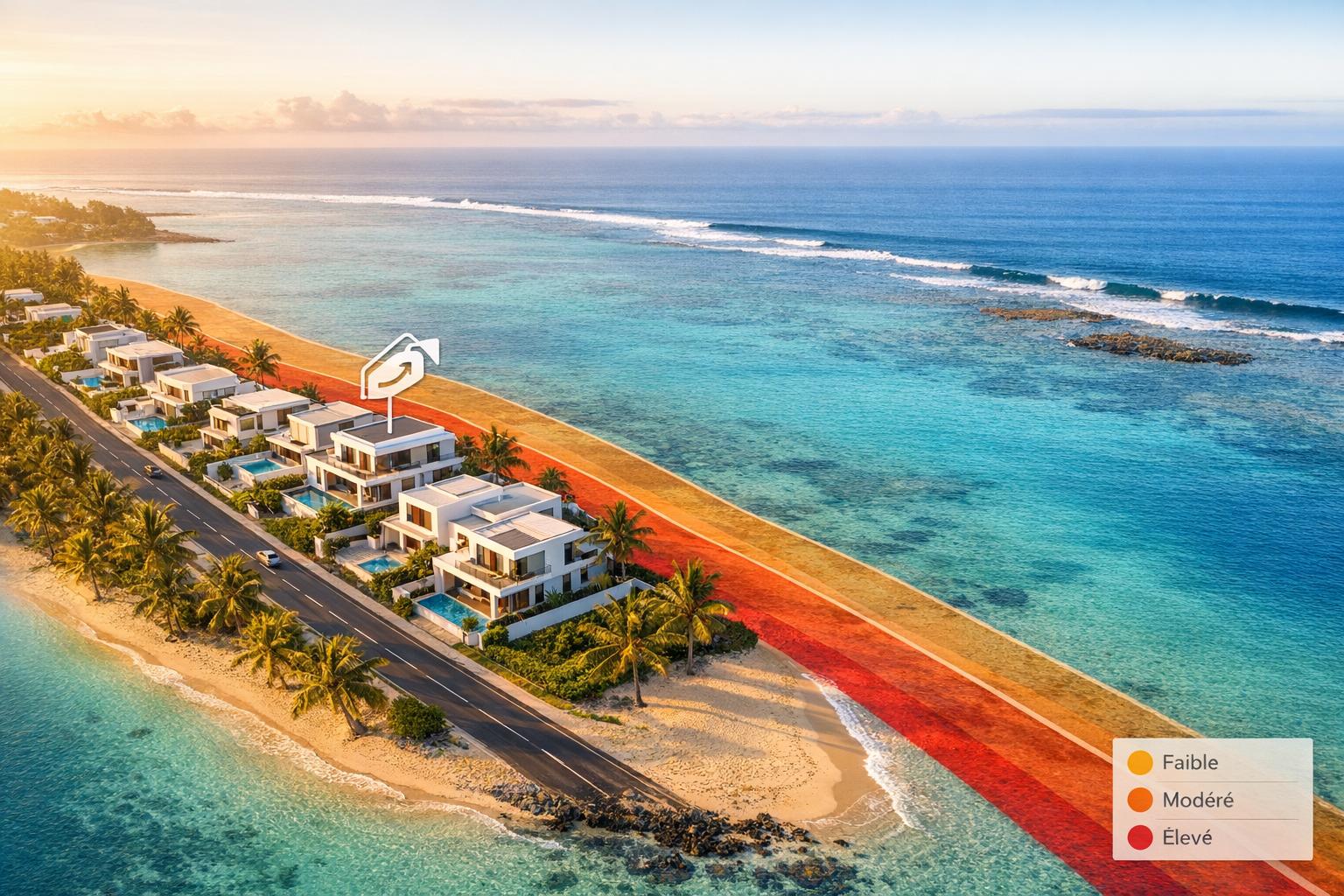
Mauritius in 2026 presents a changing real estate market, marked by economic, environmental and regulatory challenges. Here are the key takeaways:
- Prices: Stabilisation since 2024 with limited increases of 5-7% in coastal areas like Grand Baie and Tamarin. Stagnation in inland regions like Moka.
- Regulations: End of tax incentives for Smart Cities projects in 2025 and an increase in registration duties to 10% for non-citizens.
- Yields: High-end areas remain attractive, offering net yields of 3-5%, despite a decrease in rental demand linked to tourism.
- Environmental risks: Coastal erosion and rising sea levels threaten coastal areas. 15.5% of the territory is classified as flood-prone.
- Taxation: Progressive scale since 2024, but still no capital gains tax on real estate or inheritance tax for direct descendants.
To succeed in an investment, it is crucial to prioritise local advice, choose areas less exposed to risks and focus on approved projects offering tax advantages before mid-2026.
Economic and Market Volatility in 2026
Global Economic Influences
Since 2022, regulatory challenges and market fluctuations have characterised the global economy. In 2026, it shows moderate growth of around 3%. This progression is based on eased monetary policies and more flexible budgetary measures, although geopolitical uncertainty remains a significant factor.
Jonathan Ashworth, Chief Economist at ACCA, describes this situation as follows:
“In a central scenario, the global economy is expected to continue its sustained growth in 2026, driven by looser monetary policy, fiscal easing and the continued rise of AI.”
Mauritius, meanwhile, continues to manage the challenges of post-COVID recovery. In 2025, the Mauritius Investment Corporation (MIC) recorded a decrease in its net worth of Rs 5.4 billion, from Rs 81 billion to Rs 75.6 billion. Ken Rogoff, former Chief Economist at the IMF, summarises this global dynamic:
“The global economy is robust but not very dynamic.”
Local Market Issues
In Mauritius, specific obstacles exacerbate economic volatility. The tourism sector, essential for the economy, experienced a 5.8% decrease in European arrivals in 2025. This directly affected rental demand in popular areas for visitors. At the same time, the emigration of young graduates has led to a shortage of skilled labour, impacting key sectors such as luxury and hospitality.
Real estate valuations now adopt an approach focused on future potential, rather than historical comparisons. Villen Anganan, a journalist, explains:
“In times of rising construction costs or uncertainty about demand, land values can change rapidly.”
In response to these challenges, the MIC reclassified Rs 1.18 billion of land, moving it from fixed assets to stock for development and sale. The total value of its real estate investments thus decreased, from Rs 11.9 billion to Rs 9.2 billion in June 2025. While these adjustments reflect some instability, they also show an adaptation to market needs.
Stable Yields in High-End Locations
Despite these turbulences, certain segments of the Mauritian real estate market continue to perform. Premium locations remain highly sought after, particularly for private villas with swimming pools, attracting an international clientele. In 2025, some lands were revalued upwards, with a cumulative increase of Rs 301 million, thanks to valuation methods based on development potential. Areas like Grand-Baie and Flic en Flac remain privileged investment destinations, even if minor security issues persist. Improved infrastructure, such as the Metro Express connecting Port-Louis to Curepipe, also enhances the attractiveness of certain urban areas.
sbb-itb-3115173
Legal, Administrative and Tax Risks
Limitations on Foreign Ownership
In addition to economic challenges, investors must also navigate a specific legal, administrative and tax framework. In Mauritius, foreigners can only acquire real estate through programmes approved by the Economic Development Board (EDB). These programmes include the Property Development Scheme (PDS), the Integrated Resort Scheme (IRS), the Smart City Scheme and R+2 buildings. However, freehold land and houses remain exclusively reserved for Mauritian citizens.
Any acquisition requires official approval and justification of the source of funds. To obtain a permanent residence permit (valid for spouse and children under 24), a minimum investment of 375,000 USD is required. Processing the application generally takes between 3 and 6 months.
These restrictions also imply additional costs and a specific tax framework, discussed below.
Additional Costs and Tax Structure
When a foreigner buys real estate in Mauritius, they must pay registration duties equivalent to 10% of the purchase price. In addition, there are various other costs, including notary fees, taxes and VAT, representing between 5% and 7% of the total transaction cost.
Since 2024, the Mauritian tax system has evolved, changing from a flat rate of 15% to a progressive scale. Incomes up to Rs 500,000 (approximately €10,500) are now exempt from tax, while higher brackets are taxed between 10% and 20%. This scale applies to tax residents, defined as people living in Mauritius for at least 183 days a year.
Despite these changes, Mauritian real estate still offers notable tax advantages: 0% tax on real estate capital gains, 0% inheritance tax for direct descendants, and no annual property tax. Furthermore, the Franco-Mauritian tax treaty of 1980 remains applicable in 2026, ensuring that rental income is taxed in Mauritius. A tax credit in France helps avoid double taxation for French investors.
Environmental and Climatic Risks
Coastal Erosion and Cyclone Threats
Mauritius is facing an accelerated rise in sea level, now reaching 4.5 mm/year in 2025, compared to 3.3 mm/year previously. This progression represents a direct threat to coastal infrastructure and tourist areas, which are key locations for high-end real estate. These environmental challenges are part of the broader risks associated with the real estate sector.
Coastal erosion, in particular, directly affects investments in the most sought-after areas. Places like Grand Baie and Flic-en-Flac are identified as particularly vulnerable to future submergence. Even areas protected by coral reefs are not spared, with significant submergence observed. During extreme events, waves reaching up to 16 meters endanger exposed coastal areas.
In November 2025, the Bureau de Recherches Géologiques et Minières (BRGM), thanks to a €1 million funding from the Agence Française de Développement (AFD), published a study entitled “Coastal Risks in Mauritius and Rodrigues”. This report enabled the production of high-resolution vulnerability maps, designed to guide territorial planning decisions.
Flood Zones and Rising Sea Levels
In addition to coastal erosion, flood zones also pose a major risk to real estate investments. The Land Drainage Master Plan (LDMP), finalised in May 2022 and made public in 2025, indicates that 15.5% of Mauritian territory is classified as a flood zone. Two categories of zones have been defined by the authorities: “No-Go Zones” (11% of the territory, or 218.33 km²), where all construction is prohibited, and “No-Expansion Zones” (4.5% of the territory, or 94.01 km²), where only vertical constructions are allowed.
Projections indicate that water levels, already measured at 2.5 meters above normal, could reach 3.5 meters by 2100. Risk maps available on the website of the Land Drainage Authority (www.lda.gov.mu.org) allow potential buyers to assess these dangers before any acquisition. Since October 2025, fines between Rs 2,000 and Rs 10,000 are applied in case of rainwater discharge onto public roads.
“Rising sea levels stand out as the main factor in the increase of coastal submergence, particularly in the long term.” - Agence Française de Développement (AFD)
Mauritius tightens the screws: end of tax advantages? Budget 2025-2026
Risk Comparison: 2022-2026
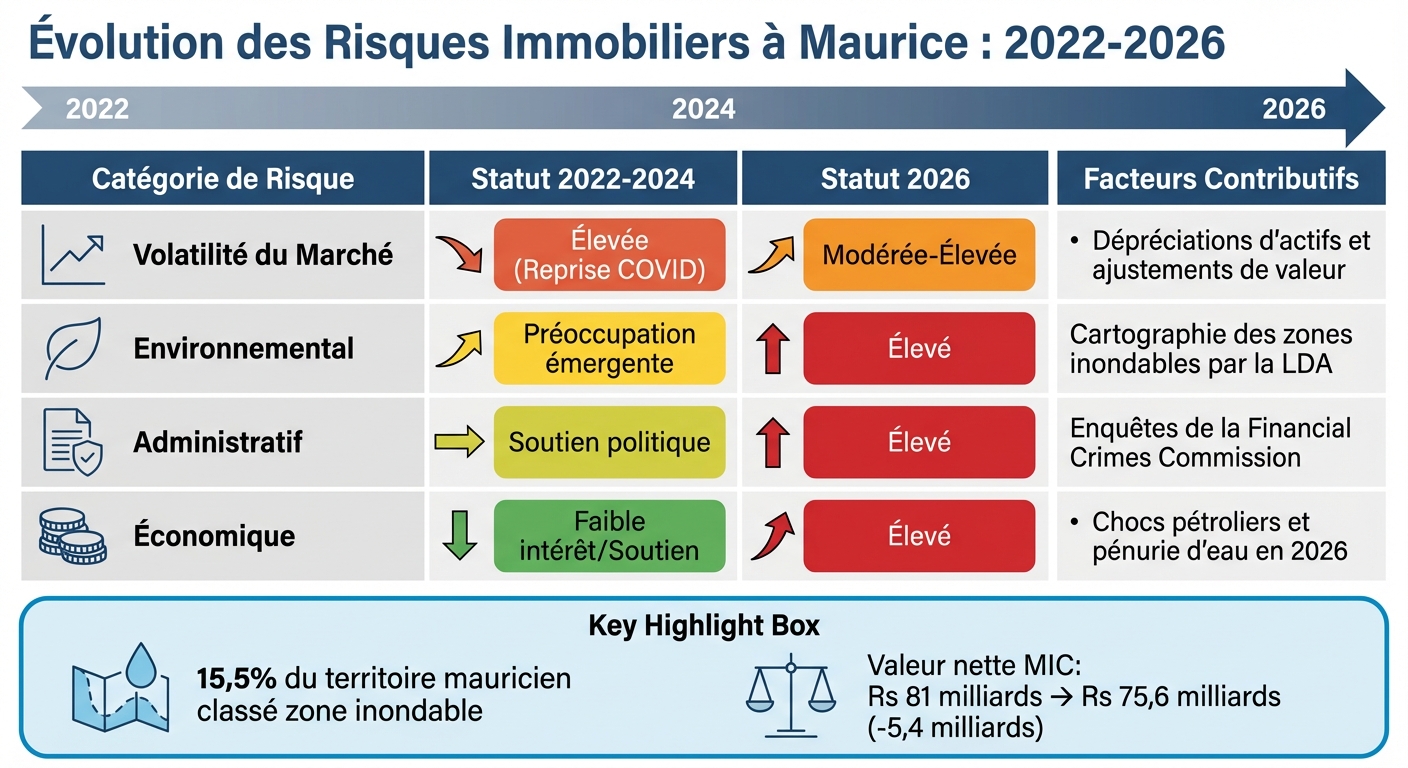
Evolution of real estate risks in Mauritius 2022-2026
Evolution of Risk Levels Over Time
Since 2022, the Mauritian real estate market has undergone significant transformations, influencing investment risks. The crisis period caused by COVID-19 (2020-2022) has given way to a normalised context by 2025-2026. This transition has led to the first notable depreciations of major assets.
The Mauritius Investment Corporation (MIC) saw its net worth fall significantly in 2025, a clear sign of this normalisation. Asset valuation now relies on “future development potential”, minus construction costs, which further exposes it to material price fluctuations. Furthermore, administrative risks have intensified, particularly with the intervention of the Financial Crimes Commission in investigations into large-scale real estate transactions.
“The year 2025 marks a turning point: when the BoM begins to adjust, more openly, the real value of this strategic subsidiary.” - Villen Anganan, L'Express (Port Louis)
In 2026, new macroeconomic risks emerged, such as energy vulnerability due to oil shocks and water supply issues, threatening the viability of real estate projects.
Comparative Risk Table
The analysis highlights an intensification of risks between 2022 and 2026, marked by the transition from an artificially supported market to a more regulated and monitored environment.
| Risk Category | Status 2022-2024 | Status 2026 | Contributing Factors |
|---|---|---|---|
| Market Volatility | High (COVID Recovery) | Moderate-High | Asset depreciations and value adjustments |
| Environmental | Emerging concern | High | Mapping of flood-prone areas by the LDA |
| Administrative | Political support | High | Financial Crimes Commission investigations |
| Economic | Low interest/Support | High | Oil shocks and water shortage in 2026 |
Environmental risk is now better quantified thanks to maps published by the Land Drainage Authority, identifying flood-prone areas. However, by the end of 2025, these restrictions were not yet fully integrated into market prices. Despite a general portfolio contraction, some lands saw their value increase by Rs 301 million in 2025, thanks to new valuation methods.
How to Reduce Investment Risks
Expert Support by Soléa Realty

In the complex context of 2026, local support becomes essential. Soléa Realty offers personalised assistance to secure every step of the acquisition. The agency helps navigate the requirements of bodies such as the Economic Development Board (EDB) and the Board of Investment (BOI). It also ensures the reliability of developers and the compliance of projects with PDS and VEFA programmes, thus avoiding costly legal errors already observed.
Another key advantage is access to exclusive off-market properties, a valuable strategy given current volatility. For example, the decrease in building permits – from 7,971 in 2022 to 6,657 in 2023 – highlights the growing scarcity of land. To address this situation, Soléa Realty works with reliable architects and builders to offer tailor-made solutions. It also verifies the Financial Completion Guarantee (GFA) with major local institutions and helps reduce ancillary costs, such as co-ownership fees, anti-cyclone insurance and agency commissions. In addition, identifying low-risk areas is an integral part of this preventive approach.
Investing in Reduced Risk Areas
Some regions, such as the west coast around Tamarin and Flic en Flac, present lower environmental risks compared to the north or east. These areas are less exposed to coastal erosion and cyclones, while offering attractive net rental yields, between 3% and 5%. Thanks to its local expertise, Soléa Realty identifies properties that comply with earthquake and cyclone standards, with maintenance funds of around €10,000 per lot and effective multi-risk insurance.
In 2026, these regions benefit from strong foreign demand, marked by a 9% increase in transactions between 2023 and 2024, as well as significant investments in infrastructure. Investing in approved programmes such as PDS, IRS or RES, with a minimum of 375,000 USD, offers not only a permanent residence permit but also attractive tax advantages: 0% on real estate capital gains and no inheritance tax in direct line. These conditions are particularly interesting before the expiration of the 5% rate scheduled for mid-2026.
Conclusion
Summary of Main Points
In 2026, although the Mauritian real estate market faces challenges such as programme saturation and the end of the 5% tax regime scheduled for mid-2026, it remains strong. Sustained international demand continues to ensure stable net yields, between 3% and 5% in high-end areas.
However, obstacles remain. Restrictions imposed on foreign investors via the BOI/EDB, prolonged delays for property transfers, as well as risks linked to unreliable developers in certain VEFA projects, constitute major concerns. Environmentally, coastal erosion, cyclones, rising sea levels and ageing properties require specific measures, such as compliance with earthquake standards, obtaining suitable insurance and creating a maintenance fund estimated at approximately €10,000 per lot.
To counter these challenges, a mitigation strategy is essential: it relies on a precise analysis of trends, rigorous selection of developers, verification of compliance in VEFA projects, and the choice of tourist areas less exposed to risks, particularly on the west and north coasts.
These elements highlight the importance of a thoughtful approach, which will be further developed in the following recommendations.
Recommendations for Investors
Engaging local experts is a key step. Soléa Realty, a specialist in luxury real estate in Mauritius, offers tailor-made support to secure each acquisition. This includes verifying the reliability of developers, compliance with current standards, and assistance within the BOI/EDB regulatory framework. The agency also identifies exclusive properties in low-risk areas and works with partners to develop suitable solutions.
Acting quickly allows you to take advantage of the latest tax benefits while ensuring interesting returns. An informed and well-prepared approach can transform these challenges into long-term opportunities.
FAQs
Which areas in Mauritius are least exposed to climate risks in 2026?
The island's interior regions and higher altitude areas appear to be the most protected from climatic hazards. These areas are generally less vulnerable to floods and cyclones, thanks to their geographical position. However, the article does not provide precise details on the specific localities that benefit from these advantages.
What documents should be checked before buying a PDS/VEFA property as a non-citizen?
Before purchasing a PDS or VEFA property as a non-citizen in Mauritius, it is crucial to check the title deed. This ensures that there are no mortgages or charges attached to the property. It is also important to comply with specific regulations for foreigners, particularly regarding investment thresholds and approved schemes, such as PDS or Ground+2 properties. These precautions are essential to ensure that your purchase complies with local laws and is secure.
How do new taxes and the end of Smart Cities change profitability in 2026?
From 2026, real estate in Mauritius could face significant challenges. Why? The end of tax incentives for Smart Cities and the introduction of new property taxes. These changes risk reducing the profitability of real estate projects.
Investors, who previously benefited from attractive tax advantages, will now have to contend with additional constraints. This could slow down the momentum of the real estate market, making investment opportunities less attractive. Consequently, the prospect of high gains could diminish for many players in the sector.