April 2, 2026
Citizenship by Investment in Mauritius: 2026 Guide
Mauritius offers a fast track to naturalisation for investors through a minimum investment of USD 500,000. Here are the key takeaways:
- Accelerated Citizenship: Investment of USD 500,000 in real estate or a local business, with 2 years of continuous residency.
- Permanent Residency: Investment of USD 375,000 in eligible real estate, offering a 20-year permit.
- Tax Advantages: Flat tax rate of 15%, no capital gains tax, and no inheritance tax.
- International Mobility: Mauritian passport allowing visa-free or visa-on-arrival access to 145 to 160 countries.
- Requirements: Mandatory physical residency, legitimate source of funds, clear police certificate, and strict due diligence.
Mauritius attracts with its stability, tax framework, and quality of life. For families, specific options allow for the inclusion of spouses and children in the process. The real estate sector, through programmes like the Property Development Scheme (PDS), remains a key option for accessing these benefits. In 2026, investors benefit from stable regulations and promising real estate growth.
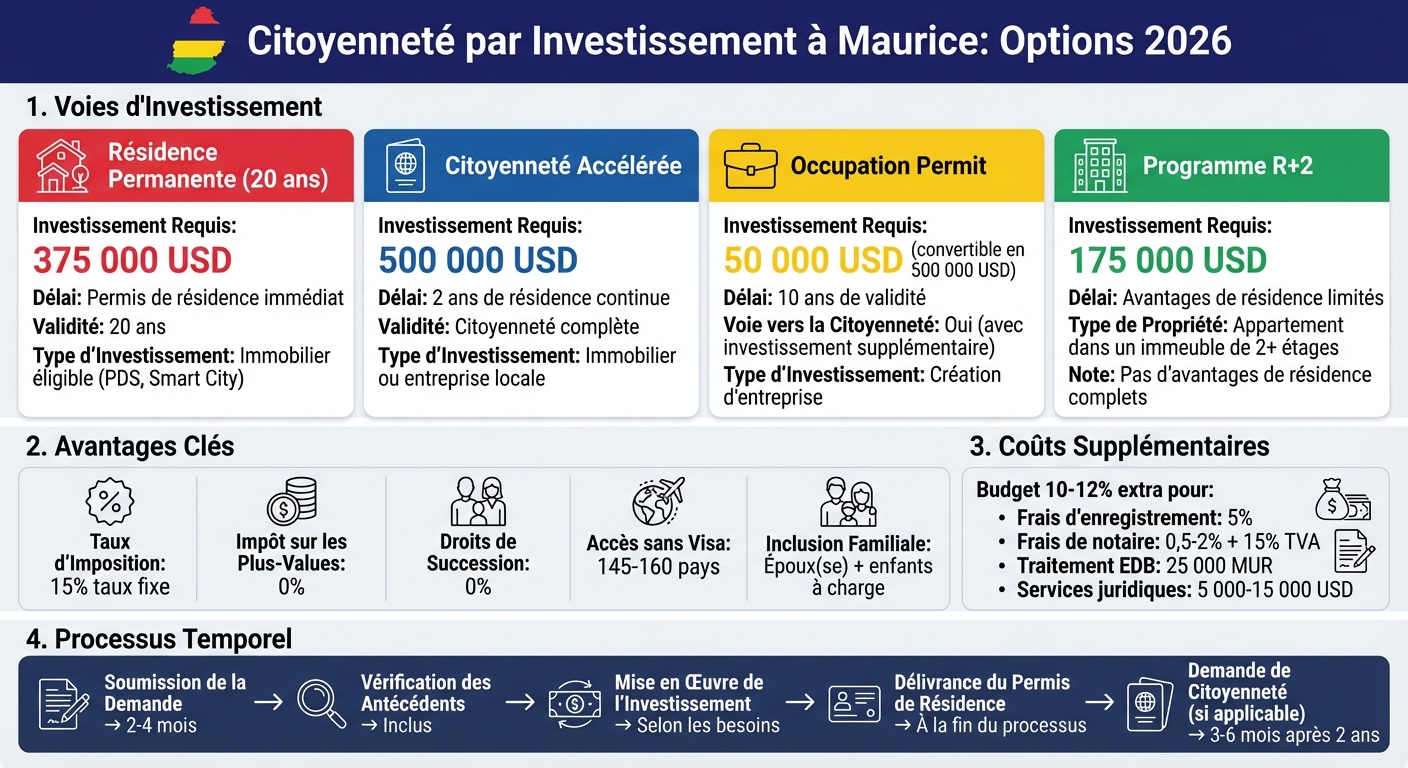
Mauritius Citizenship by Investment: Investment Options and Requirements 2026
Eligibility Criteria
Basic Qualifications
To begin, you will need to provide a clear police certificate, issued by your country of origin as well as by Mauritius, attesting to the absence of convictions. A thorough background check will also be carried out by the local police.
On the medical front, it is necessary to submit valid medical certificates when submitting your application. You must also include references attesting to your good character. If you plan to apply for citizenship, you will need to publish a notice of intent in two Mauritian newspapers.
Regarding financial requirements, two options are available to you: invest USD 375,000 to obtain a 20-year permit or invest USD 500,000 to benefit from accelerated naturalisation in just 2 years. These amounts must be paid in convertible currency, and their legitimate origin must be proven. Also, budget an additional 10 to 12% to cover legal, administrative, and registration fees.
Let's now see how to include your family members in this process.
Including Family Members
Unlike some regional programmes that offer family packages, applications are processed individually. This means that each member must meet their own criteria. However, your spouse can immediately reside in Mauritius as a dependent. To apply for citizenship, they will have to wait 4 years of continuous marriage and cohabitation.
Children under 18 benefit from a simplified process: they can be registered as citizens as soon as the main parent obtains naturalisation, without any additional residency requirements. On the other hand, for adult dependents, such as parents or adult children, a residence permit can be granted as a dependent. However, they will have to follow the standard naturalisation process, which takes between 5 and 7 years.
Remember to gather all necessary documents for your family in advance, such as birth certificates, marriage certificates, and police certificates. These documents must be up-to-date and, in some cases, require an apostille to be valid.
sbb-itb-3115173
Real Estate Investment Programmes
Property Development Scheme (PDS)
Since 2015, the Property Development Scheme (PDS) has become the main framework for foreign real estate investment in Mauritius. This programme replaces the former IRS and RES schemes, offering a simplified approach and a broader vision. Unlike previous restrictions to coastal areas, PDS allows projects anywhere on the island, including in inland regions.
With a minimum investment of USD 375,000, investors obtain a residence permit valid for themselves, their spouse, and their dependent children. This permit remains valid as long as the property is retained and also allows for commercial activities in Mauritius. Approved projects under the PDS represent a total value exceeding USD 2 billion. As of December 2024, a new rule requires 85% of the purchase amount to be converted into Mauritian rupees (MUR), thereby strengthening the country's foreign exchange reserves.
Ancillary costs include:
- 5% registration fees
- MUR 25,000 for processing fees with the EDB
- Notary fees ranging between 0.5% and 2%, plus 15% VAT.
Before any commitment, ensure that the project is certified by the EDB via the PAMS system. This programme is part of a global framework aimed at meeting the varied needs of real estate investors.
Integrated Resort Scheme (IRS)
The Integrated Resort Scheme (IRS) targets luxury properties located within high-end residential complexes. Although this scheme no longer accepts new applications since the introduction of the PDS, it remains relevant for investors already involved in these projects. The investment threshold is also set at USD 375,000, but a specific government tax of USD 70,000 applies.
Complementary Programmes (RES, Smart City, IHS)
Other investment options are available to meet various objectives:
- Real Estate Scheme (RES): This programme concerned smaller residential developments, on land ranging from 4,220 m² to 10 hectares.
- Smart City Scheme: These are integrated urban projects, combining residential, commercial, and professional spaces. An investment of USD 375,000 also allows for a residence permit.
- Integrated Hotel Scheme (IHS): This programme allows for the acquisition of units in hotels. However, no residency rights are granted with these properties.
Soléa Realty specialises in assisting investors, offering tailored advice to choose the programme that best suits their needs and objectives. With these varied options, every investor can find a suitable solution.
Application Process
Application Submission to the Economic Development Board (EDB)
Once you have chosen the investment programme that suits you, it's time to proceed with the application process. Each step must be followed carefully to avoid unnecessary delays or complications related to incorrect documents.
The Economic Development Board (EDB) is the central body responsible for processing all investment-based residence permit applications in Mauritius. Whether you opt for a real estate investment via PDS or for setting up a business, this institution will evaluate your application. Thanks to its online portal, you can submit your initial application and track its progress in real time.
The process comprises four main stages: pre-approval, background check, investment implementation, and finally issuance of the residence permit. It is imperative that the invested funds come from a legal source and are fully traceable, as strict compliance checks are carried out. In addition, valid health insurance is required for you and your relatives throughout your residency.
Expected Processing Time
Generally, processing a residency by investment application takes between 2 and 4 months. If you also plan to apply for citizenship, you will need to reside continuously in Mauritius for at least 2 years before initiating an additional procedure of 3 to 6 months. The longest stages often concern background checks and validation of the origin of funds. These deadlines are the same for individual applications or those including family members.
Adding Family Members
It is possible to include your spouse and dependent children in your residency application. However, the same background checks apply to each added member, and each must have valid health coverage.
Regarding citizenship, spouses can apply for naturalisation after 4 years of marriage and cohabitation in Mauritius. As for minor children, they can be registered immediately after the parent obtains citizenship.
Programme Costs and Fees
Minimum Investment Amounts
The programme offers different investment thresholds depending on your specific objectives:
- Permanent residency (20 years): USD 375,000 through the purchase of a designated property.
- Accelerated Citizenship: A minimum investment of USD 500,000.
- Business Investment: USD 50,000 to obtain an Occupation Permit, convertible to USD 500,000 to become eligible for citizenship.
- R+2 Programme: USD 175,000 for an apartment in a building of at least two storeys. This programme does not offer all the benefits of full residency.
These amounts come with additional fees that are important to consider.
Administrative and Legal Fees
In addition to the initial investment, expect a surcharge of 10 to 12% to cover ancillary costs:
- Notary and registration fees: Approximately 5% of the property value.
- Residence permit:
- Occupation Permit for investors: USD 3,750 (valid for 10 years).
- Permanent residence permit: USD 1,000.
- Legal and support services: Between USD 5,000 and USD 15,000, depending on the complexity of the case.
- Citizenship application: A few hundred dollars for the initial application, with additional fees of less than USD 500 for the certificate and oath-taking.
These fees must be considered to evaluate the total cost of your project.
Benefits of Residency and Path to Citizenship
Benefits of Residency
Living in Mauritius comes with numerous benefits, particularly in terms of taxation, international mobility, and access to modern services. The attractive tax regime allows investors to optimise their income while relying on reliable legal stability.
International mobility is another strong point, offering simplified access to major global markets. This facilitates both business and personal travel.
The residence permit automatically includes the spouse and dependent children, opening doors to international schools and modern healthcare services. Furthermore, Mauritius benefits from a stable democracy and a strategic position as a business hub, with privileged access to African and Asian markets.
These advantages also facilitate the transition to citizenship, accessible through two distinct options.
Becoming a Citizen
To obtain Mauritian citizenship, two paths are possible. The classic naturalisation route requires 5 years of residency for Commonwealth citizens and 7 years for other nationalities. A faster option, however, allows for naturalisation in just 2 years, provided an investment of at least USD 500,000 is made, according to established criteria.
The application process includes several mandatory steps. You must publish a notice of intent in two local newspapers, submit the application in person to the Home Affairs Secretariat, take an oath before a magistrate, and undergo a thorough police check. Once the residency period is fulfilled, the application processing generally takes between 3 and 6 months.
An important point to note: Mauritius does not allow dual nationality for naturalised citizens, which requires renouncing one's original nationality. Furthermore, spouses can apply for citizenship after 4 years of marriage and cohabitation, while minor children (under 18) can be registered as citizens as soon as a parent is naturalised.
Mauritius Citizenship by Investment [The $500k Property Route]
How Soléa Realty Supports Your Investment
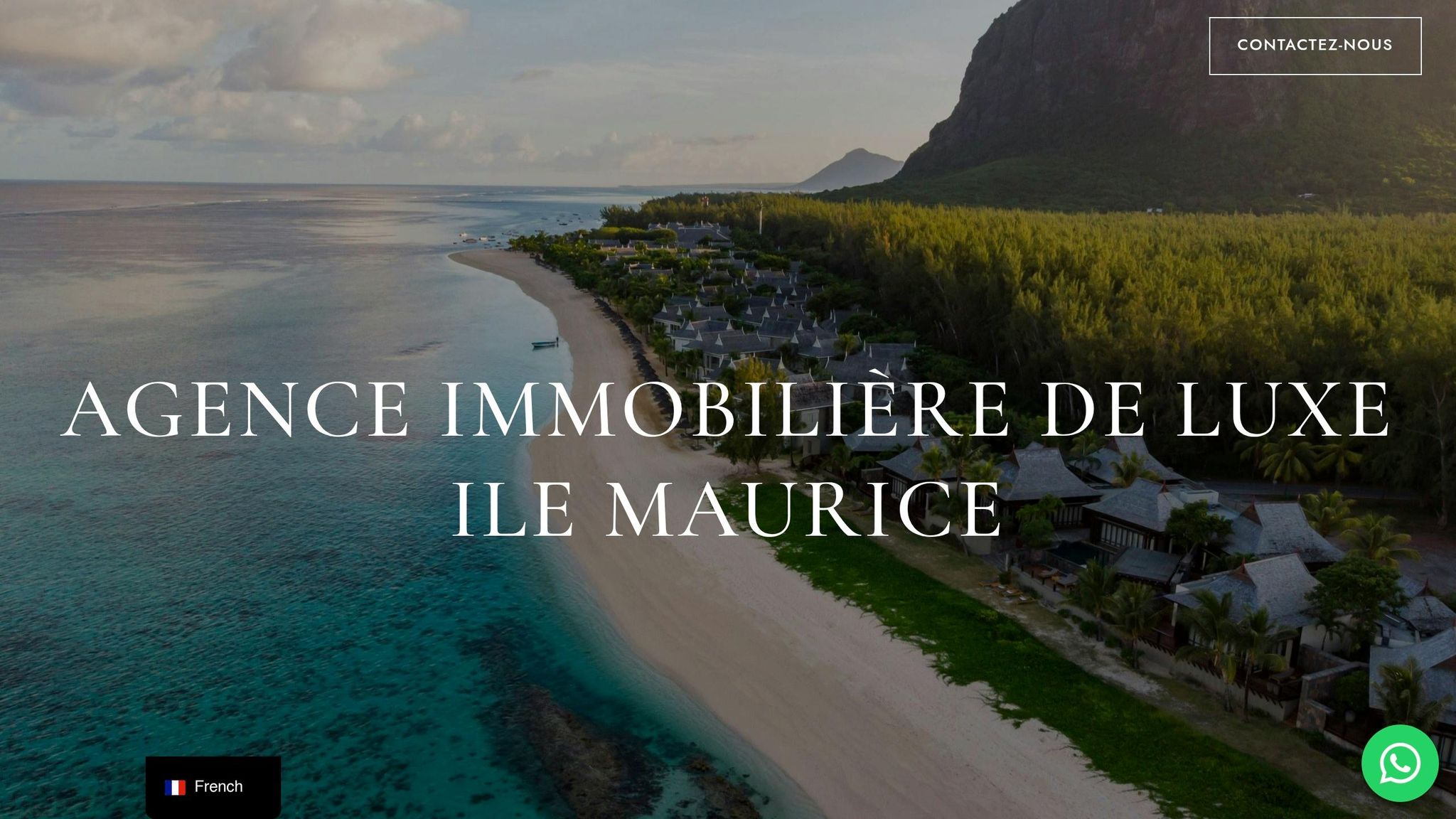
After understanding the requirements and costs associated with the investment, let's see how Soléa Realty makes your purchase and relocation journey smoother.
Professional Assistance
Navigating legal and administrative obligations can quickly become complex, but that's where Soléa Realty comes in. The agency supports you at every step: from selecting eligible properties to full support for your relocation.
The team ensures that each property belongs to a government-approved programme, such as the Property Development Scheme (PDS), the Integrated Resort Scheme (IRS), or the Smart City Scheme. These programmes are the only options allowing foreigners to acquire residential properties in Mauritius. For those seeking to obtain citizenship through accelerated investment, Soléa Realty ensures that the minimum required amount of USD 500,000 is met. This threshold is higher than the USD 375,000 needed for a standard permanent residency. The agency also handles the management of additional fees (estimated between 10% and 12% of the invested amount), covering registrations and legal fees.
Soléa Realty simplifies the process by directly managing interactions with the Economic Development Board (EDB) and the Home Affairs Division. It coordinates all administrative formalities, including police certificates, medical certificates, and the mandatory publication of notices of intent in two local newspapers.
Premium Property Portfolio
Soléa Realty's expertise is also reflected in its portfolio of high-end properties. The agency offers an exclusive selection of villas, penthouses, and other investment properties located within approved programmes. It also provides privileged access to off-market properties. Thanks to strong partnerships with architects, engineers, and builders, tailor-made solutions are available.
This personalised approach allows investors to find properties that not only meet the eligibility criteria for residency or citizenship but also align with their lifestyle and investment aspirations. Soléa Realty guarantees rigorous monitoring throughout the acquisition process, thus facilitating settlement and integration into Mauritian life.
2026 Programme Updates
Recent Programme Changes
In 2026, Mauritius continues to stand out with its unique accelerated naturalisation programme, which requires a physical presence of only two years. Unlike some Caribbean programmes, this method strengthens international confidence in the process. Investment thresholds remain stable: USD 375,000 to obtain permanent residency and USD 500,000 for citizenship. Furthermore, registration fees for foreign buyers remain fixed at 10%. These stable parameters are part of a context where the local real estate market shows promising prospects for the coming year.
Investment Returns and Lifestyle Benefits
Mauritius' real estate sector anticipates a price increase of between 5% and 10% in 2026, while rental yields in premium areas are expected to be between 6% and 10%. This positive trend is supported by the rebound in tourism and infrastructure projects that reinforce the island's economic appeal.
Beyond the figures, Mauritius offers an attractive combination of tax advantages and quality of life. With a flat tax rate of 15%, no capital gains tax for sales in approved projects, and visa-free access to approximately 145 to 160 countries, the island is attracting more and more international investors. The bilingual English-French framework, security, and sunny climate complete this offer, making Mauritius a choice destination in 2026 for combining profitable investments and an enviable lifestyle.
FAQs
What is the difference between permanent residency and accelerated citizenship in Mauritius?
Permanent residency in Mauritius offers the possibility of long-term living on the island. This status is generally accessible through an investment in the local economy, such as purchasing property or contributing to economic projects. While it provides stability for residing in Mauritius, it does not directly lead to citizenship. In other words, you can live and work on the island, but you will not benefit from the full rights of a Mauritian citizen.
Accelerated citizenship, on the other hand, is a rare but valuable option. It allows for obtaining Mauritian nationality in a shorter timeframe than traditional routes. This specific process grants access to a Mauritian passport and its accompanying benefits, such as the right to vote or greater freedom of travel. However, the criteria for this path are strict and reserved for specific cases.
How long do I have to reside in Mauritius to be naturalised?
To obtain naturalisation in Mauritius, it is necessary to reside physically on the island for a specific period, generally between 6 and 12 months. This period may vary depending on the chosen programme and the prevailing criteria. It is important to consult the specific conditions that apply to your situation before starting the process.
What documents are required to prove the legitimate origin of funds?
To demonstrate that your funds come from a legal source, you will need to present documents that clearly attest to this. Here are some examples:
- Bank statements showing transaction history.
- Tax attestations confirming your income declarations.
- Documents related to an inheritance or asset sale, such as notarised deeds or sales contracts.
These supporting documents must comply with the specific criteria of the accelerated naturalisation process in Mauritius. Ensure they are complete and up-to-date.
Related blog posts
Frequently asked questions
- How much do you need to invest for Mauritian citizenship in 2026?
- The investment route is based on a USD 500,000 contribution to the Mauritius Sovereign Fund for the main applicant, plus USD 50,000 for each additional dependant. An eligible property purchase (PDS, IRS, Smart City) from USD 375,000 first secures the residence permit, which is the step before naturalisation.
- How long does it take to get a Mauritian passport?
- Expect roughly 3 to 6 months for the residence permit after purchase, then a qualifying period of legal residence before a naturalisation application can be filed. The citizenship file itself is usually processed within 6 to 12 months.
- Do you have to physically live in Mauritius?
- Yes for naturalisation: Mauritian law requires genuine physical presence during the qualifying period. The investment residence permit itself carries no minimum annual stay.
- Can family members be included?
- Spouse, dependent children and, under conditions, parents can be added to the main application with an additional contribution per person.
- Does Mauritius allow dual nationality?
- Yes. Mauritius recognises dual nationality, so you keep your original citizenship provided your home country allows it too.