April 6, 2026
Non-Citizens Property Restriction Act: summary
Since 1975, the Non-Citizens Property Restriction Act has closely controlled the purchase, ownership, and sale of real estate by foreigners in Mauritius. Any real estate transaction involving a non-citizen requires prior authorisation from the Prime Minister's Office (PMO). A key amendment on 29 April 2021 strengthened these rules by also requiring this authorisation to sell, mortgage, or encumber a property.
Key takeaways:
- Mandatory authorisation: Purchase, sale, or mortgage by a foreigner requires PMO approval.
- Extended restrictions: The Act also applies to companies, partnerships, and trusts controlled by non-citizens.
- Exemptions: Inheritance, marriage to a Mauritian citizen (community of property) and purchase of apartments in G+2 buildings (min. Rs 6 M).
- Penalties: Fines up to Rs 50,000 and imprisonment up to 2 years for non-compliance.
- Financial impact: Rs 6.64 billion collected in 2021-2022, including Rs 3.21 billion from acquisitions by foreigners.
The changes aim to protect strategic land and prevent circumvention via foundations. For foreign investors, it is essential to understand these complex rules and to be accompanied by experts to ensure compliant and secure transactions.
How to buy property in Mauritius – Park Lane Properties
sbb-itb-3115173
Main Regulations under the Act
The Non-Citizens Property Restriction Act sets strict rules that any foreign investor must comply with. Under this Act, no non-citizen may purchase, acquire, or hold real estate in Mauritius without first obtaining a certificate issued by the Prime Minister's Office (PMO). These restrictions apply to all forms of property, whether freehold land, leasehold, or even the acquisition of shares in companies holding real estate. The following sections explain the key legal terms, the approval process, and the provided exemptions.
Important Legal Terms
The Act clarifies several essential terms for its application.
- A “non-citizen” refers to any person who is not a Mauritian citizen, as well as any company, partnership, or trust controlled or held by non-citizens.
- The term “property” includes freehold land, leases, as well as shares or interests in companies or partnerships that own real estate in Mauritius.
- “To dispose of” covers actions such as selling, exchanging, donating, or even placing a mortgage or charge.
- A “qualified corporation” refers to a company registered in Mauritius that can benefit from specific rights to hold real estate under investment certificates.
Application Process for Approval
Requests for authorisation must be submitted to the PMO, often in coordination with the EDB for certain programmes. Investors must provide a complete file including:
- A site plan of the land;
- An valuation report prepared by a sworn expert;
- A letter of intent from the seller;
- KYC documents, such as a valid passport and proof of funds.
It is also crucial to check whether the envisaged acquisition structure (company or partnership) is classified as a “non-citizen” entity according to the control criteria defined by the Act.
Exemptions to the Act
Certain situations allow circumventing the PMO's authorisation requirements:
- Property acquired through succession does not require a certificate if the heir is a non-citizen.
- A non-citizen married to a Mauritian citizen under the legal regime of community of property may purchase property without a certificate.
- Since an amendment in 2016, the purchase of an apartment in a building of at least two storeys above ground floor (G+2) is exempt, provided the purchase price is at least Rs 6,000,000 and the acquisition is registered with the EDB.
Evolution of the Act Over Time
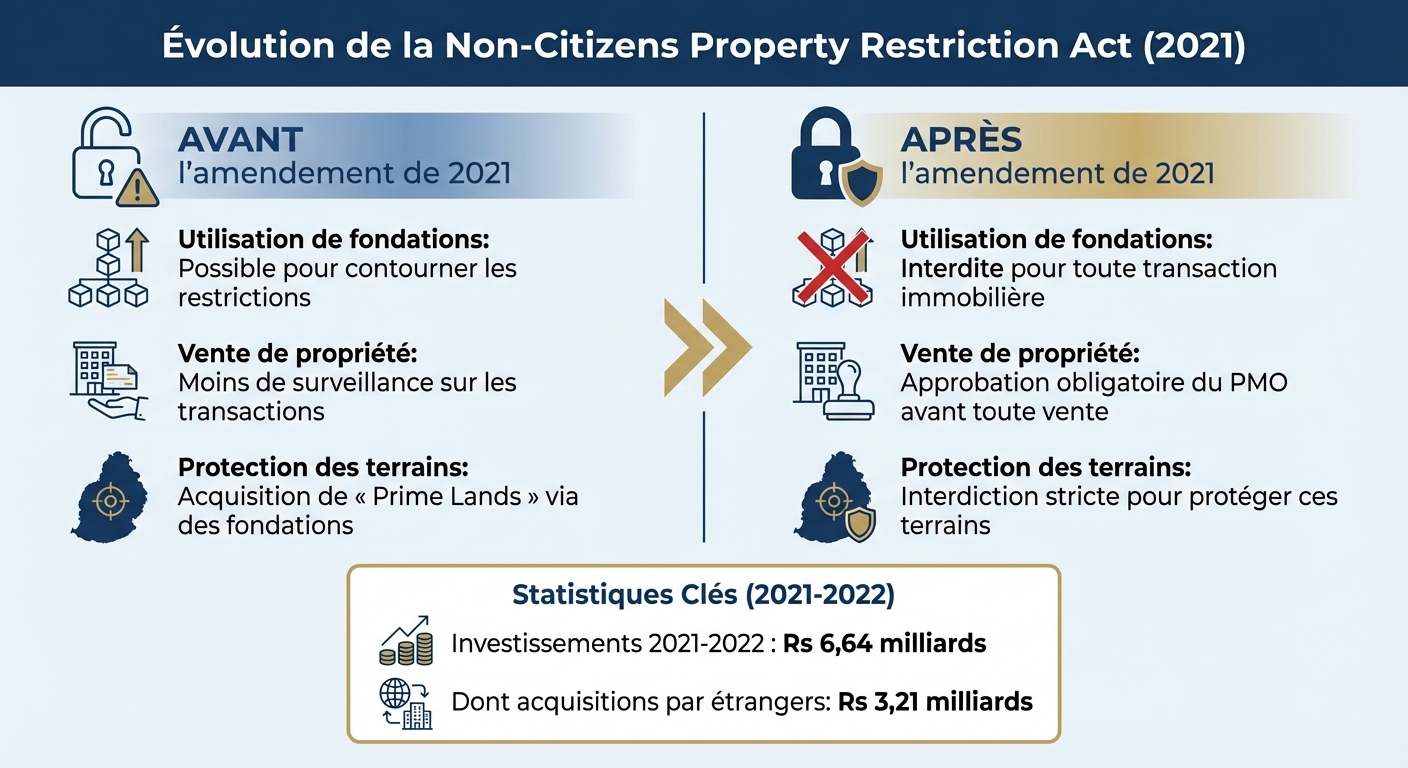
Non-Citizens Property Restriction Act: Before and After the 2021 Amendment
Mauritian property legislation has evolved over the years, incorporating significant amendments to regulate acquisition and sale by foreigners. These changes reflect a clear desire by the authorities to further regulate the real estate market, while protecting the country's land resources. Let's take a closer look at the key amendments that have marked this evolution.
2016 Amendment: Apartment Purchase
The year 2016 marked a turning point with the introduction of a new provision allowing non-citizens to acquire apartments located in G+2 type buildings. This measure aimed to encourage foreign investment in the residential sector while maintaining control over the market. It represents an important step in adapting legislation to economic realities and investment needs.
2021 Amendment: Property Sales
On 29 April 2021, another crucial amendment was adopted, aiming to close a legal loophole. This change now prohibits the use of foundations in real estate transactions, a practice that previously allowed some non-citizens to circumvent legal restrictions to acquire high-value land.
As Prime Minister Pravind Jugnauth explained:
[I have] information to the effect that certain people, notably individuals not holding Mauritian citizenship, would use foundations to bypass the law and acquire property, especially Prime Lands. Hence the urgent need to fill the legal vacuum.
The primary objective of this amendment was to protect “Prime Lands” and tighten controls on transactions involving foreigners. For the financial year 2021-2022, investments generated by this law reached approximately Rs 6,640,888,101.57, of which Rs 3,216,064,154.89 came directly from the acquisition of shares by non-citizens.
Comparison Before and After
Here is a summary of the changes introduced by the 2021 amendment:
| Aspect | Before the 2021 amendment | After the 2021 amendment |
|---|---|---|
| Use of foundations | Possible to circumvent restrictions | Prohibited for any real estate transaction |
| Property sale | Less oversight on transactions | Mandatory PMO approval before any sale |
| Land protection | Acquisition of “Prime Lands” via foundations | Strict prohibition to protect these lands |
These legislative adjustments enhance transparency and control over real estate transactions, while clarifying the rules for foreign investors. These developments pave the way for a more in-depth discussion on the penalties and challenges faced by non-citizens within this legal framework.
Penalties for Non-Compliance with the Act
Breaching the Non-Citizens Property Restriction Act can lead to serious legal consequences. Mauritian authorities, especially since the 2021 amendments, are applying these measures with increased vigilance to regulate real estate transactions.
Any real estate transaction carried out without prior PMO authorisation is considered illegal and may be annulled. Attempts to circumvent the law, for example by using structures like foundations, expose non-citizens to criminal prosecution. Furthermore, the Financial Crimes Commission (FCC) plays an active role in examining suspicious transactions, particularly those that may be linked to money laundering activities.
A striking case illustrates this rigor: in April 2026, Chetan Purmanund, director of a real estate company, was arrested by the FCC as part of a money laundering investigation, also leading to investigations concerning his brother.
In addition, illegally acquired assets risk being confiscated by the State.
These measures aim to protect national land heritage and ensure transparency in the real estate sector. For foreign investors, it is crucial to fully understand these risks before any acquisition. This strict approach shapes investment strategies and highlights the specific challenges non-citizen buyers may face in the Mauritian market.
Impact of the Act on Foreign Buyers
Common Difficulties for Non-Citizens
Buying a luxury property in Mauritius as a non-citizen can be a real headache, with legal and administrative obstacles at every step. Every transaction now requires authorisation from the PMO (Prime Minister’s Office), whether for purchase, sale, or even using the property as mortgage collateral. The UNCTAD Investment Policy Hub explains:
The definition of the term 'dispose of' includes the burdening of a property with a mortgage or charge.
These requirements make financial procedures more complex for foreign investors.
In addition, often delayed approvals from the Secretary for Home Affairs postpone the finalisation of transactions, which can significantly slow down the acquisition process. Buyers also face a limited choice of eligible properties, which reduces their investment options.
Understanding the legal requirements is another major challenge. The Act concerns not only individuals but also companies, partnerships, and trusts where a non-citizen holds control or a beneficial interest. This legal complexity requires precise expertise to avoid costly errors. In this context, being accompanied by professionals becomes almost indispensable.
How Soléa Realty Supports Buyers
Soléa Realty positions itself as a key ally to help foreign investors navigate this regulatory labyrinth. The agency offers a tailor-made service that supports buyers at every step of the process.
The Soléa Realty team begins by quickly identifying eligible properties, whether villas in approved projects or penthouses meeting the imposed price thresholds. Then, it handles the preparation and submission of authorisation applications to the PMO, ensuring that all required documents are complete and compliant from the outset. This helps limit delays and avoid rejections.
In parallel, Soléa Realty works with a reliable network of professionals – lawyers, notaries, architects – to ensure that every step of the transaction complies with the Non-Citizens Property Restriction Act. This comprehensive approach reduces risks and simplifies a process that could otherwise be daunting.
With in-depth knowledge of the Mauritian real estate market and current regulations, Soléa Realty transforms a complex journey into a smooth and secure experience, allowing foreign buyers to realise their projects with complete peace of mind.
Summary
The Non-Citizens Property Restriction Act governs real estate acquisitions by foreigners in Mauritius. Any transaction – whether purchase, ownership, or sale – requires prior authorisation from the Prime Minister's Office. This rule applies to individuals, as well as entities such as companies, partnerships, and trusts.
In 2021, amendments strengthened this Act to close legal loopholes. According to Prime Minister Pravind Jugnauth, some individuals were using structures like foundations to circumvent restrictions and acquire properties, notably Prime Lands. These changes aim to ensure rigorous control over land ownership and prevent any attempt to circumvent the rules. Furthermore, these adjustments introduce strict penalties for infringements.
The consequences of non-compliance are severe: a fine of up to Rs 50,000 and imprisonment for up to two years. In addition, properties acquired in violation of the Act may be subject to a court-ordered sale. The proceeds of this sale are then transferred to the Curator of Vacant Estates, after deducting associated costs.
In this complex legal framework, professional assistance is crucial. Soléa Realty offers comprehensive support by identifying compliant properties, preparing authorisation applications, and collaborating with a reliable network of lawyers and notaries. Their expertise ensures secure and regulation-compliant real estate transactions.
FAQs
How long does PMO authorisation take?
Obtaining PMO authorisation for a non-citizen to buy or sell property in Mauritius can take several weeks. However, the exact duration is not clearly defined in the available information.
What documents are required for a PMO application?
To submit an application to the PMO (Property Management Office), you will need to provide certain essential documents. These typically include:
- Identity documents: A copy of your national identity card or passport.
- Proof of residence: A recent utility bill (electricity, water, etc.) or an official certificate indicating your current address.
- Specific documents: Depending on the nature of your application, additional documents may be required.
It is important to note that the exact list of documents may vary depending on the specific requirements of each procedure. Remember to check directly with the PMO for detailed and up-to-date information.
What are the risks of buying or selling without authorisation?
Buying or selling without authorisation constitutes an infringement of the Non-Citizens (Property Restriction) Act. This can lead to legal penalties such as fines or even legal proceedings.